Saturday, October 30, 2010

2010 Fall Scramble

It is a beautiful day for the Fall Scramble at Sugar Creek!

These golfers try their luck on the third hole's risk vs. reward bonus. They may gain a 1/2 stroke advantage over the competition for shooting at the difficult far pin placement (Blue Flag).  Which one will it be, guys?

If you look close, there are 2 flags on the 3rd green! (Just for today).

It may be October 30th, but Mr. Hoffman is not ready to give up his shorts for winter gear:


Sunday, October 10, 2010

#1 Red Tee Germination

The red tee on #1 started germinating and filling in this week. 

Many people have asked about the brown spots on the front of this tee.  They look like little piles of dirt deposited on the tee, and that is pretty close to what they are.  The spots are actually earthworm castings, a.k.a. worm poop.  They will not adversely affect the establishment of the tee, although they may smother small quarter-sized areas. Once the grass gets taller and starts to spread, they should become mostly invisible.  Worm castings are actually in most turf, we just rarely notice them except on extremely short turf or newly seeded areas. 

Drainage Project on #1

Last week, we tackled a few drainage projects on the course and by the clubhouse. We ran some drain lines to the right of #1 fairway in an attempt to fix a persistent soggy spot. After ruling out the usual culprits, irrigation leak or broken drain line, we found that in this whole area water seeps up from the ground around the rocks and bricks that are buried here. Adding perforated drain lines should give the water a clear route to the creek instead of bubbling up to the surface. We will probably have to wait until next year to judge the success of this project, but these additional lines should improve the situation.

1st Step - Sod Removal

Trenching in progress

This trench started filling with water very soon after digging


Laying the lines and replacing sod

Tuesday, September 28, 2010

Recent Projects: September 2010

The past few weeks have been ideal for completing many of our planned renovations and improvements.  Rainfall and temperatures have been moderate except for a couple above average days.  The sun has been shining more often.  It's been a nice month!

The renovated 5 tee continues to grow in despite a brief setback due to seedling blight on a hot day.  In general, it is looking good:

5 tee - September 27, 2010


Small patches of "damping off" of seedlings
After 5 tee, the crew began work on the forward tee on the 1st hole.  Renovating this tee required the excavation of a small drainage swale to prevent water from flowing onto the tee from the hill and cartpath.  The soil was also modified and regraded.  With these modifications, this tee should not experience the same level of scald and water damage that it did this year.

Here is the tee a day before seeding:

1st tee renovation in progress
In addition to tee renovations, the crew has been busy slit-seeding fairway spots in an effort to replace our lost annual bluegrass with bentgrass.  We have already had some success with slit-seeding this year and are hoping for even better results this round due to lower soil temperatures and, hopefully, no flooding!

Walk behind slit seeder in action

Tuesday, September 21, 2010

5 Tee Renovation Progress

Last week, the maintenance crew finished moving soil and grading 5 tee.  We seeded the tee on Wednesday, September 15th, with 'Declaration' bentgrass.  The process involved moving and grading 80 tons of material. 


The grading process went smoothly.  We used a tractor, box blade, laser level, and sand trap rake to move and compact the material to the desired grade.  Here is how it looked after grading:


On Monday morning, we already noticed significant germination.  Germination in 5 days is faster than I expected, but ideal soil tempuratures and light rainfall sped up the process. 

This photo is from Tuesday morning:


So far, the new tee is progressing nicely, but it is very fragile.  Care must be taken to keep the seedlings moist and keep traffic off the tee.  While the tee still needs a lot of time and attention, this one-week-old tee is looking good considering its age!

Friday, September 10, 2010

5 Tee Renovation

Today we started work on the 5th tee.  This tee was hard hit by our wet, hot summer due to poor surface drainage and poor soil structure.  This tee has always had a hard time in summer, but this year was especially difficult.  Our goal with this renovation is to correct these underlying problems so that we have a healthy tee in the future. 

Here's our progress so far in picture:

First, we surveyed site elevations and marked out the center lines and the shape of the new tee.  As you can see, the turf is not happy in this photo.  This area was around 2 inches lower than it should be:


Using a sod cutter, a sand trap rake, and a tractor, we stripped the first inch of material from the tee:


Here is the tee with the sod stripped and groomed a bit.  The sand on top is from 7 years of topdressing and divot filling:

Unfortunately, the sand layer doesn't go very deep. It's only about an inch.  Below this layer is where the problems start, as you can see in this photo:


After about 3 inches, the material is what one consultant called "construction gumbo": clay, gravel, asphalt, rocks, rebar, etc.  So . . . we're going to build upwards by adding several inches of a soil/sand mix often used in tee construction. 

While we had the sod stripped, we took the opportunity to aerify the sub-soil.  We hope this will help meld the sand and soil layers at the base of the tee:


This soil was then groomed and worked to approximate the finished grade after our new material is added.

The last thing we did today was rough grade a drainage swale between the upper and lower tiers of the tee.  This swale will move excess water flowing down the hill away from the lower tee instead of flooding it:


Next week, the maintenance crew will be moving material to this tee and grading it.  The tee will then be seeded.  While seed takes longer to establish than sod, it will result in a longer-lasting, healthier tee.  A temporary tee area will be in use while the tee is renovated.  Our target date for opening the re-grassed tee is June 1st of next year.

Aerification 2010

The greens were aerified and topdressed Wednesday, September 8th.  Everything went smoothly and we were able to complete all 10 greens in one day.  The greens have been rolled for the past 3 days and are putting smoothly. 

Here are some pictures from Wednesday:

Holes being punched on the 2nd green
The topdresser in action
A greens brush is used to sweep the sand
We also aerated, seeded, and topdressed the tees this week
 

Wednesday, September 1, 2010

Greens Aerification Starts September 8th

We will be aerifying greens starting Wednesday, September 8th.  The process will take until Friday the 10th to complete.  The maintenance crew will start early in the morning on the 8th and work backwards.  With this method, we will be able to complete several holes before most golfers catch up to us.  Our goal is to complete this important process while disrupting play as little as possible.

Here are some quick facts about aeration from the Golf Course Superintendent's Association:
 Aerification is a short-term disruption that has long-term benefits for golf courses.

 For grass to grow at 3/16-inch, they need to have deep, healthy roots. Good roots demand oxygen.

 Aerification is a mechanical process that creates more air space in the soil and promotes deeper rooting, thus helping the grass plants stay healthy.

 In most cases, aerification involves removing 1/2-inch cores. The spaces are then filled with sand "topdressing" that helps the soil retain air space and makes it easier for roots to grow downward.

 For more information, go to www.gcsaa.org/solutions

Thursday, August 5, 2010

Rain, Rain, Go Away

As everyone in the Chicagoland area knows, we've had a lot of rain recently.  According to our rain gauge readings, we've had somewhere around 15 inches since July 23rd, including 7.5 inches on July 23-24 and another 5 inches in the past two days.  Finally, it looks like we will have a chance to dry out!

The crew is out pumping and reconstructing the traps again:


Despite all the rain, golfers are still out having fun.  This brave golfer shows off her mud splattered legs and shoes as a badge of honor:


At least the next few days look dry, so it should dry out soon!

Turf Notes: Pythium Blight

In general, golf course superintendents don't like to see white, cottony stuff in the morning.  It usually indicates some sort of fungal pathogen.  There is one form of white, cottony we really don't like to see: Pythium Blight.  This fast acting disease loves heat and water.  We can blame the recent rain for its presence today.  According to Purdue University's Richard Latin: "Late afternoon rain during these hot, humid periods further favor disease development and may be responsible for rapid spread of the pathogen."  He's absolutely right.  Yesterday, it rained all morning and in the late afternoon.

I haven't seen this disease for 3 years.  I was hoping to never see it again, but nature had other plans.  I offer the following pictures for identification and educational purposes to anyone interested in turf out there:

Pythium in the morning
Pythium Blight
Pythium, aka Grease Spot
Pythium Blight - Close-up

Saturday, July 31, 2010

First Signs of Germination

Friday we saw the first few blades of new grass in the areas slit-seeded Monday.  Germination of bentgrass in 5 days is fast due to high soil temperatures and available moisture.  Today, Saturday, I sighted germination all over #1 fairway.  If you click on the pictures to make them larger, you can see the first fine blades peeking out of the slits:

Bentgrass Germination in Slits
Bentgrass Germination in Slits - Part 2
Saturday morning, we received about 7/10ths of rain.  This will help some areas, but hurt others.  Areas with standing water for prolonged periods may not fair well.  Luckily, it is forecasted to be a cool day topping out at around 80.  Last night was also a cool 65 degrees which lowered soil temperature significantly. 

The rain soaked a few areas more than I would like.  I'm seeing good germination in areas with moderate soil moisture -- say halfway up a hill.  The areas with puddles are having difficulty.  Rain is not always our friend.  Most of the time, we would prefer to supply the moisture ourselves.  Here is a low-lying area that is problematic:
Soaked area on #1 Fairway - No germination yet
It is not a coincidence that the areas with puddles are the areas that died in the first place.  These areas "cooked" in mid-July when the surface water and high temperatures lead to the death of Poa annua.  For more on this phenomenon, see "Turf Notes: Summer Decline of Annual Bluegrass".

Overall, we are happy to see some germination on this fairway.  I would expect to see some of the tees start germinating in the order that we seeded them last week.  I'm guessing we may see some action on #4 and #2 tee by Sunday or Monday.  We are looking at some 90 degree days next week so some mid-day watering will need to be performed.  The trick now is keeping the seedlings alive!

Tuesday, July 27, 2010

Slit Seeding in Progress

Before the flood, I wrote about the problems with annual bluegrass, or Poa annua, that golf courses have been experiencing this summer.  We started work on this problem today.  Our first step is to slit seed the tees and fairways with bentgrass.  Some areas, like the par-3 approaches, already have a significant Penncross population so we will focus on the areas that do not.

With a lot of care and some luck, we should be able to get some good germination in less than a week.  Seeding in the summer can be difficult, but since the annual bluegrass is weak at this time we should be able to "get the jump on it" with bentgrass.  If we waited for cooler temperatures, the annual bluegrass would germinate and outcompete our new bentgrass seed.  The drawback to seeding bentgrass in the summer is the likelihood of "damping off" which we will have to watch for.

One of the advantages of slit seeding is the minimal disruption to play it causes.  Many areas can be slit seeded without any obvious effect.  Areas with patches of declined annual bluegrass will show the slits for a while before they close up or germination occurs.

Slit seeding the fairways
Here is a spot on the tees:


Some areas we will have to do more than slit seed, but a slit seeding program will help most of our problem areas greatly.  I will update when germination occurs!

Update on the Flood

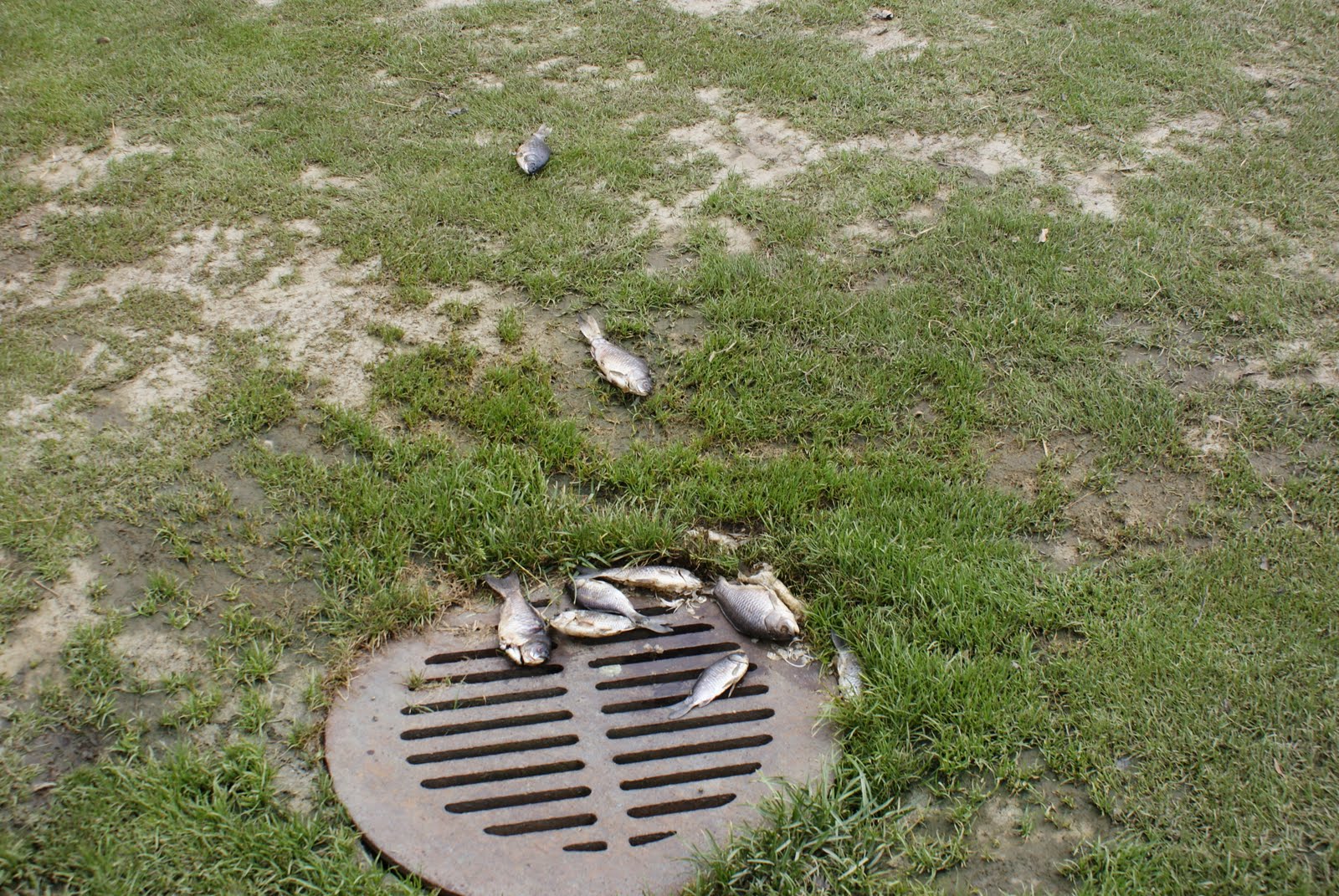
The ground is drying out fast after the flood last weekend.  We were lucky the water went down fairly quickly.  The maintenance crew has now fixed all the sand traps and mowed almost all the rough.  The course is starting to look like normal.

Loads of debris were removed after the flood, but we still keep finding things where they are not supposed to be.  One of the most unpleasant jobs of flood cleanup:  Fish duty!  (See photo below)


Don't worry.  They have been removed!

Sunday, July 25, 2010

Flood Pictures from July 24, 2010

On Friday night and Saturday morning, our area was hit by heavy storms and flooding . . . again.  With some trouble due to closed roads, the maintenance crew arrived at the course to find our 5" rain gauge already full at 5am.  In all, we had around 7" of rain overnight.  According to a neighbor, the water almost reached 1987 levels. 

Storm Total Map from National Weather Service shows Villa Park from 6-8"
As of this post, the water has left the course except for a some puddles.  Much of the debris has been picked up.  The evidence of the flood is still apparent in the fine layer of silt on the turf in some areas and the serious damage to the sand traps.  We expect to be open on Monday.

For the curious, here are some pictures of the flood.  While it was a sad scene, we couldn't help but be impressed by the power of Mother Nature at times like these:

First Fairway
First Green in the distance
The 3rd Hole with extra water hazard
7th Fariway underwater
#6 Redesigned with an island tee
#1 Green - later in the evening
Later in the evening - #4 still underwater
You can tell the tee was underwater at the peak of the flood
One of the problems with flooding:
Sand being carried downstream with the water from #6 green