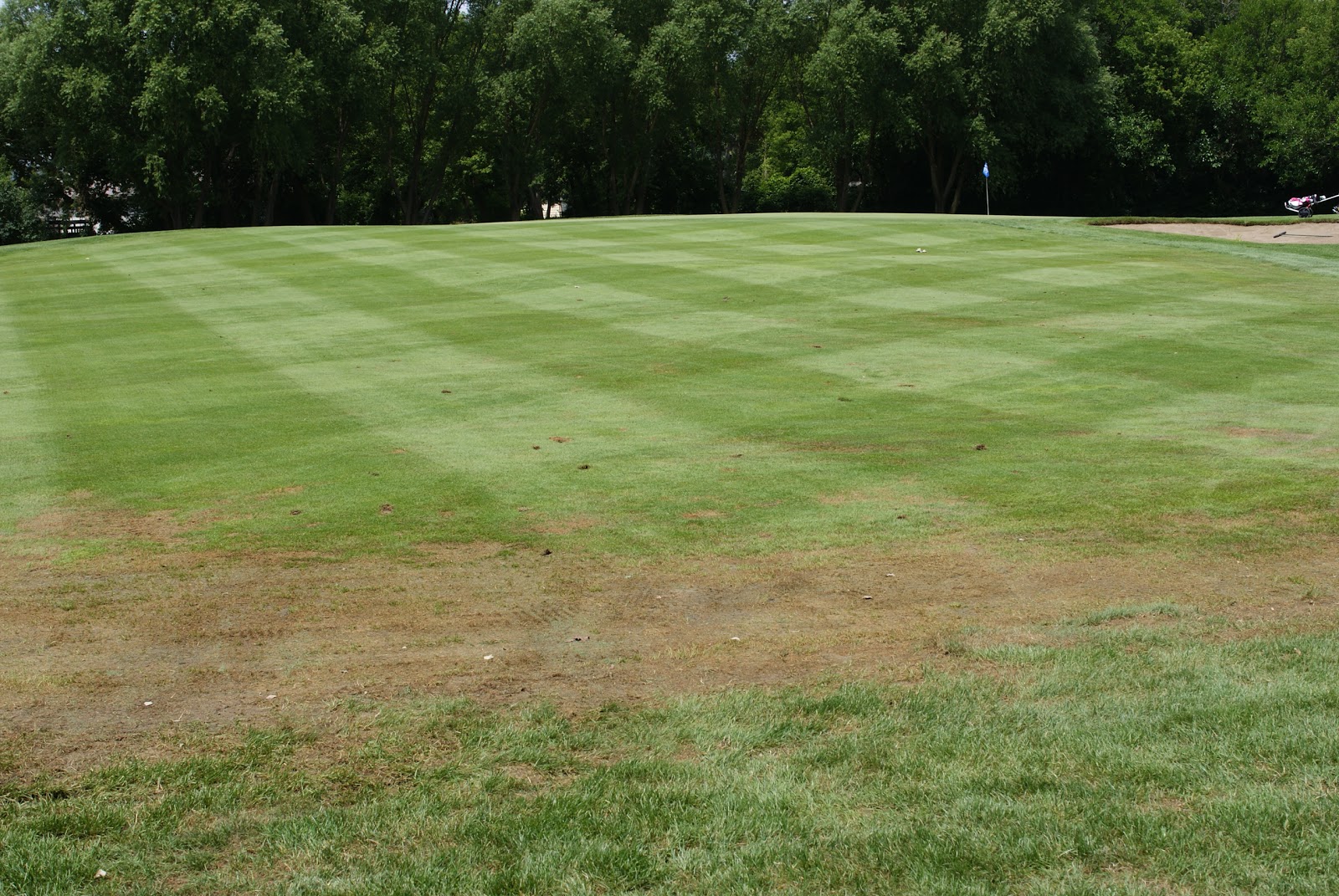
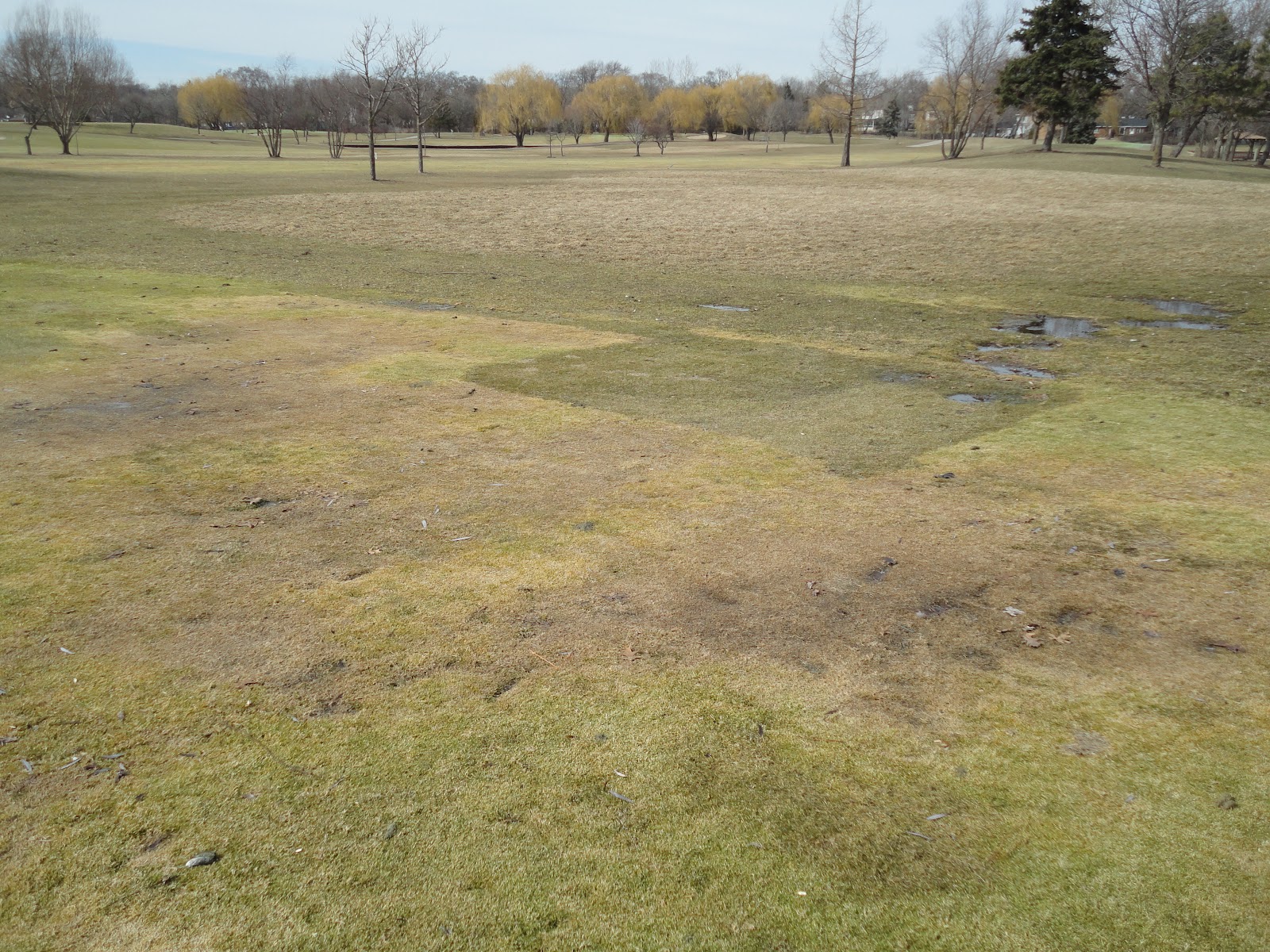
When it is too wet to mow fairways, one of our favorite pastimes is finding and fixing old drain lines. There are very few in the fairways so we have been finding the ones that are there and testing them.
We just found the old lines on the 4th fairway. The good news is that the 4 inch line going to the creek works! The bad news is that the rest of the system is thin 2 inch spiral corrugated tube that is not flowing. It is crushed in many places. There is a good reason 4 inch is the standard size.
In a situation like this we will get the system working as well as it can and install a catch basin here. At least the 4 inch line heading off toward the top of the picture will take water and the pea gravel around the 2 inch lines is collecting some water. In the future, reinstalling 4 inch lines in this area would help dry it out more quickly after heavy rain. At least now we have a better idea what is here to work with.
Showing posts with label Drainage. Show all posts
Wednesday, July 2, 2014
Tuesday, April 24, 2012
Tale of the Trap -- Part 2
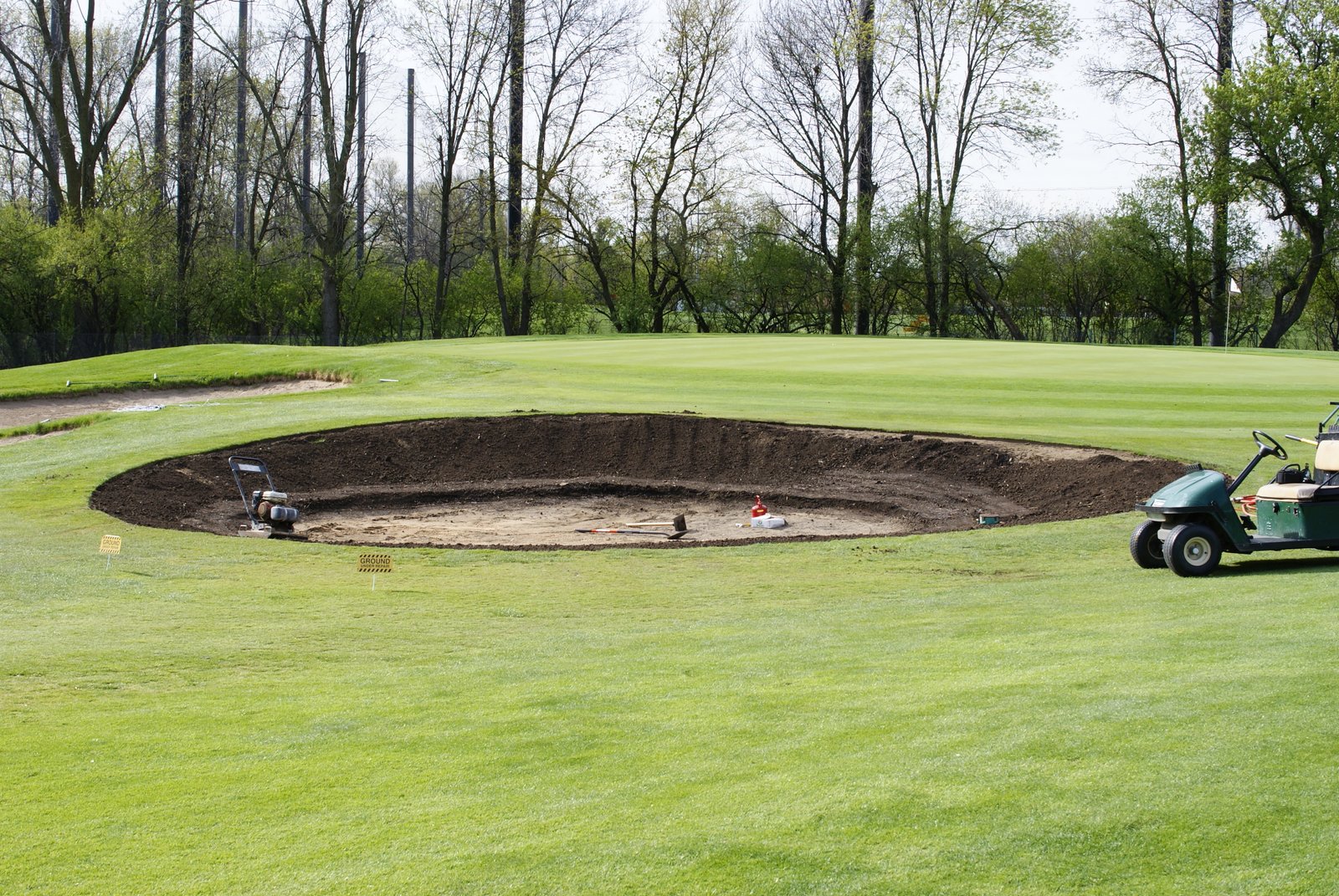
Work is complete on the sand trap in front of the green on the 8th hole. Many golfers have commented that the new trap and surrounding area will be easier to play from in some ways and more difficult in others. Of course, the idea is to avoid it altogether!
Here are some pictures of the construction process:
Once the sod has fully rooted, this trap will be open for business. Currently, it is still marked Ground Under Repair so golfers can take a free drop if they enter the area.
Labels:
Drainage,
Projects,
Sand Traps
Thursday, March 22, 2012
The Tale of a Trap
Today, we began work on the sand bunker in front of the 8th green. This area is currently "Ground Under Repair," meaning any golfer who 'accidentally' hits a ball into the trap may drop a ball no closer to the hole with no penalty. If you would like to learn more about the history of this bunker, read on. . .
HistoryThe bunkers at Sugar Creek were built in 2004 as part of the course improvements. The trap in front of the 8th green is a vital element of the hole's design as a short but challenging par 4. Without the bunker, golfers could "go for the green" with a driver without much risk -- if hit straight of course! The bunker creates a nice "risk versus reward" situation for the long drive hitter and doesn't penalize the short drive hitter. The placement of this bunker makes good sense for the hole. It has, however, been difficult to maintain since it was built.
Here is the bunker at its best last year:
Unfortunately, the crew can only get the bunker in this condition with Mother Nature's help. This picture was taken during a dry spell with no rain for 2 weeks. The trap is playable under those circumstances, but any rain puts this in jeopardy.
This bunker has several problems:
- The top lip is dug into the sub-surface of the green so it is always crumbing
- An old drainline from the green oozes water into the trap
- The trap has been "over-edged." Every time the top lip crumbled, it was edged back a foot or two. From digging around, I can tell the original shape of the trap was a full 10 feet smaller! This edging has only made the situation worse.
- During a heavy thunderstorm, water flows off the green straight into the trap. This fills it with water and mixes soil with the sand stopping drainage.
Every time the bunker "washes out," the sand becomes mixed with soil and loses more and more of its ability to dry out.
The Fix
To solve these problems, we are going to . . .
- Restore the bunker to its original shape
- Build a soil barrier between the green's sub-soil and the bunker
- Clean sand and soil from drain lines and add clean-out ports so we can keep the lines clean
- Shape the top lip to route as much water as possible away from the trap
- Sod the top lip with bluegrass to slow sheet flow during a storm
- Replace the contaminated sand and pea gravel with clean materials
A golfer just asked me not to fix this trap. He said he enjoyed the "Combo hazard" -- you never knew if it was going to be water or sand! Unfortunately we are too far along to stop now.
Labels:
Drainage,
Projects,
Sand Traps
Monday, August 8, 2011
Interview with a Fairway
So, fairway, it looks like you’ve been having a rough time in the past weeks?
Tell me about it! I was doing great up until it started raining again. I appreciate a nice shower. Even a short bath I can tolerate, but I can’t sit in water for a week. I can’t breathe. Especially when the sun is out – that water gets hot! Try holding your breath underwater in a hot tub. That’s what it’s been like.
How did you cope with the extreme heat? Was that a problem?
That string of really hot days wasn’t a walk in the park, but I survived. The maintenance crew tried to give me just the right amount of water. Too much water would have cooked me and too little would have permanently wilted me. I made it through those hot days by breathing at night and holding my breath during mid-day. That way I didn’t wilt to death during the middle of the day. I’m not saying it was pleasant, but I can handle that for a while as long as the maintenance crew is helping me out.
If you didn’t mind the extreme heat, when did the trouble start?
Well. I started getting wet. The first downpour was alright. I soaked it up and it was cloudy and not too hot out. The second one on July 23rd was way too much for me to handle, my roots were saturated and I couldn’t breathe. Luckily it wasn’t too hot and sunny so you couldn’t really tell how much I was hurting.
It seemed like you suddenly got sick right after that. What happened next?
Just when I was starting to dry out and feel good again, I got a combined 2.5 inches of rain on the 28th and 29th. Those two days were cloudy and not too hot so I just held on partially underwater. Some of my low spots were starting to get smothered, but I was mostly ok. And then it happened . . . Saturday and Sunday were the worst!
Did you get a horrible disease or something?
Not really. The maintenance crew had just helped me out with some protectants that prevented most of the diseases. I may have had a spot or two of Pythium Blight and Brown Patch, but that wasn’t really a big deal. It was just the conditions out here on the 30th and 31st. Remember, I’m plants, I can’t run away from lethal heat like you can -- hiding in your nice air conditioning all day and night! I have to just sit here and take it.
I remember it was miserable out there in the middle of the day. Why couldn’t you use the water to cool off?
My roots were still soaked and it was very humid so I couldn’t transpire. Kind of like humans and your sweat, I need to evaporate some water to cool myself off.
Didn't the maintenance crew just add some drain lines on the first hole to help you out?
Yes they did, and I appreciate the effort. They put a new line under the cart path and some other lines. I'm sorry, but the way I'm built, it's going to take a lot more than that to dry me out when it rains this much!
| New drain and sodded area on #1. Sod didn't make it. |
I wasn’t dry yet and the sun came out. July 30th was the sunniest day in a long time and the temperatures hit the low 90’s. The sun heated up the surface of the water that was partly covering my blades to over 110 degrees and it cooked their insides. In a four hour span on Saturday afternoon, a lot of my cells turned to useless soup. Sunday afternoon hurt again with the exact same conditions.
Can we do anything to help right now?
Well. The maintenance crew tried to help by aerating some holes for me. Unfortunately, it has continued to rain so I still haven’t been able to breathe much. Just rained another 1.5 inches in the last 24 hours. At least the temperatures have cooled off so I’m not losing any more plants. I know the maintenance crew is going to aerate and overseed this week once I dry out a little. I’ve been in this situation before and I always come back with a little help. Please be patient while I grow some new shoots and roots.
Why are other areas of the course growing so well and you’re not?
There are lots of reasons, but most of them go back many years. If you notice, I’m low and the greens and tees are high – for the most part. They were built with soil and sand custom made for greens and tees. I’m all clay, rock, asphalt, and brick. You might not know this, but I was a rock dump before I was a golf course fairway. The greens and tees got the benefit of topsoil and there wasn’t much left for me. I have a rougher life than those pampered greens. They don't even get driven on by carts! The tees are less spoiled – at least they have to deal with divots. Now, if you'll excuse me, I need to grow some roots now.
One more question -- When do you think you'll be back to "normal"?
If past years are any guide, I will probably have one more rough patch in August that will prevent a big recovery. At the end of August, I will recover and grow new shoots with the help of the maintenance crew. By October 1, you may not be able to tell that it was another hot, wet summer.
That was the end of our interview. You may want to see these post for more information:
Scald and annual bluegrass (Poa annua) problems:
http://sugarcreekgolfcourse.blogspot.com/2010/07/turf-notes-summer-decline-of-annual.html
Pythium Blight:
http://sugarcreekgolfcourse.blogspot.com/2010/08/turf-notes-pythium-blight.html
Drainage project on 1st hole:
http://sugarcreekgolfcourse.blogspot.com/2011/05/1-cart-path-drainage-project-update.html
2010 -- a similar year for us -- in review:
http://sugarcreekgolfcourse.blogspot.com/2010/12/2010-year-in-pictures.html
If past years are any guide, I will probably have one more rough patch in August that will prevent a big recovery. At the end of August, I will recover and grow new shoots with the help of the maintenance crew. By October 1, you may not be able to tell that it was another hot, wet summer.
| Early October 2010 |
Scald and annual bluegrass (Poa annua) problems:
http://sugarcreekgolfcourse.blogspot.com/2010/07/turf-notes-summer-decline-of-annual.html
Pythium Blight:
http://sugarcreekgolfcourse.blogspot.com/2010/08/turf-notes-pythium-blight.html
Drainage project on 1st hole:
http://sugarcreekgolfcourse.blogspot.com/2011/05/1-cart-path-drainage-project-update.html
2010 -- a similar year for us -- in review:
http://sugarcreekgolfcourse.blogspot.com/2010/12/2010-year-in-pictures.html
Labels:
Articles,
Drainage,
Heat Stress,
Poa,
Turf
Monday, August 1, 2011
Venting Fairways and Tees
The past couple weeks have not been kind to most Chicago-area golf courses. First we had extreme heat and then lots of rain. While some turf wilted in the heat and the rough went dormant in many areas, we could cope with dry and hot. The wet period that started on July 22nd was a different matter. The end of last week (July 27-29) saw significant rain 3 days in a row with warm temperatures. This created a situation we know well in a wet late summer -- a toxic soup of wet wilt, scald, and pythium. The high temps this weekend cooked saturated, low-lying fairway areas but the rough is looking fabulous! Quite a few golfers have commented on how green it is on the course and they are right: The greens, higher areas, and rough are healthy and growing fast. It is those lower areas that are the problem.
At the moment, there is only one thing we can do to improve the situation and speed up turf recovery -- Vent! Not the verbal kind of venting, although that can help, but the mechanical kind. Venting refers to solid tine aeration done mostly for the purpose of improving gas exchange in the soil. We have been using a machine called the Planet Air on the fairways that shatters soil while leaving only a slit in the turf and a minimum of mess. Tees are being treated with solid tines on a conventional aerifier. So far, I have no plans to needle tine the greens as they are still performing well.
I've noticed a lot of superintendents are doing the same thing and dealing with a lot of the same problems. Check here for more recent superintendent blog posts (Link). I especially like this blog post as they seem to be in a similar situation (Link).
In his Scouting Report for July 29, 2011, Dr. Settle writes: "Then there's why overly wet rootzones are our worst enemy. Midsummer is never a good time for cool-season turfgrass because any additional downward spiral of turfgrass health can be difficult to reverse until cooler weather returns. Root biomass/length are at their lowest levels and what's left root-wise has impaired function because of high soil temperature. Turf plants in physiological decline display abnormal photosynthesis and respiration, yet concentrated wear continues on a daily basis (the life of a golf green). Often the only recourse is a well-timed cultural method such as needle-tine aeration. If it sounds as if I'm exaggerating or blaming the weather too much, guess again."
Thanks for telling it how it is! Wet + Hot + Stress = Unhappy Turf. These scouting reports a great resource for everyone involved in golf. You can check them out at Chicago District Golf Association Turfgrass.
| Scalded low area near the creek on #1. |
| Aerator uses a slicing motion to vent turf |
| Slicing Tines on Planet Air |
In his Scouting Report for July 29, 2011, Dr. Settle writes: "Then there's why overly wet rootzones are our worst enemy. Midsummer is never a good time for cool-season turfgrass because any additional downward spiral of turfgrass health can be difficult to reverse until cooler weather returns. Root biomass/length are at their lowest levels and what's left root-wise has impaired function because of high soil temperature. Turf plants in physiological decline display abnormal photosynthesis and respiration, yet concentrated wear continues on a daily basis (the life of a golf green). Often the only recourse is a well-timed cultural method such as needle-tine aeration. If it sounds as if I'm exaggerating or blaming the weather too much, guess again."
Thanks for telling it how it is! Wet + Hot + Stress = Unhappy Turf. These scouting reports a great resource for everyone involved in golf. You can check them out at Chicago District Golf Association Turfgrass.
| Classic water damage in a drainage swail. Saturated conditions lasted for longer than the turf could tolerate. |
Wednesday, May 25, 2011
#1 Cart Path Drainage Project Update
In March, the maintenance crew added a new drain under the cart path on #1 to prevent flooding and ice related problems along the path. Almost every year, ice kills a portion of this turf. Seed was not growing fast enough for us due to our cool, wet April so we decided to sod the area to completely restore it.
Here are some before and after pictures:
This area could still benefit from the addition of some sub-surface drain lines but the new catch basin will greatly reduce the amount of water hung up on the high side of the path. Something tells me this will not be the last drainage project done in this area, but it is greatly improved.
Here are some before and after pictures:
| Before |
| Before |
| After |
Tuesday, March 22, 2011
Drainage Project under Cart Path on #1
As part of our continuing effort to improve drainage on the 1st hole, the maintenance crew repaired a drain under the cart path. Last fall, we added some lines by the sandtrap on the right (Click here for more on that project). This year, we are fixing the bottleneck under the cart path on the left. Many years ago, the addition of the cart path interrupted surface flow to the creek and crushed a couple 4-inch drain lines. The one functioning 4-inch line in this low spot is not capable of collecting and moving all the water to the other side of the path.
Here is a picture of the problem area:
After some investigation we found that the line was partially crushed slowing down drainage. At the time this picture was taken, the rest of the course was dry and it had not rained or snowed for days.
We could feel an obstruction under the path with a hose, so we decided to cut the path and fix the problem:
Here we start excavating the drain line. The curve in the line is the result of going around a large rock that we eventually removed:
Here is a picture of the problem area:
After some investigation we found that the line was partially crushed slowing down drainage. At the time this picture was taken, the rest of the course was dry and it had not rained or snowed for days.
We could feel an obstruction under the path with a hose, so we decided to cut the path and fix the problem:
Here we start excavating the drain line. The curve in the line is the result of going around a large rock that we eventually removed:
We decided to replace the pipe with a section of 6-inch solid PVC that we had on hand from another project a few years ago. To do this, we had to make the trench deeper and dig holes for 2 large catch basins.
Here is the structure we installed before backfilling:
And after some backfilling:
This is the first step in the project. Now that we have a good route under the cart path, we can run drain lines to it to dry up the area. Before, we had no way to drain the water to a lower point.
Obviously, the area still needs to be finished and seeded. I will post a "finished" picture below once the grass starts growing (looks like we are going back to freezing temps for a while) . . .
Labels:
Drainage
Thursday, March 17, 2011
Turf Notes: Annual Bluegrass and Winter Hardiness
Compared to last year, it looks like we will have only limited areas of winterkill this spring. In 2010, a long period of snow cover and a long period of freezing and thawing of ice sheets resulted in a lot of lost annual bluegrass (Poa annua). We sodded the worst areas and slit seeded the rest. For pictures from 2010, see "7th Fairway- Update."
If you see any strange patterns or lines in the fairways this March or April, it may be areas sodded with bentgrass in 2010. Pictures like the ones below really illustrate the weaknesses of annual bluegrass compared to creeping bentgrass or Kentucky bluegrass.
These areas have 2 problems that go together: poor drainage (they are naturally low and almost flat) and poor turf species. While it will take a combination of approaches to improve these areas of the fairways, I am glad to see that bentgrass is capable of surviving the winter in these difficult spots. It shows that keeping up with our current strategies will improve these areas in the long term.
Right now, you can really see the contrast between different grass species and their reaction to cold temperatures. Unfortunately, most of the brown areas around our sod from 2010 will green up with warmer temperatures. I say "unfortunately" because it would be a lot easier to get rid of annual bluegrass if it would die off and stay dead. Its persistance is amazing. It will die in a heartbeat in the winter and summer and re-germinate just as fast in the spring and fall.
| Sodding areas of the 6th fairway in 2010 |
| Bentgrass sod design on 6 fairway |
| Another square on 6 fairway from 2010 |
| Creeping bent on the left -- Annual bluegrass on the right |
| Large square sodded in 2010 |
Right now, you can really see the contrast between different grass species and their reaction to cold temperatures. Unfortunately, most of the brown areas around our sod from 2010 will green up with warmer temperatures. I say "unfortunately" because it would be a lot easier to get rid of annual bluegrass if it would die off and stay dead. Its persistance is amazing. It will die in a heartbeat in the winter and summer and re-germinate just as fast in the spring and fall.
Tuesday, March 1, 2011
Thawing and Freezing
Since the snow has mostly melted, we have been assessing the health of our turf coming out of winter. Last year, I wrote about the factors that influence turf health coming out of winter in Good or Bad Winter for Turf and A Long, Difficult Winter for Turf. As it turned out, we had to do a lot seeding and sodding last April to repair ice damage in the fairways. After a tough summer in 2010, it would be nice to have favorable conditions for turf growth this spring.
Like most golf courses, we have a few areas that tend to weaken or die over the winter. About every other year, the 7th fairway exhibits significant ice damage. My theory is that this ice damage is caused by crown hydration of mostly Poa annua during freeze/thaw cycles. During our last thaw after the first of the year, the grass plants appeared healthy. While it is difficult to assess health during the winter, ice damaged plants often take on a mushy, soupy texture due to their ruptured cell walls. This month's freezing and thawing are starting to concern golf course superintendents, but I am still hoping we will have less damage than last year when the ice didn't melt until the middle of March.
On February 28th, the fairways were covered in ice after a heavy rain. Luckily most of the ice has melted and drained overnight.
Here are two spots we are watching closely:
In 2010, we tried to improve the drainage in these areas and re-seeded them with creeping bentgrass. Because bentgrass has a greater tolerance for ice cover and cold temperatures than Poa annua, we are hoping to see less ice damage this year in the places where the bentgrass took. More improvements will need to be made to drain these areas more quickly, but planting a hardier species should help these areas survive the winter in the meantime.
Besides these areas, the turf is looking good after a snowy February. Our newly planted tees are looking healthy and the greens are free of snow mold.
Like most golf courses, we have a few areas that tend to weaken or die over the winter. About every other year, the 7th fairway exhibits significant ice damage. My theory is that this ice damage is caused by crown hydration of mostly Poa annua during freeze/thaw cycles. During our last thaw after the first of the year, the grass plants appeared healthy. While it is difficult to assess health during the winter, ice damaged plants often take on a mushy, soupy texture due to their ruptured cell walls. This month's freezing and thawing are starting to concern golf course superintendents, but I am still hoping we will have less damage than last year when the ice didn't melt until the middle of March.
On February 28th, the fairways were covered in ice after a heavy rain. Luckily most of the ice has melted and drained overnight.
Here are two spots we are watching closely:
| Draining areas on 7 fairway |
| Melting ice on 6 fairway |
Besides these areas, the turf is looking good after a snowy February. Our newly planted tees are looking healthy and the greens are free of snow mold.
Wednesday, December 8, 2010
Sunday, October 10, 2010
Drainage Project on #1
Last week, we tackled a few drainage projects on the course and by the clubhouse. We ran some drain lines to the right of #1 fairway in an attempt to fix a persistent soggy spot. After ruling out the usual culprits, irrigation leak or broken drain line, we found that in this whole area water seeps up from the ground around the rocks and bricks that are buried here. Adding perforated drain lines should give the water a clear route to the creek instead of bubbling up to the surface. We will probably have to wait until next year to judge the success of this project, but these additional lines should improve the situation.
| 1st Step - Sod Removal |
| Trenching in progress |
Subscribe to:
Posts (Atom)