Showing posts with label Winter. Show all posts

Saturday, June 28, 2014

Spring 2014 Turf Recovery in Pictures

The winter of 2013-2014 was tough on turf.   The cold temperatures and snowfall lead to a lot of dead Poa. Many golf courses were left with large areas of dead turf that had to be seeded, sodded, or otherwise coaxed back into playable shape.  At Sugar Creek, the rough, greens, and most tees survived the winter fine but the fairways are another story.  In areas of shady floodplain, solid layers of ice sometimes a foot thick formed and eventually suffocated the Poa annua that calls these areas home.  After a lot of aerifying (3 times), slit-seeding, levelling, watering, and sodding, the fairways were almost 100% filled in by the end of May.  I'll be the first to admit that Mother Nature did most of the work -- we can't do anything without the right temperatures, moisture levels, and sunlight to grow plants -- but we significantly sped up the process and made some progress against Poa.

Here are some pictures from the last 3 months that dramatically illustrate the recovery:

7 Fairway - April 12, 2014
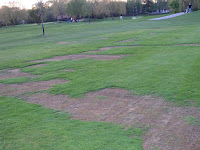
Here you can see some of the creeping bentgrass we have been able to get growing after the floods in 2010 and 2013 (and the heat wave in 2012).  Everything green in the fairway is bentgrass. Everything brown is Poa annua. 

7 Fairway - April 12, 2014

7 Fairway after slit-seeding  - April 25, 2014
Below you can see the fairway filling in with new seedlings.  We wish they were all bentgrass seedlings, but many are coming from the dormant Poa annua seedbank in the soil.  At this point, you take what you can get!

7 Fairway filling in - May 30, 2014
 
And below is now.  You can tell we had moderate temps and a lot of rain recently!

7 Fairway - June 27, 2014
7 Fairway from the reverse angle:


The first fairway suffered similar damage but not as extensive.  As an experiment, we slit-seeded T-1 creeping bentgrass when it was still very cold at the end of March and had seed coming up in April.  It filled in quickly after that.

Slit-seeding germination - April 25, 2014
 
These photos were taken of the 1st fairway toward the tee:


Monday, March 18, 2013

Emerald Ash Borer Tree Removals

This winter, we began removing Ash trees infected with the Emerald Ash Borer (EAB) that were visibly declining or dead in 2012 and deemed hazardous to people or property. So far, 44 of 286 Fraxinus (Ash) species trees have been removed leaving 242.  All of the remaining are infected and in various states of decline.

The EAB is a non-native, phloem-feeding insect that aggressively kills both healthy and stressed Ash trees of all ages. The EAB adult, a metallic green beetle, lays eggs in the bark of Ash trees. These eggs hatch into larvae which bore through the bark and into the cambium where they feed, overwinter, and pupate. It is the larval stage which kills the tree once the cambium is girdled by feeding. See the USDA’s “Emerald Ash Borer Program Manual” for more information.

Emerald Ash Borer S-shaped galleries
Emerald Ash Borer larvae IL
Emerald Ash Borer larvae
The EAB was first identified in Villa Park in the summer of 2011 but we did not have conclusive proof on the golf course until February 2012 last year.  During the winter from 2011 to 2012, woodpeckers were seen attacking Ash trees and leaving light-colored marks where the bark had been peeled away.  These marks are the easiest way to identify EAB infection over the winter.  While the woodpeckers may be feeding on native borers that attack stressed trees, if the tree was previously healthy, EAB is strongly indicated.  By the time you see woodpecker damage, the borer has already done significant damage during the year.  It is best to call a professional arborist as soon as possible to determine a course of action.
Many people ask me whether they should treat their Ash trees with pesticides or remove them.  There is no easy answer to that questions.  Ash trees can be saved even after infection with the right treatments -- this is true.  The important thing to remember is that treatment is forever or, more accurately, for the life of the tree.  If you miss treatments or happen to be in the small percentage where the treatment is ineffective, the tree will again be at risk of infection.  The other important thing to remember is this: no matter what you do, you still have an Ash tree.  Ash trees are not long-lived or structurally strong.  They tend to suffer severe storm damage later in life and can be hazardous. 
The factors that need to be considered include:
  • Cost
  • Location, location, location
  • Size of the tree
  • Age of the tree
  • Condition of the tree
  • Potential hazards
  • Environmental impact of pesticide use
  • Willingness to commit to treatment for decades, or the life of the tree
As you might have guessed from the above, it is my opinion, verified by a lot of calculations, that it is almost always more desirable and cost-effective to remove an Ash tree and replace it with a more disease-resistant, longer-lived, and safer tree.  I know many arborists selling treatment will argue with me, but the math is not on the side of treatment in the vast majority of cases.  If you have an Ash tree that you consider invaluable to your property and it is in good condition and it isn't too old and it is not likely to become a hazard, then I would consider treatment.  If not, cut your losses and plant something else!

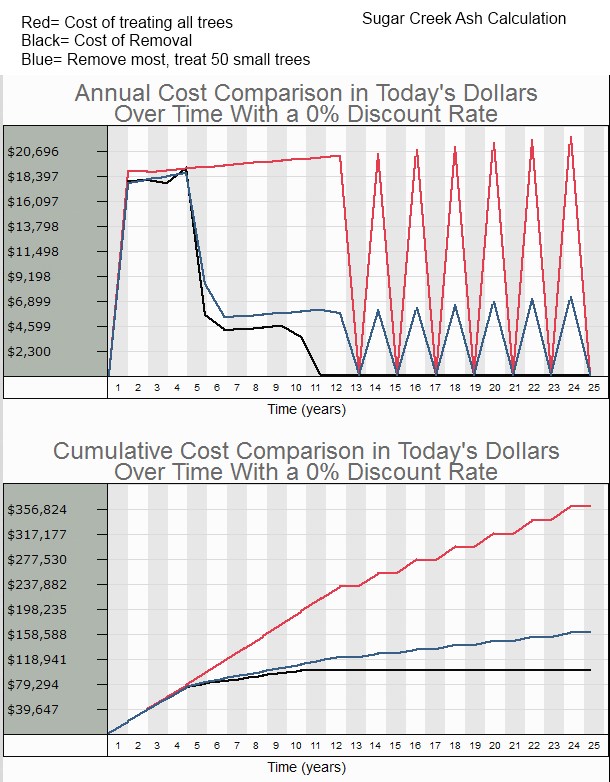
The graphs below were created using the Purdue EAB Cost Calculator.  As you can see, with Sugar Creek's large Ash population it is not cost effective to try and save all of our Ash trees.  These costs are Purdue's estimate and may be higher than we could do the work for, but the relative costs are what counts.  With a removal program combined with replacement of the landscape trees over time, the cost of the strategy disappears in 10 years or so.  With treatment, it never disappears and the trees will still die some day with age and storm damage.
Comparison of EAB removal vs treatment

Below is a picture of Ash storm damage. After almost every wind event, some older Ash trees need to be pruned or removed. This is true for both golf course trees and street trees. Most of the Ash trees at Sugar Creek are older and were in decline before the borer arrived. They were becoming hazardous to the clubhouse and driving range net, so their removal will give us a chance to plant trees more suited to the location.
Typical Ash tree storm damage
Most of the Ash trees at Sugar Creek are located along the fencelines around the driving range and on the 6th hole. Over the next few years, these trees will be removed and replaced with a variety of disease-resistant trees and shrubs.  We are beginning replacements for the 44 trees removed this winter this spring behind the 6th green.

Map of Ash trees at Sugar Creek Golf Course

Monday, March 11, 2013

A Sampling of Winter Projects

During the winter, golf course equipment needs to be maintained and serviced for the year.  We have finished our long list of preventative maintenance tasks and have moved on to the projects that can add new life to old machines or extend the life of a newer machine.
Rusty mowing decks get scraped and repainted. This adds many years to the life of these decks.  If allowed to rust, the structural integrity of the deck is compromised.
Rusty LandPride rotary deck 
This year we tried a product called "Rust Reformer" as a primer after wire brushing off the loose material. It claims to "convert" rust to a paintable surface. Not sure what what that means, but it sounds good. Time will be the judge.  As auto body workers have told me, inspired by Neil Young of course: rust never sleeps.
Rust reformer on LandPride Deck 
We also tiled the bathroom and put up waterproof panelling this winter:
 
Here is a bench waiting to go out on the 4th hole Red Tee.  It was donated by the Carey family who lived across the street from the golf course for many years:
 
Our 1996 sprayer now sports new plumbing and a "Cleanload" eductor on the side. This is the black container on the side. It will be used primarily for disolving granular fertilizer and mixing it into the tank.  Many people aren't aware of this, but we actually use our sprayer most often for fertilization.
 
These are just a few projects that the Superintendent and Equipment Tech completed over the past few months. We are ready to turn our attention more to the outdoors! Spring is coming soon.

Friday, December 9, 2011

Time to Grind

If you walk past a golf course maintenance facility this time of year, you will most likely hear the sound of grinding wheels, air rachets, and other assorted power tools. Winter maintenance of golf course equipment is essential to keeping them sharp and operational. At Sugar Creek, we use two Neary grinders to spin-grind reels and grind bedknives back into cutting shape. These grinders are considered "classics" but they do their job well if you are careful and treat them nicely.  Throughout the season, we touch-up and adjust these reels twice a week but winter is when we re-grind and re-set all the cutting angles and surfaces.

Here are some pictures of Greens King IV reels being worked on:

Our equipment technician uses very precise gauges and calipers to ensure that the reels are not slightly cone-shaped or the bedknives tilted. He often uses this Interapid indicator to test within a 10,000th of an inch if everything is coming out straight and parallel. Here you can see the indicator being used on the bedknife grinder:

Winter is when golf course equipment technicians shine. In addition to sharpening and grinding reels and blades, they change bearings, grease joints, change oil, rebuild engines, service hydraulics, replace brake pads, and a whole bunch of other stuff that I won't list here. After finishing grinding and preventative maintenance on the machines, we will be replacing the reels on the fairway mower and refurbishing the groomers on our greens mower early next year.


In the above photo, you can see the groomer blades on the greens mower cutting units.  The bearings and adjustment hardware are worn out making it very difficult to set them precisely and have them stay there.  Grooming is tricky as it is without having the cutting depth change on you.  Ideally we like the little vertical blades to go into the "canopy" of the turf just slightly and lift up leaf blades that are getting too long or running sideways (about .030" below height of cut on greens).  Having groomers too deep could damage the green and would eventually break groomers -- for deep cutting we have verti-cutter units.  Going too shallow will have no effect at all.  Since accurate adjustment is so important, the bearings and hardware on these groomers needs to be replaced once in a while to produce a quality results.

Somebody once told me Superintendents swear by groomers; mechanics swear at them.  This will most likely be true in our shop sometime in mid to late January when we take them apart and start fixing them up. 

Friday, January 29, 2010

Good Winter or Bad Winter for Turf?

As we get ready for the 2010 golf season, I know a lot of superintendents are asking themselves:  How much seeding and sodding will we have to do this spring?  How well will the turf survive this winter?  Will this turn out to be a good winter or a bad winter for the turf?  How can we tell?