Showing posts with label Trees. Show all posts

Wednesday, March 18, 2015

2015 Emerald Ash Borer Tree Removals

Tree crews are currently removing the dead Ash trees around the driving range net at Sugar Creek. These trees died because of the Emerald Ash Borer which began killing Ash trees in our area in 2011.  Most of the dead Ash trees in playable areas have also been removed.  We started with 286 infected trees in 2012.  As of today, we are down to around 150 trees.

The following was originally posted in March of 2013:

This winter, we began removing Ash trees infected with the Emerald Ash Borer (EAB) that were visibly declining or dead in 2012 and deemed hazardous to people or property. So far, 44 of 286 Fraxinus (Ash) species trees have been removed leaving 242.  All of the remaining are infected and in various states of decline.

The EAB is a non-native, phloem-feeding insect that aggressively kills both healthy and stressed Ash trees of all ages. The EAB adult, a metallic green beetle, lays eggs in the bark of Ash trees. These eggs hatch into larvae which bore through the bark and into the cambium where they feed, overwinter, and pupate. It is the larval stage which kills the tree once the cambium is girdled by feeding. See the USDA’s “Emerald Ash Borer Program Manual” for more information.

Emerald Ash Borer S-shaped galleries
Emerald Ash Borer larvae IL
Emerald Ash Borer larvae
The EAB was first identified in Villa Park in the summer of 2011 but we did not have conclusive proof on the golf course until February 2012 last year.  During the winter from 2011 to 2012, woodpeckers were seen attacking Ash trees and leaving light-colored marks where the bark had been peeled away.  These marks are the easiest way to identify EAB infection over the winter.  While the woodpeckers may be feeding on native borers that attack stressed trees, if the tree was previously healthy, EAB is strongly indicated.  By the time you see woodpecker damage, the borer has already done significant damage during the year.  It is best to call a professional arborist as soon as possible to determine a course of action.
Many people ask me whether they should treat their Ash trees with pesticides or remove them.  There is no easy answer to that questions.  Ash trees can be saved even after infection with the right treatments -- this is true.  The important thing to remember is that treatment is forever or, more accurately, for the life of the tree.  If you miss treatments or happen to be in the small percentage where the treatment is ineffective, the tree will again be at risk of infection.  The other important thing to remember is this: no matter what you do, you still have an Ash tree.  Ash trees are not long-lived or structurally strong.  They tend to suffer severe storm damage later in life and can be hazardous. 
The factors that need to be considered include:
  • Cost
  • Location, location, location
  • Size of the tree
  • Age of the tree
  • Condition of the tree
  • Potential hazards
  • Environmental impact of pesticide use
  • Willingness to commit to treatment for decades, or the life of the tree
As you might have guessed from the above, it is my opinion, verified by a lot of calculations, that it is almost always more desirable and cost-effective to remove an Ash tree and replace it with a more disease-resistant, longer-lived, and safer tree.  I know many arborists selling treatment will argue with me, but the math is not on the side of treatment in the vast majority of cases.  If you have an Ash tree that you consider invaluable to your property and it is in good condition and it isn't too old and it is not likely to become a hazard, then I would consider treatment.  If not, cut your losses and plant something else!

The graphs below were created using the Purdue EAB Cost Calculator.  As you can see, with Sugar Creek's large Ash population it is not cost effective to try and save all of our Ash trees.  These costs are Purdue's estimate and may be higher than we could do the work for, but the relative costs are what counts.  With a removal program combined with replacement of the landscape trees over time, the cost of the strategy disappears in 10 years or so.  With treatment, it never disappears and the trees will still die some day with age and storm damage.
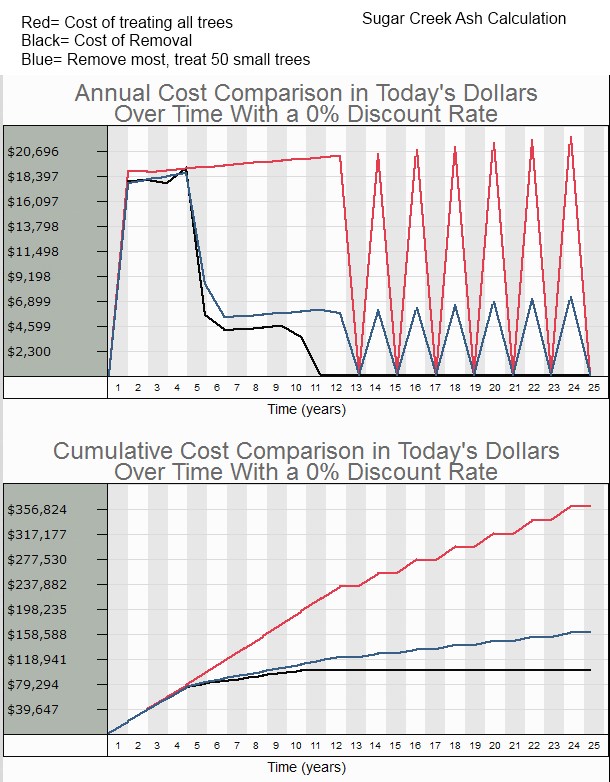
Comparison of EAB removal vs treatment

Below is a picture of Ash storm damage. After almost every wind event, some older Ash trees need to be pruned or removed. This is true for both golf course trees and street trees. Most of the Ash trees at Sugar Creek are older and were in decline before the borer arrived. They were becoming hazardous to the clubhouse and driving range net, so their removal will give us a chance to plant trees more suited to the location.
Typical Ash tree storm damage
Most of the Ash trees at Sugar Creek are located along the fencelines around the driving range and on the 6th hole. Over the next few years, these trees will be removed and replaced with a variety of disease-resistant trees and shrubs.  We are beginning replacements for the 44 trees removed this winter this spring behind the 6th green.

Map of Ash trees at Sugar Creek Golf Course

Monday, March 18, 2013

Emerald Ash Borer Tree Removals

This winter, we began removing Ash trees infected with the Emerald Ash Borer (EAB) that were visibly declining or dead in 2012 and deemed hazardous to people or property. So far, 44 of 286 Fraxinus (Ash) species trees have been removed leaving 242.  All of the remaining are infected and in various states of decline.

The EAB is a non-native, phloem-feeding insect that aggressively kills both healthy and stressed Ash trees of all ages. The EAB adult, a metallic green beetle, lays eggs in the bark of Ash trees. These eggs hatch into larvae which bore through the bark and into the cambium where they feed, overwinter, and pupate. It is the larval stage which kills the tree once the cambium is girdled by feeding. See the USDA’s “Emerald Ash Borer Program Manual” for more information.

Emerald Ash Borer S-shaped galleries
Emerald Ash Borer larvae IL
Emerald Ash Borer larvae
The EAB was first identified in Villa Park in the summer of 2011 but we did not have conclusive proof on the golf course until February 2012 last year.  During the winter from 2011 to 2012, woodpeckers were seen attacking Ash trees and leaving light-colored marks where the bark had been peeled away.  These marks are the easiest way to identify EAB infection over the winter.  While the woodpeckers may be feeding on native borers that attack stressed trees, if the tree was previously healthy, EAB is strongly indicated.  By the time you see woodpecker damage, the borer has already done significant damage during the year.  It is best to call a professional arborist as soon as possible to determine a course of action.
Many people ask me whether they should treat their Ash trees with pesticides or remove them.  There is no easy answer to that questions.  Ash trees can be saved even after infection with the right treatments -- this is true.  The important thing to remember is that treatment is forever or, more accurately, for the life of the tree.  If you miss treatments or happen to be in the small percentage where the treatment is ineffective, the tree will again be at risk of infection.  The other important thing to remember is this: no matter what you do, you still have an Ash tree.  Ash trees are not long-lived or structurally strong.  They tend to suffer severe storm damage later in life and can be hazardous. 
The factors that need to be considered include:
  • Cost
  • Location, location, location
  • Size of the tree
  • Age of the tree
  • Condition of the tree
  • Potential hazards
  • Environmental impact of pesticide use
  • Willingness to commit to treatment for decades, or the life of the tree
As you might have guessed from the above, it is my opinion, verified by a lot of calculations, that it is almost always more desirable and cost-effective to remove an Ash tree and replace it with a more disease-resistant, longer-lived, and safer tree.  I know many arborists selling treatment will argue with me, but the math is not on the side of treatment in the vast majority of cases.  If you have an Ash tree that you consider invaluable to your property and it is in good condition and it isn't too old and it is not likely to become a hazard, then I would consider treatment.  If not, cut your losses and plant something else!

The graphs below were created using the Purdue EAB Cost Calculator.  As you can see, with Sugar Creek's large Ash population it is not cost effective to try and save all of our Ash trees.  These costs are Purdue's estimate and may be higher than we could do the work for, but the relative costs are what counts.  With a removal program combined with replacement of the landscape trees over time, the cost of the strategy disappears in 10 years or so.  With treatment, it never disappears and the trees will still die some day with age and storm damage.
Comparison of EAB removal vs treatment

Below is a picture of Ash storm damage. After almost every wind event, some older Ash trees need to be pruned or removed. This is true for both golf course trees and street trees. Most of the Ash trees at Sugar Creek are older and were in decline before the borer arrived. They were becoming hazardous to the clubhouse and driving range net, so their removal will give us a chance to plant trees more suited to the location.
Typical Ash tree storm damage
Most of the Ash trees at Sugar Creek are located along the fencelines around the driving range and on the 6th hole. Over the next few years, these trees will be removed and replaced with a variety of disease-resistant trees and shrubs.  We are beginning replacements for the 44 trees removed this winter this spring behind the 6th green.

Map of Ash trees at Sugar Creek Golf Course

Monday, June 25, 2012

Tree Plantings and Drainage

Just like turf, trees appreciate good drainage.  The pictures below show the effect of even a small difference in drainage.  The two trees were planted 50 feet apart.  The tree on the left was planted in rocky clay soil.  Not very good soil, but it was dry.  That tree is thriving.  When we dug the hole for the tree on the right, I remember a trickle of water coming up from the bottom.  After the tree was planted, we ran a drain line near it that I was hoping would help.  This dry year might actually do it some good.  The tree on the right might still make it, but the tree on the left is clearly more healthy.

Saturday, November 27, 2010

Tree Trimming and Buckthorn Removal on #7

Now that the grass has stopped growing, it is tree trimming season again!  Last week, we started work on some trees that were resulting in some unfair tee shots on #7 and some buckthorn that was encroaching on the course from the fenceline.  A few overhanging branches were rendering the back of 7 tee almost unusable during the season.  After removal, the health of the tee will also probably improve due to increase sun exposure.

You can see from this photo that the view from the tee will be significantly improved in 2011:
7 Tee
Last winter, I wrote a post about buckthorn that answers many questions about the undesirable nature of this plant (Link to article). In addition to the ecological reasons for controling buckthorn, this fenceline in particular often resulted lost balls.  Lost balls ofen cause slow play so we began our winter buckthorn removal here.

A portion of the fence line cleared

Buckthorn along 7 fence line


Sunday, April 25, 2010

Flowering Trees

Many of the Crabapple trees are flowering right now.  Some cultivars are about to open next week.  In this picture you can see a nice old white crabapple with two Saucer Magnolias in the foreground:


Another tree currently blooming is the Redbud (Cercis canadensis).  Here is one blooming nicely behind the 1st tee:


A week ago, the Callery Pears (a.k.a. Bradford Pears) were beautiful.  They have since dropped most of their petals with some help from the rain.  This picture is from April 16th:

Sunday, April 4, 2010

First Flowers of the Year

A Crocus blooming on March 30:


This Corneliancherry Dogwood (Cornus mas) is about to be in full bloom:


The Star Magnolia (Magnolia stellata) are beginning to bloom near the clubhouse:


Soon dozens of species will be in bloom around the clubhouse and golf course.  Our reward for making it through another long winter!

Wednesday, March 3, 2010

Buckthorn Removal

This plant, Common Buckthorn, is everywhere.  It leafs out early and keeps its leaves well into the fall.  It grows anywhere, and it grows fast.  It can grow 6 feet in one year!  Buckthorn was brought to the United States from Europe and was a popular hedge plant for decades in the 1800's.  With all this going for it, what's wrong with buckthorn?

Friday, February 19, 2010

Recent Tree Removals

Unfortunately, or fortunately for some, we had to say good-bye to two old willow trees this winter.  One was located on the 1st hole near the creek, and the other was to the left of 5 green.  The removal of these trees is one of the changes golfers may notice in 2010.