
The rainstorms last night dumped a lot of water on us. We're not exactly sure of the amount because our rain gauge was knocked over. My best guess is over 2 inches but way less than the over 6 inches falling at O'hare. Most of the water drained off as of 7:30am. The course has remained open so far and many groups have played. More rain appears to be on the way, so please check with the clubhouse to be sure of the course's status (Phone #: 630-834-3325).
Last week was very hot and humid, but the course made it through in good shape. You will hear many superintendents say that they prefer to have it not rain when it is hot. Too much water combined with heat leads to more severe problems than drought stress (see posts from 2010!). Last week was a good example of why rain is not always welcome for a golf course. Through moderate irrigation and spot watering by hand with hoses we were able to get through the week without major problems. This amount of rain a couple days ago would have lead to severe scald, wet wilt, and probably diseases. Hopefully it will stay cloudy today and not get too hot until it dries up a little. It looks like we have a little cool down coming Sunday night through Tuesday which will be a welcome relief for both people and plants.
Saturday, July 23, 2011


Tuesday, June 21, 2011
Bug Spray Harms Turf
I have received a few questions about the mysterious patches of light tan turf that appeared over the weekend. This is one turf problem that has a simple explanation: Whenever the weather is muggy and buggy, we experience an outbreak of "bug spray disease." Most golfers do not know that their insect repellent will harm turf, especially when directed at legs and ankles. The overspray usually leaves a pattern of a green footprint or footprints surrounded by straw-colored injured turf.
The solution to this problem is to spray legs and ankles on a cart path or other non-turf surface where the overspray will not contact grass. Depending on conditions and the amount of spray on the grass, these spots usually recover in 1-4 weeks. In extreme cases, though, they can result in the death of the patch of turf.
Hopefully these pictures will help us all remember to use bug spray on the cart path. I know it has slipped my mind in the middle of a mosquito attack. Next time you golf on a buggy day, please help us educate others about the cause of the mysterious green footprint disease.
The solution to this problem is to spray legs and ankles on a cart path or other non-turf surface where the overspray will not contact grass. Depending on conditions and the amount of spray on the grass, these spots usually recover in 1-4 weeks. In extreme cases, though, they can result in the death of the patch of turf.
 |
| Bug spray injury on a tee with a footprint in the center |
 |
| Bug spray injury on a green collar |
 |
| Can you see the footprint? |
Hopefully these pictures will help us all remember to use bug spray on the cart path. I know it has slipped my mind in the middle of a mosquito attack. Next time you golf on a buggy day, please help us educate others about the cause of the mysterious green footprint disease.
Thursday, June 16, 2011
Pictures from June 2011
While looking over recent pictures, I noticed that we golf course superintendents tend to take a lot of pictures of problem areas or projects in progress. I take about 10 times more pictures meant to inform (not so pretty) than pictures meant to impress (pretty ones). Superintendents are fascinated by pictures of turf disorders, projects involving mud and machines, and rare phenomenon. We can't help it. It's our job to deal with the behind-the-scenes stuff that makes golf courses tick. I realized the other day that if you looked at this blog, you might think that Sugar Creek is always 1) flooded, or 2) under construction. Definitely not true! The majority of the time it is a beautiful place with lots of golfers enjoying themselves. I decided to lead with the good stuff this post!
A collection of pretty pictures can be found here : Slideshow
So far, June has been an eventful month at Sugar Creek. We have had many beautiful days for golf. We've also had a tiny flood -- just a little one, no big deal!
June wouldn't be complete without one flood picture. Let's hope it's the only one! Thuderstorms gave us over 3 inches with the inevitable result:
The crew has been very busy working on the sandtraps, mulching landscape beds, preparing the course, and all the other tasks that are part of our in season routine. The course is in very nice shape thanks to the efforts of our dedicated staff.
One of our major accomplishments over the past few months was the replacement of our main irrigation pump and the renovation of the pumphouse plumbing. Thanks to the previous experience of our handy mechanic, we were able to do the work in-house and meticulously go over these pieces of equipment. I am now 99% sure this plumbing will hold on any given night. Last year, it was down to about 50/50. We got it up and running just in time for some dry weather, which all too quickly turned into wet weather.
Below you can see our beautiful new Berkeley pump and reassembled plumbing. The pumphouse is really the heart of any golf course. This pumphouse supplies the rest of the course with life at about 600 gallons per minute:
We used the new pump for 2 nights before the recent rainy spell hit. Who knows when we will need it again! No one is really looking forward to the forecast at the moment:

I'm thinking this has to be a mistake. The meteorologists are having a good laugh right now. OK guys, you can change it to the real forecast any time now!
Added June 19, 2011: I knew the forecast had to be wrong. It has turned out to be a beautiful Father's Day weekend in our area. Slight chance of a sprinkle later Sunday but I'm betting on it missing us.
A collection of pretty pictures can be found here : Slideshow
So far, June has been an eventful month at Sugar Creek. We have had many beautiful days for golf. We've also had a tiny flood -- just a little one, no big deal!
 |
| 9 Green and Clubhouse on a nice day |
 |
| 2 Green and Clubhouse |
 |
| 4 Tee |
 |
| 4 Fairway |
One of our major accomplishments over the past few months was the replacement of our main irrigation pump and the renovation of the pumphouse plumbing. Thanks to the previous experience of our handy mechanic, we were able to do the work in-house and meticulously go over these pieces of equipment. I am now 99% sure this plumbing will hold on any given night. Last year, it was down to about 50/50. We got it up and running just in time for some dry weather, which all too quickly turned into wet weather.
Below you can see our beautiful new Berkeley pump and reassembled plumbing. The pumphouse is really the heart of any golf course. This pumphouse supplies the rest of the course with life at about 600 gallons per minute:
 |
| 40hp centrifugal pump |
 |
| Rebuilt valves and plumbing |

I'm thinking this has to be a mistake. The meteorologists are having a good laugh right now. OK guys, you can change it to the real forecast any time now!
Added June 19, 2011: I knew the forecast had to be wrong. It has turned out to be a beautiful Father's Day weekend in our area. Slight chance of a sprinkle later Sunday but I'm betting on it missing us.
Sunday, June 5, 2011
A Beautiful Sunday Morning
The weather is finally cooperating in our area and many golfers have been coming out to enjoy it. Here are some pictures from this morning - a typical Sunday morning during the season at Sugar Creek. You can click on the pictures to enlarge:
 |
| Mowing the first green |
 |
| Jim prepares the greens |
 |
| View of the clubhouse from the 2nd hole |
 |
| 4th Hole early in the morning |
Wednesday, May 25, 2011
#1 Cart Path Drainage Project Update
In March, the maintenance crew added a new drain under the cart path on #1 to prevent flooding and ice related problems along the path. Almost every year, ice kills a portion of this turf. Seed was not growing fast enough for us due to our cool, wet April so we decided to sod the area to completely restore it.
Here are some before and after pictures:
This area could still benefit from the addition of some sub-surface drain lines but the new catch basin will greatly reduce the amount of water hung up on the high side of the path. Something tells me this will not be the last drainage project done in this area, but it is greatly improved.
Here are some before and after pictures:
 |
| Before |
 |
| Before |
 |
| After |
5 Tee Results
Last fall, we resurfaced the 5th tee with bentgrass. It has been open since April, but is just now starting to really look good. Our cool, wet April delayed its growth for a while. Soil temperatures have now risen to a point where it is looking happy!


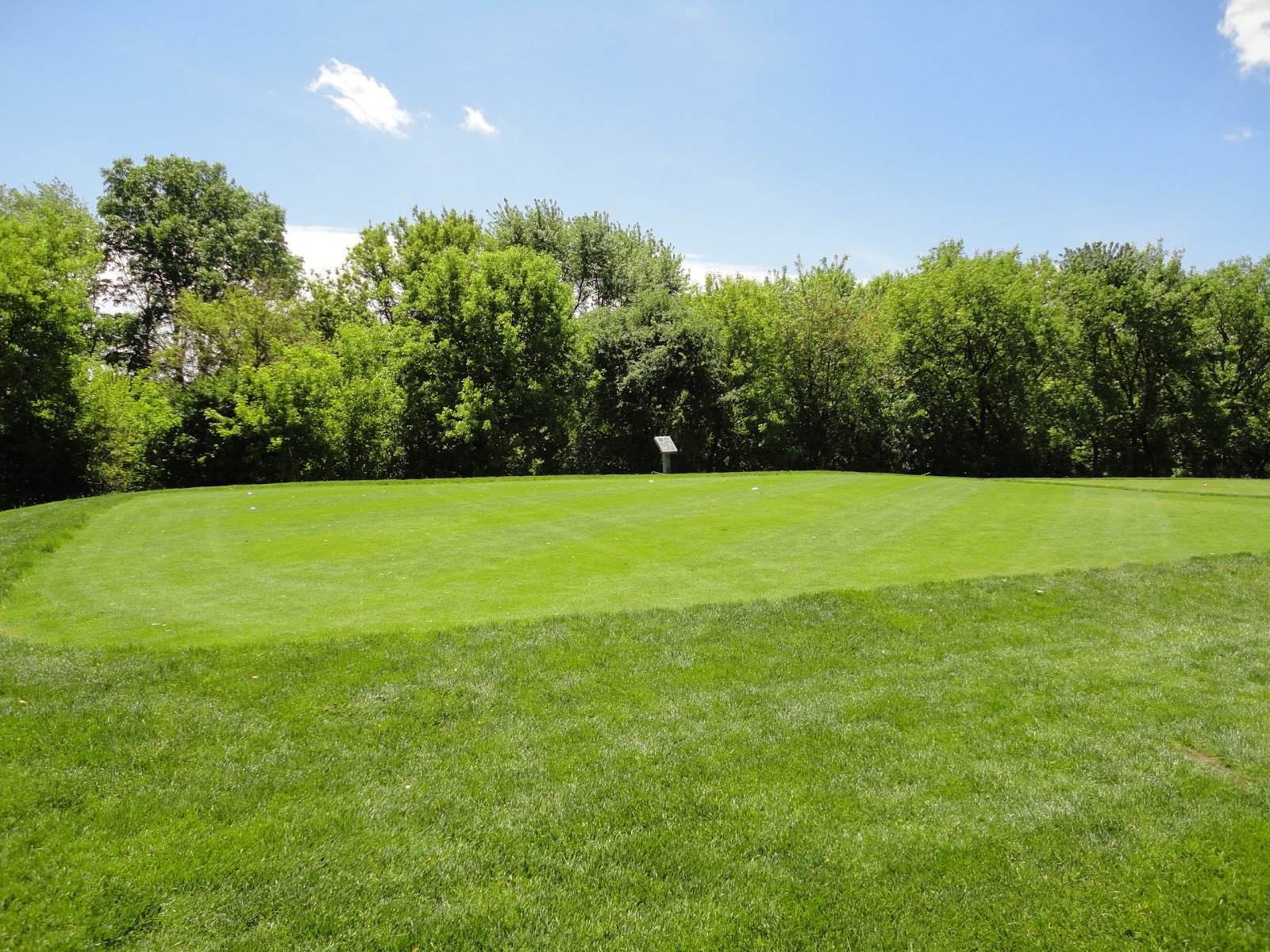
The new Red tee on #1 is also now open. It takes a while to develop soil fertility and culture when starting with a sandy mix. These new tees are undergoing the transition from seedlings to an mature turf system and are still developing root mass and a thatch layer. Some have commented on how firm they can be when dry. This will go away in time with aerification and normal maturation processes.
Tuesday, April 19, 2011
Rain Days
People often wonder what golf course workers do when it is raining. Well . . . it's been raining this April so I can answer that question! Rainy days actually serve an important function for a golf course crew. I always keep a couple "rain day" jobs on the back burner until there is a suitable day to get them done. In fact, if it never rained, I think I would have to create "virtual rain days" where the crew stays off the course and focusses on other projects.
Here's what we've been up to on the past few rain, or snow, days:
Over time, fiberglass bunker rakes start to fade and splinter. They last longer than the old aluminum handles that would kink and bend, but nobody likes fiberglass splinters. Paint doesn't stick for long, so we decided to use a product called Vinyl Guard to refurbish the rakes. Vinyl Guard uses a heat shrrinking process to put a permanent protective coat on the handle. For a couple bucks per rake, they are like new.
The Pump House
We are in the process of making some repairs to the irrigation pump system. Over the past week, we have been disassembling and inspecting all the components of the system. Most of the piping will be replaced due to its age and condition but some elements can be refurbished.
Particularly interesting has been the "mystery of the bladder tank"! We have never been able to figure out the manufacturer or model number of our tank because there are no markings. We also weren't exactly sure if it was working properly or not (we suspected not).
The red tank in the following pictures is supposed to hold an inflated air bladder that buffers system pressure and protects the pumps from excessive starts and stops. It is important to maintaining the system's health and longevity. Unfortunately, the air cavity was slowly leaking pressure and had been contaminated with water and sludge. The tank weighed at least 800 pounds in its waterlogged state so our mechanic had to do some rigging to move it. Using a combination of chainfalls, sleds, chains, and rollers, he moved the tank out of the pumphouse without breaking a sweat.
With the tank at the shop, it was time to investigate. Many of these tanks are repairable if you can find the manufacturer and replace the "bladder" inside. We carefully removed the flanges and drained the air compartment of water so we could take out the bladder. Here is what it looks like:
After a lot of searching, we found the slit that was leaking. Unfortunately these are not patchable. They have to hold 120 psi while expanding and contracting constantly so they have to be in one piece. We had to consult with a few experienced pump contractors to figure out the manufacturer. After calling the manufacturer, we determined a replacement bladder is available. Now we have the option to replace the bladder and rebuild this tank instead of buying a whole new tank. Neither option is exactly "cheap" but the mystery has been solved!
 |
| A View from the Maintenance Building |
- 3-hour Spring Safety Training and Staff Meeting
- 1 worker fixed ball marks in the rain
- 1 worker changed course set up so that we can catch up on mowing when it drys out
- We disassembled most of the pumphouse in preparation for some repairs
- Refurbished 50 bunker rakes with Vinyl Guard
- Investigated the mystery of the bladder tank (see below)
- Cleaned shop
- At the moment, the crew is helping me do an alpha sort and file of receipts and PO's from 2010. I meant to do it over the winter but, you know, didn't get around to it.
- Blog!
Over time, fiberglass bunker rakes start to fade and splinter. They last longer than the old aluminum handles that would kink and bend, but nobody likes fiberglass splinters. Paint doesn't stick for long, so we decided to use a product called Vinyl Guard to refurbish the rakes. Vinyl Guard uses a heat shrrinking process to put a permanent protective coat on the handle. For a couple bucks per rake, they are like new.
 |
| Jimmy's favorite job |
 |
| Some of our "new" bunker rakes |
We are in the process of making some repairs to the irrigation pump system. Over the past week, we have been disassembling and inspecting all the components of the system. Most of the piping will be replaced due to its age and condition but some elements can be refurbished.
 |
| Irrigation system components up for replacement |
 |
| Definitely in the "replace" pile |
The red tank in the following pictures is supposed to hold an inflated air bladder that buffers system pressure and protects the pumps from excessive starts and stops. It is important to maintaining the system's health and longevity. Unfortunately, the air cavity was slowly leaking pressure and had been contaminated with water and sludge. The tank weighed at least 800 pounds in its waterlogged state so our mechanic had to do some rigging to move it. Using a combination of chainfalls, sleds, chains, and rollers, he moved the tank out of the pumphouse without breaking a sweat.
 |
| The tank on a "sled" with rollers |
 |
| Out the door and in the air |
 |
| Pressure tank bladder |
Sunday, April 3, 2011
Spring Green-up
Spring is coming slowly but surely! We have had a cooler March than last year, but April is here. In 2010, we had some unusually warm days early on. April 1 and 2, 2010, were over 80 degrees! We haven't had any really warm days yet, but temps are climbing gradually and turf is starting to respond.
Here is a pair of photos that illustrate how different each year can be:
April in 2010 was unusually warm early on, so we're not complaining. We're just looking forward to those 70 degree and sunny days that are on their way.
Here is a pair of photos that illustrate how different each year can be:
 |
| March 31st 2011 - Starting to warm up |
 |
| April 2nd 2010 - 80 degrees and green already |
Tuesday, March 22, 2011
Drainage Project under Cart Path on #1
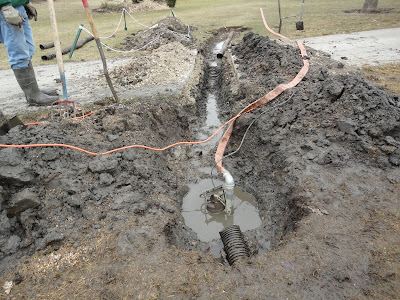
As part of our continuing effort to improve drainage on the 1st hole, the maintenance crew repaired a drain under the cart path. Last fall, we added some lines by the sandtrap on the right (Click here for more on that project). This year, we are fixing the bottleneck under the cart path on the left. Many years ago, the addition of the cart path interrupted surface flow to the creek and crushed a couple 4-inch drain lines. The one functioning 4-inch line in this low spot is not capable of collecting and moving all the water to the other side of the path.
Here is a picture of the problem area:

After some investigation we found that the line was partially crushed slowing down drainage. At the time this picture was taken, the rest of the course was dry and it had not rained or snowed for days.
We could feel an obstruction under the path with a hose, so we decided to cut the path and fix the problem:

Here we start excavating the drain line. The curve in the line is the result of going around a large rock that we eventually removed:



Here is a picture of the problem area:
After some investigation we found that the line was partially crushed slowing down drainage. At the time this picture was taken, the rest of the course was dry and it had not rained or snowed for days.
We could feel an obstruction under the path with a hose, so we decided to cut the path and fix the problem:
Here we start excavating the drain line. The curve in the line is the result of going around a large rock that we eventually removed:


We decided to replace the pipe with a section of 6-inch solid PVC that we had on hand from another project a few years ago. To do this, we had to make the trench deeper and dig holes for 2 large catch basins.
Here is the structure we installed before backfilling:

And after some backfilling:

This is the first step in the project. Now that we have a good route under the cart path, we can run drain lines to it to dry up the area. Before, we had no way to drain the water to a lower point.
Obviously, the area still needs to be finished and seeded. I will post a "finished" picture below once the grass starts growing (looks like we are going back to freezing temps for a while) . . .
Sunday, March 20, 2011
Golf Course Management Blogging World

I just ran across a great resource for anyone interested in golf course management and maintenance. Golf Course Management Blogging World will save me the trouble of having to search for all of the blogs out there and "Follow" them. Not only does the site list a lot of resources, but it contains a snippet from the blogs' latest post. Thanks to whoever put this together -- I couldn't find the author mentioned. This will save me a lot of time. Instead of making sure I'm following all these blogs with a newsreader, I'll just check this site.
There are two other handy lists of golf blogs that I use frequently. They are a great source of real world information about golf course maintenance and management. Do you want to know how greens are maintained at various courses? Wondering about course conditions in a certain region of the country? Ever think "How did they do that"? I know I have. These sites are a great place to find the answer.


Thanks to all of these sites for including Sugar Creek!
Saturday, March 19, 2011
Frost Season 2011
 |
| Did it snow? No. Just frost. |
Click here for more information and a video about frost delays.
When we have to delay play due to frost at Sugar Creek, we place signs around the putting green and clubhouse to alert golfers of the condition.

Click here for pictures of frost damage.
If you watched golf this winter, you may remember the Phoenix Open in Scottsdale, Arizona this February won by Mark Wilson . Frost delays forced the PGA tournament to finish on Monday instead of Sunday. The frost delays were unusual for Arizona, but we are very familiar with them in the Chicago area. The winner of the tournament, Mark Wilson, is from Wisconsin and lives in Illinois. Could his familiarity with cold mornings and frost delays have given him an edge over others in the field?
Dealing with frost delays takes a lot of patience from golfers and staff. As always, we appreciate the understanding of golfers while we wait for the frost to lift.
Thursday, March 17, 2011
Turf Notes: Annual Bluegrass and Winter Hardiness
Compared to last year, it looks like we will have only limited areas of winterkill this spring. In 2010, a long period of snow cover and a long period of freezing and thawing of ice sheets resulted in a lot of lost annual bluegrass (Poa annua). We sodded the worst areas and slit seeded the rest. For pictures from 2010, see "7th Fairway- Update."
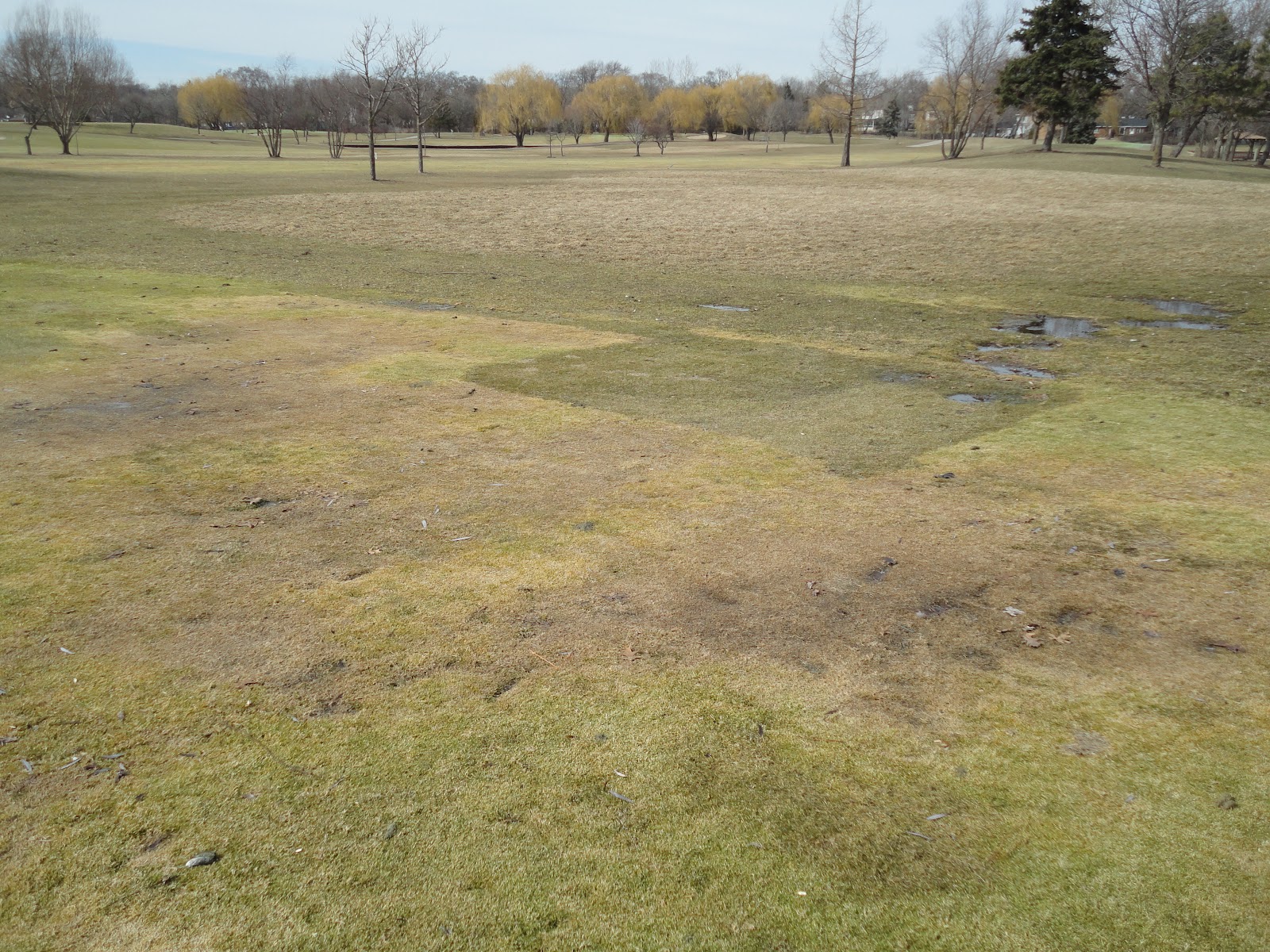
If you see any strange patterns or lines in the fairways this March or April, it may be areas sodded with bentgrass in 2010. Pictures like the ones below really illustrate the weaknesses of annual bluegrass compared to creeping bentgrass or Kentucky bluegrass.
These areas have 2 problems that go together: poor drainage (they are naturally low and almost flat) and poor turf species. While it will take a combination of approaches to improve these areas of the fairways, I am glad to see that bentgrass is capable of surviving the winter in these difficult spots. It shows that keeping up with our current strategies will improve these areas in the long term.
Right now, you can really see the contrast between different grass species and their reaction to cold temperatures. Unfortunately, most of the brown areas around our sod from 2010 will green up with warmer temperatures. I say "unfortunately" because it would be a lot easier to get rid of annual bluegrass if it would die off and stay dead. Its persistance is amazing. It will die in a heartbeat in the winter and summer and re-germinate just as fast in the spring and fall.
 |
| Sodding areas of the 6th fairway in 2010 |
 |
| Bentgrass sod design on 6 fairway |
 |
| Another square on 6 fairway from 2010 |
 |
| Creeping bent on the left -- Annual bluegrass on the right |
 |
| Large square sodded in 2010 |
Right now, you can really see the contrast between different grass species and their reaction to cold temperatures. Unfortunately, most of the brown areas around our sod from 2010 will green up with warmer temperatures. I say "unfortunately" because it would be a lot easier to get rid of annual bluegrass if it would die off and stay dead. Its persistance is amazing. It will die in a heartbeat in the winter and summer and re-germinate just as fast in the spring and fall.
Monday, March 14, 2011
The Golf Course is Open
With the rising temperatures, golfers have started coming out in increasing numbers. We had our first significant amount of rounds on Sunday. This week looks to be a good one for golf.
If you would like to golf, we are open and the course is looking and playing well for this time of year. The maintenance crew has been busy cleaning greens, tees, and fairways and finishing our winter tree work. The grass isn't growing yet, but it looks like spring is just around the corner.
You can always check availability or make tee times at our website (Click here).

If you would like to golf, we are open and the course is looking and playing well for this time of year. The maintenance crew has been busy cleaning greens, tees, and fairways and finishing our winter tree work. The grass isn't growing yet, but it looks like spring is just around the corner.
You can always check availability or make tee times at our website (Click here).

Tuesday, March 8, 2011
Soil Temperatures Since 2005
Over the winter, I had the opportunity to gather and analyze some climate data from the past decade. One chart in particular I thought interesting enough to share with the golf and turf community. The following chart summarizes average soil temperature at a 4-inch depth from 2005-2010. It confirms what superintendents and golfers already know: 2009 was an unusually favorable year for cool-season turf, and 2010 unusually unfavorable.
The peaks of the trendlines are about 5 degrees apart. That is a huge difference, especially considering that our major turf species prefer soil temperatures well under 70 degrees. A trend of average soil temperature over 75 degrees is a difficult summer, especially for Poa annua.
I fully admit that I produced this chart to put my mind at ease! 2010 was my second year as a superintendent and I needed some scientific confirmation: Yes, there was something very different about 2010 -- and it doesn't happen every year. The take-away message of 2010 for me: Superintendents have to work to make improvements during those "easier" years to get as much turf as possible through those tough years.
 |
| Click on image for a larger view |
The peaks of the trendlines are about 5 degrees apart. That is a huge difference, especially considering that our major turf species prefer soil temperatures well under 70 degrees. A trend of average soil temperature over 75 degrees is a difficult summer, especially for Poa annua.
I fully admit that I produced this chart to put my mind at ease! 2010 was my second year as a superintendent and I needed some scientific confirmation: Yes, there was something very different about 2010 -- and it doesn't happen every year. The take-away message of 2010 for me: Superintendents have to work to make improvements during those "easier" years to get as much turf as possible through those tough years.
Tuesday, March 1, 2011
Thawing and Freezing
Since the snow has mostly melted, we have been assessing the health of our turf coming out of winter. Last year, I wrote about the factors that influence turf health coming out of winter in Good or Bad Winter for Turf and A Long, Difficult Winter for Turf. As it turned out, we had to do a lot seeding and sodding last April to repair ice damage in the fairways. After a tough summer in 2010, it would be nice to have favorable conditions for turf growth this spring.
Like most golf courses, we have a few areas that tend to weaken or die over the winter. About every other year, the 7th fairway exhibits significant ice damage. My theory is that this ice damage is caused by crown hydration of mostly Poa annua during freeze/thaw cycles. During our last thaw after the first of the year, the grass plants appeared healthy. While it is difficult to assess health during the winter, ice damaged plants often take on a mushy, soupy texture due to their ruptured cell walls. This month's freezing and thawing are starting to concern golf course superintendents, but I am still hoping we will have less damage than last year when the ice didn't melt until the middle of March.
On February 28th, the fairways were covered in ice after a heavy rain. Luckily most of the ice has melted and drained overnight.
Here are two spots we are watching closely:
In 2010, we tried to improve the drainage in these areas and re-seeded them with creeping bentgrass. Because bentgrass has a greater tolerance for ice cover and cold temperatures than Poa annua, we are hoping to see less ice damage this year in the places where the bentgrass took. More improvements will need to be made to drain these areas more quickly, but planting a hardier species should help these areas survive the winter in the meantime.
Besides these areas, the turf is looking good after a snowy February. Our newly planted tees are looking healthy and the greens are free of snow mold.
Like most golf courses, we have a few areas that tend to weaken or die over the winter. About every other year, the 7th fairway exhibits significant ice damage. My theory is that this ice damage is caused by crown hydration of mostly Poa annua during freeze/thaw cycles. During our last thaw after the first of the year, the grass plants appeared healthy. While it is difficult to assess health during the winter, ice damaged plants often take on a mushy, soupy texture due to their ruptured cell walls. This month's freezing and thawing are starting to concern golf course superintendents, but I am still hoping we will have less damage than last year when the ice didn't melt until the middle of March.
On February 28th, the fairways were covered in ice after a heavy rain. Luckily most of the ice has melted and drained overnight.
Here are two spots we are watching closely:
 |
| Draining areas on 7 fairway |
 |
| Melting ice on 6 fairway |
Besides these areas, the turf is looking good after a snowy February. Our newly planted tees are looking healthy and the greens are free of snow mold.
Wednesday, December 8, 2010
Saturday, November 27, 2010
Tree Trimming and Buckthorn Removal on #7
Now that the grass has stopped growing, it is tree trimming season again! Last week, we started work on some trees that were resulting in some unfair tee shots on #7 and some buckthorn that was encroaching on the course from the fenceline. A few overhanging branches were rendering the back of 7 tee almost unusable during the season. After removal, the health of the tee will also probably improve due to increase sun exposure.
You can see from this photo that the view from the tee will be significantly improved in 2011:
You can see from this photo that the view from the tee will be significantly improved in 2011:
 |
| 7 Tee |
Last winter, I wrote a post about buckthorn that answers many questions about the undesirable nature of this plant (Link to article). In addition to the ecological reasons for controling buckthorn, this fenceline in particular often resulted lost balls. Lost balls ofen cause slow play so we began our winter buckthorn removal here.
 |
| A portion of the fence line cleared |
 |
| Buckthorn along 7 fence line |
Subscribe to:
Posts (Atom)


