Sunday, June 13, 2010

Pictures from May 2010

Here are some recent photos from this year.  If anyone has a favorite, please leave a comment and I will add it to the Slideshow!  You can click on the pictures for a larger version.


Sunday, June 6, 2010

Rain Storms

On Saturday, June 5th, we experienced a 2" rainfall in less than 30 min.  As I mentioned in a previous post, this really wreaks havoc on the sand traps and lower areas of the course.  The rest of the golf course is wet but undamaged.

Check out Sugar Creek's Facebook page for some photos from just after the down pour (Click here).  If you ever wondered what the golf course looks like right after a storm, here is your chance to find out!

Monday, May 24, 2010

How to Fix a Ball Mark

Have you ever been involved in a heated debate about the best way to fix a ball mark?  I know I have!  In general, superintendents would prefer that golfers use any method as opposed to doing nothing, but there is a method endorsed by the golf community that is considered the official way. 

Here are some quick facts on ballmarks:
  • Unfixed ball marks result in an uneven and scarred putting surface
  • It is the responsibility of every golfer to fix at least their own ball mark
  • It can take 2 or 3 weeks for an unfixed ball mark to heal
  • Fixing ball marks vastly improves the putting surface for everyone
The best way to fix a ball mark

When I first started golfing in grade school, I assumed the best way to fix a ball mark was to use a tool to pry up the middle of the indentation.  This seems logical but it can result in torn roots and more recovery time.  The best way is the "twist" method endorsed by the Golf Course Superintendents Association (GCSAA). 

Here is the secret:  Your goal is to stretch the undamaged surface back into the depression, not to lift the depression by prying.  The putting surface is actually a fairly elastic thing.  Ball impact pushes the surface out to form the ridges around the depression, so you can fix it by stretching the surface back in.  In the process, the indentation or depression should flatten out.

Here is a graphic from the GCSAA.  Please click the image for a larger image:


I think many people are reluctant to try this method because it is difficult to visualize.  As a result, many golfers may not attempt to fix their ball marks because they are afraid of doing it the "wrong" way.  I am going to go out on a limb and say "If you have a method that works for you and results in a puttable surface, go for it!"  If you don't, try this method.  You may be suprised by how easy it is.

Sunday, May 16, 2010

Sunrise at Sugar Creek


Cart Path Restrictions

After heavy rains, golf courses often have to restrict cart traffic.  There are generally two types of restrictions: no carts available or cart path only.  We do this to limit damage to the course and ensure playability for the season. 

The following is from the Golf Course Superintendents Association:

For the sake of your golf course, remember that golf car traffic can cause damage to the golf course that is both unsightly and expensive to repair. Tire ruts in soft, wet areas can take weeks to heal. Compaction caused by heavy traffic can ruin the playing surface. As a result, most courses have a standard golf car policy and sometimes employ temporary restrictions due to weather, construction or other factors.

Golf course superintendents only put restrictions such as "Paths Only" rules in place when they feel it's necessary to protect the turf from damage. (GCSAA Article)
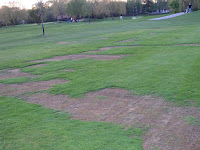
After the heavy rains Thursday, we had to restrict carts to paths only for two days.  During that time, we had some golfers stray from the paths with visible results. 

The pictures below show why we occasionally have to restrict cart usage:


As a superintendent, I really dislike having to restrict cart usage to the paths but you can see why it is important.  Imagine if 10 people decided to go off the path instead of the 2 or 3 that probably did.  If the areas you can see in the pictures were driven over multiple times, these areas would be damaged for weeks or even months. 

To summarize, cart path restrictions are put in place by the people who really know the condition of the golf course and they are for every one's benefit.  Just like frost delays, no one likes them -- but they are necessary for the health of the course.

Update: May 15, 2010

After a relatively warm and dry April, the first half of May has been a little cool and wet.  Many golf courses flooded last Thursday, May 13th.  The average rainfall for May 1-13 is 1.5 inches and we have seen around 4.5 inches at Sugar Creek (WGN).  Areas north of us have seen even more. 

At Sugar Creek, we were fairly lucky.  The water rose on Thursday morning after the thunderstorms but receded by the end of the day.  With some modifications to our normal mowing schedule due to wet conditions, we were able to have the course in good shape on Friday for an outing. 

One of the mosts time consuming jobs after a thunderstorm is fixing sandtraps.  After a good downpour, the sand from the upper parts of the traps wash down and the traps are filled with water.  Drains in the sandtraps will remove the water eventually but not immediately.  To make the traps playable quickly, they need to be pumped, resculpted, and raked.

On Friday morning, our traps looked like this:


Or like this one that has already been pumped out:


Pumping, pushing up sand, and raking takes at least 2 people from 30 minutes to an hour per trap, depending on thier size.  It can take a couple days to restore the traps to thier usual state, or more like this:


Excessive rain also interupts our mowing schedule temporarily leading to some catch-up work when it dries out.  However, adjusting the mowing schedule is not nearly as time-consuming as sand trap restoration.

Saturday, May 8, 2010

Frost Advisories

There is a frost advisory for this Sunday morning.  I was hoping we had already seen the last frost, but you never can tell.  I usually check National Weather Service Chicago at http://www.crh.noaa.gov/lot/ for frost and severe weather information.

For information on golf and frost delays, check out Frost Delays on this blog.
Here is the advisory for Saturday night and Sunday morning:

THE NATIONAL WEATHER SERVICE IN CHICAGO HAS ISSUED A FROST
ADVISORY...WHICH IS IN EFFECT FROM 3 AM CDT /4 AM EDT/ TO 8 AM
CDT /9 AM EDT/ SUNDAY.

* TEMPERATURE...OVERNIGHT LOWS TONIGHT WILL DROP TO NEAR 30 AT
SOME SPOTS FROM THE FOX VALLEY...WESTWARD ACROSS NORTH CENTRAL
ILLINOIS. OVER NORTHEAST ILLINOIS...LOWS WILL DROP INTO THE
LOWER 30S BY DAYBREAK...EXCEPT IN DOWNTOWN CHICAGO WHERE
TEMPERATURES WILL HOLD UP AROUND 40. OVER NORTHWEST
INDIANA...WEST TO NORTHWEST WINDS WILL REMAIN ELEVATED UNTIL
LATE IN THE NIGHT...HELPING OVERNIGHT LOWS TO ONLY DROP TO THE
MID 30S.

* IMPACTS...WIDESPREAD FROST IS EXPECTED TO BE A DANGER TO
SENSITIVE VEGETATION ACROSS NORTH CENTRAL AND MUCH OF NORTHEAST
ILLINOIS. THE RISK TO VEGETATION WILL DECREASE HEADING EASTWARD
ACROSS NORTHWEST INDIANA WHERE OVERNIGHT LOWS AND WIND SPEEDS
ARE EXPECTED TO BE A BIT HIGHER...MAKING THE FROST MORE
SCATTERED.

PRECAUTIONARY/PREPAREDNESS ACTIONS...

A FROST ADVISORY MEANS THAT FROST WILL BE A THREAT TO SENSITIVE
OUTDOOR PLANTS LEFT UNPROTECTED.

Saturday, May 1, 2010

Irrigation Repairs

One of the often overlooked responsibilities of a golf course superintendent is plumbing -- not residential plumbing, but high pressure irrigation plumbing.  Over the last two weeks, we fixed 3 leaks on the golf course and replaced our main 6" suction pipe in the pump house.  Click on the picture on the left to see more pictures from this project.

Wednesday, April 28, 2010

Frost Delays


Since we have a frost delay today, I thought I would post some information on frost and frost delays.  No one likes frost delays - maintenance workers especially - but they are necessary for the health of the course.  Golf course employees ask for your understanding during frost delays.  We don't like them either.

Here are some key points from the Golf Course Superintendent Association:
• Frost is basically frozen dew that has crystallized on the grass, making it hard and brittle. A grass blade is actually 90 percent water, therefore it also freezes.

• Walking on frost-covered greens causes the plant to break and cell walls to rupture, thereby losing its ability to function normally.

• When damaged, the putting surface weakens and becomes more susceptible to disease and weeds.

• One foursome can leave several hundred footprints on each green, causing extensive damage.

• A short delay while the frost melts can preserve the quality of the greens and prevent needless repairs.
You can find a more detailed article on frost formation and effects in this article - "The Big Chill"

The following is a video from the USGA:

Sunday, April 25, 2010

Flowering Trees

Many of the Crabapple trees are flowering right now.  Some cultivars are about to open next week.  In this picture you can see a nice old white crabapple with two Saucer Magnolias in the foreground:


Another tree currently blooming is the Redbud (Cercis canadensis).  Here is one blooming nicely behind the 1st tee:


A week ago, the Callery Pears (a.k.a. Bradford Pears) were beautiful.  They have since dropped most of their petals with some help from the rain.  This picture is from April 16th:

7th Fairway - Update

Previous posts on this topic:
Good Winter or Bad Winter for Turf?
A Long, Difficult Winter for Turf
7th Fairway Project

Update - 4/25/2010
The seed planted 3 weeks ago has germinated and started to grow.  In this picture you can see the seed that is filling in the damaged areas:


The maintenance crew also sodded some areas that we know from experience will take a long time to fill in with seed alone.  This should speed up the grow-in time.

You can see some of the sodded areas in this picture:


Most of the areas injured over the winter have filled in or are greatly improved.  These few stubborn spots needed some sod.  With a little more sun and heat, the rest of the seeded areas should fill in quickly.

Sunday, April 18, 2010

New Yardage Markers

Last week, the maintenance crew installed new yardage markers on the course.  The five par 4's are marked down the middle of the fairway every 25 yards from 200 yards out to 75 yards out.  We measured the center of the green back to front and left to right.  Remember that the markers go to the center of the green, not necessarily the pin location.  For pin locations, a red flag means the hole is in the front third of the green, a white flag indicates the middle third, and a blue flag means back third. 

One of our new pop-up yardage markers:


Yardage marker on the 6th hole:


We hope having more visible yardage markers every 25 yards instead of every 50 yards will make it easier to find your distance to the green and lead to more enjoyable rounds at Sugar Creek.

Monday, April 12, 2010

3rd Hole - April 9, 2010


The turf really greened up last week and the willows are flowering. An abundance of catkins (flowers) and growing stems gives them a yellow color this time of year.

Saturday, April 10, 2010

An Interesting Duck

Last week we saw a duck that looks different than any other duck we've seen at Sugar Creek.  After a little research, I think it is a hybrid between a Mallard and a Muscovy duck (that would be Anas platyryhnchos x Cairina moschata).  If there are any duck experts out there, please let me know if I'm on the right track.  Whatever it is, it's an interesting looking duck with nice green and blue colors in its wings.

Check out the pictures below.  You can click on the picture for a larger image.


In this one, you can see that it is much bigger than most Mallard ducks:


If anyone has any information on this duck, please let me know.

Sunday, April 4, 2010

First Flowers of the Year

A Crocus blooming on March 30:


This Corneliancherry Dogwood (Cornus mas) is about to be in full bloom:


The Star Magnolia (Magnolia stellata) are beginning to bloom near the clubhouse:


Soon dozens of species will be in bloom around the clubhouse and golf course.  Our reward for making it through another long winter!

Saturday, April 3, 2010

7th Fairway Project

A few weeks ago, I wrote about some of the turf problems golf courses have been experiencing this spring under "A Long, Difficult Winter for Turf."  Our 7th fairway experienced some crown hydration damage in the late winter.  The maintenance crew has taken many steps to regrow these areas with less sensitive grass species.  Read on to learn more....

Sunday, March 28, 2010

Update: March 28, 2010

We've been waiting a long time to see a forecast like this.  On November 7th and 8th, 2009, the temperatures broke 70 degrees for a fleeting moment, but you have to go back to September of 2009 to find another 70 degree day.  In fact, we haven't seen a stretch of sunny, temperate days since the one that ended on September 19th -- about six months ago.  Let's hope the forecast doesn't change on us!

We have already had a lot of play this March, but I suspect many golfers will play their first rounds soon.  You can always see and book available tee times at our website: http://www.sugarcreekgolfcourse.org/.  As of today, the course is dry enough to allow riding carts without restrictions until further notice.

Monday, March 22, 2010

Update: March 22, 2010

Winter returned briefly last weekend, but all the snow has melted.  The greens and tees are looking good along with most areas of the fairways.  The weather for this week looks a lot better than they were forecasting.  It will be a good week for early spring golf!

Wednesday, March 17, 2010

A Beautiful Day

What a day for March 16th!  The greens were mowed for the first time and are putting well.  The next few days look like more of the same beatiful weather. 

Many golfers came out to enjoy our 9,000 square foot putting green
Not bad for March 16th!
7th Green on March 16th

Sunday, March 14, 2010

Golf Course Opening

Starting Monday, March 15, the golf course will be playable and open.  The rain on Saturday set us back a bit, but the greens and tees are clean and firming up.  After a long winter, the weather starting March 15 looks great!

Did you know that last winter was one of the longest, coldest winters ever?  The Chicago area had 97 straight days under 50 degrees.  By this measure, only 4 winters were worse: 1920, 1945, 1899, and 1979.  You can read about it here (WGN Weather Blog).

Saturday, March 13, 2010

A Long, Difficult Winter for Turf

A couple months ago, I wrote about possible sources of winter damage to turf ("Good Winter or Bad Winter for Turf?").  As of now, we can say it was not an easy winter on any sort of turf -- home lawns or golf courses.  Almost every turf area I've seen has been affected in some way.  What can we do about it?

Wednesday, March 10, 2010

It's Almost Time!

The driving range is now open!  As for the rest of the course, it is getting close.  There is still quite a bit of ice and slush out there.  4 of our 10 greens are still covered in ice and slush.  The maintenance crew has been busy blowing debris (and some ice) off of the greens and tees so that the course will be playable as soon as possible. 

Check back soon for more updates.

8 green with ice -- March 10 -- Should be gone tomorrow

7 Fairway with some ice, melting fast

Wednesday, March 3, 2010

Buckthorn Removal

This plant, Common Buckthorn, is everywhere.  It leafs out early and keeps its leaves well into the fall.  It grows anywhere, and it grows fast.  It can grow 6 feet in one year!  Buckthorn was brought to the United States from Europe and was a popular hedge plant for decades in the 1800's.  With all this going for it, what's wrong with buckthorn?

Sunday, February 28, 2010

Looking forward to spring

It won't be long before this:

4th Hole in February
looks like this:

4th hole in April
Or this:

1st tee in February

looks like this!

1st tee in early April

Friday, February 19, 2010

Recent Tree Removals

Unfortunately, or fortunately for some, we had to say good-bye to two old willow trees this winter.  One was located on the 1st hole near the creek, and the other was to the left of 5 green.  The removal of these trees is one of the changes golfers may notice in 2010.

Tuesday, February 9, 2010

Wildlife Slideshow

One of the best parts of working at a golf course is getting to see interesting wildlife every day. At Sugar Creek, we see great blue heron, white egrets, mallards, and green heron almost every day during the season. These birds especially like hanging out by the bridge between the 5th and 6th hole at sunrise and sunset. For most of the day, they hunt for fish in the pond.

Other animals like coyote, beaver, fox, and even deer are seen more rarely at sunrise. Luckily the beaver has not been seen for 3 years!

Over the past few years, I've been able to capture a decent amount of these animals on camera. There are a lot more smaller mammals and songbirds around that have so far evaded the camera. Keep your eyes open next time you play Sugar Creek. You never know what you might see!


Friday, January 29, 2010

Good Winter or Bad Winter for Turf?

As we get ready for the 2010 golf season, I know a lot of superintendents are asking themselves:  How much seeding and sodding will we have to do this spring?  How well will the turf survive this winter?  Will this turn out to be a good winter or a bad winter for the turf?  How can we tell?

Tuesday, January 19, 2010

Reel Grinding Complete

Annual equipment maintenance is an important project for any golf course maintenance department during the winter months. Our goal is to have all the machines ready-for-action when the season starts. To do this, we perform maintenance according to the machines' service manual, and we try to minimize down-time during the season by anticipating any problems that might occur. In addition to completing annual service on all the traction units and engines, golf courses also have to maintain complicated cutting units.

Here's a look at the underside of one of our greens reel units: