Saturday, July 31, 2010

First Signs of Germination

Friday we saw the first few blades of new grass in the areas slit-seeded Monday.  Germination of bentgrass in 5 days is fast due to high soil temperatures and available moisture.  Today, Saturday, I sighted germination all over #1 fairway.  If you click on the pictures to make them larger, you can see the first fine blades peeking out of the slits:

Bentgrass Germination in Slits
Bentgrass Germination in Slits - Part 2
Saturday morning, we received about 7/10ths of rain.  This will help some areas, but hurt others.  Areas with standing water for prolonged periods may not fair well.  Luckily, it is forecasted to be a cool day topping out at around 80.  Last night was also a cool 65 degrees which lowered soil temperature significantly. 

The rain soaked a few areas more than I would like.  I'm seeing good germination in areas with moderate soil moisture -- say halfway up a hill.  The areas with puddles are having difficulty.  Rain is not always our friend.  Most of the time, we would prefer to supply the moisture ourselves.  Here is a low-lying area that is problematic:
Soaked area on #1 Fairway - No germination yet
It is not a coincidence that the areas with puddles are the areas that died in the first place.  These areas "cooked" in mid-July when the surface water and high temperatures lead to the death of Poa annua.  For more on this phenomenon, see "Turf Notes: Summer Decline of Annual Bluegrass".

Overall, we are happy to see some germination on this fairway.  I would expect to see some of the tees start germinating in the order that we seeded them last week.  I'm guessing we may see some action on #4 and #2 tee by Sunday or Monday.  We are looking at some 90 degree days next week so some mid-day watering will need to be performed.  The trick now is keeping the seedlings alive!

Tuesday, July 27, 2010

Slit Seeding in Progress

Before the flood, I wrote about the problems with annual bluegrass, or Poa annua, that golf courses have been experiencing this summer.  We started work on this problem today.  Our first step is to slit seed the tees and fairways with bentgrass.  Some areas, like the par-3 approaches, already have a significant Penncross population so we will focus on the areas that do not.

With a lot of care and some luck, we should be able to get some good germination in less than a week.  Seeding in the summer can be difficult, but since the annual bluegrass is weak at this time we should be able to "get the jump on it" with bentgrass.  If we waited for cooler temperatures, the annual bluegrass would germinate and outcompete our new bentgrass seed.  The drawback to seeding bentgrass in the summer is the likelihood of "damping off" which we will have to watch for.

One of the advantages of slit seeding is the minimal disruption to play it causes.  Many areas can be slit seeded without any obvious effect.  Areas with patches of declined annual bluegrass will show the slits for a while before they close up or germination occurs.

Slit seeding the fairways
Here is a spot on the tees:


Some areas we will have to do more than slit seed, but a slit seeding program will help most of our problem areas greatly.  I will update when germination occurs!

Update on the Flood

The ground is drying out fast after the flood last weekend.  We were lucky the water went down fairly quickly.  The maintenance crew has now fixed all the sand traps and mowed almost all the rough.  The course is starting to look like normal.

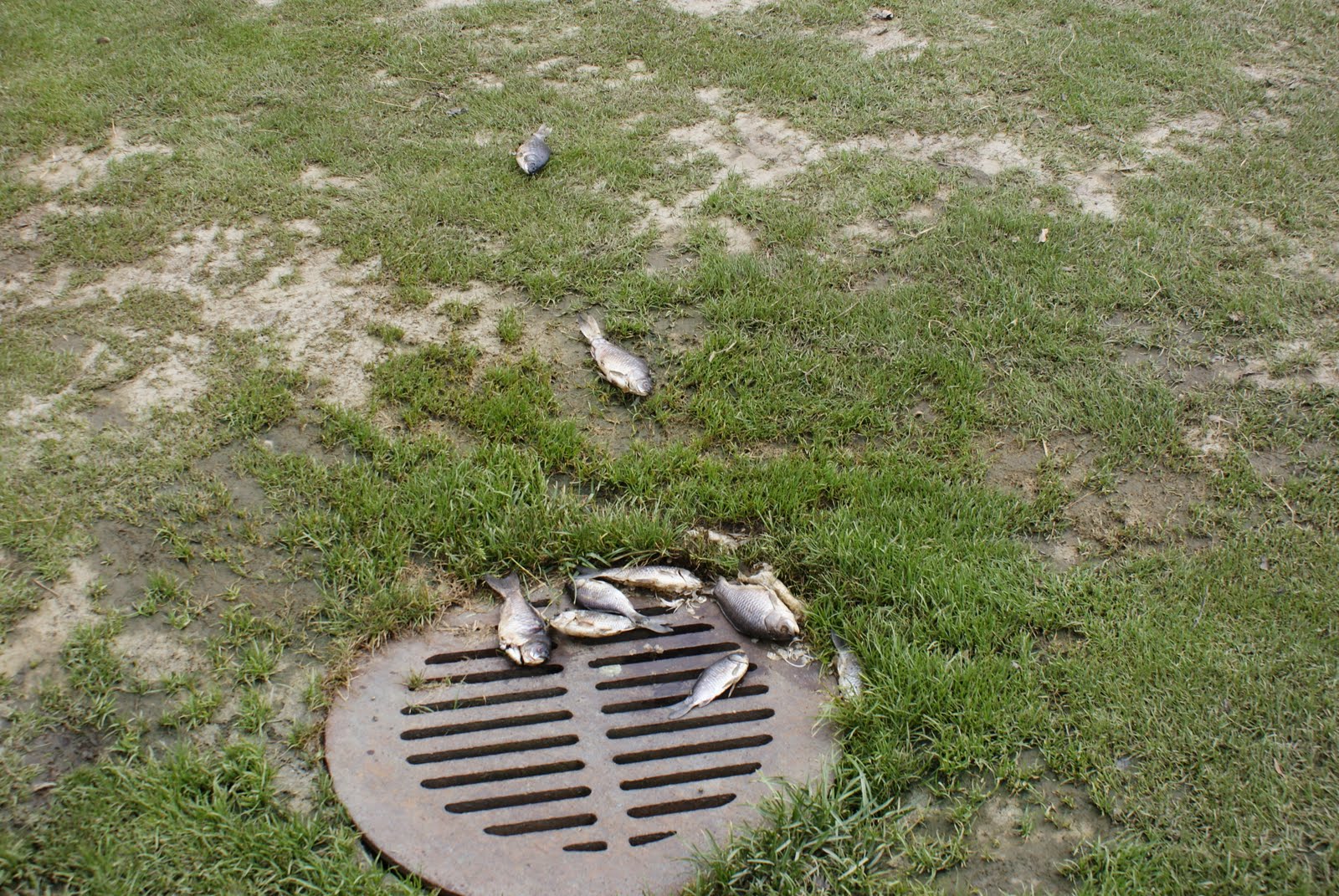
Loads of debris were removed after the flood, but we still keep finding things where they are not supposed to be.  One of the most unpleasant jobs of flood cleanup:  Fish duty!  (See photo below)


Don't worry.  They have been removed!

Sunday, July 25, 2010

Flood Pictures from July 24, 2010

On Friday night and Saturday morning, our area was hit by heavy storms and flooding . . . again.  With some trouble due to closed roads, the maintenance crew arrived at the course to find our 5" rain gauge already full at 5am.  In all, we had around 7" of rain overnight.  According to a neighbor, the water almost reached 1987 levels. 

Storm Total Map from National Weather Service shows Villa Park from 6-8"
As of this post, the water has left the course except for a some puddles.  Much of the debris has been picked up.  The evidence of the flood is still apparent in the fine layer of silt on the turf in some areas and the serious damage to the sand traps.  We expect to be open on Monday.

For the curious, here are some pictures of the flood.  While it was a sad scene, we couldn't help but be impressed by the power of Mother Nature at times like these:

First Fairway
First Green in the distance
The 3rd Hole with extra water hazard
7th Fariway underwater
#6 Redesigned with an island tee
#1 Green - later in the evening
Later in the evening - #4 still underwater
You can tell the tee was underwater at the peak of the flood
One of the problems with flooding:
Sand being carried downstream with the water from #6 green

Tuesday, July 20, 2010

Turf Notes: Summer Decline of Annual Bluegrass

So far, 2010 has been very different than 2009 or 2008 for turf managers.  2010 soil tempuratures have been on average 10 degrees higher than 2009.  The same goes for air tempuratures and humidity.  We have also experienced extreme fluctuations in moisture - excessive rain followed by dry periods.  While most turfgrasses can handle this sort of stress given decent soil conditions, there are a few that can't.  The most notable being annual bluegrass, or Poa annua:


Photo: University of Kentucky Annual Bluegrass Profile

Introduction
Most turf is composed of different species of grass, unless it is a new construction planted as a monoculture.  In most older golf course fairways, you can observe different types of bentgrass, Kentucky bluegrass, rye, Poa annua, and Poa trivialis all within a 500 square foot plot of turf.  This has some benefits.  Often when one species declines, another will take over.  It is the transition period that causes problems for turf managers.  Of the above listed species Poa annua (annual bluegrass) is the most problematic.

The life cycle of annual bluegrass is important to understanding its summer decline.  Annual bluegrass grows aggressively in spring and germinates aggressively in fall.  Summer and winter are its weak points.  It does not survive cold temperatures or ice cover like perennial species, and it is genetically programmed to die during the summer.  Some years, like 2009, it survived all year under cultivation (like at a golf course).  This year, its weaknesses are more clear.  Unlike creeping bentgrass or Kentucky bluegrass, annual bluegrass does not have a physiological mechanism like dormancy for dealing with heat stress.  It doesn't have to since it relies on seed to perpetuate the species. 

Turf managers often look at soil tempurature to determine the likelihood of turf stress.  Significant root growth stops at 70 degrees F in cool season grasses, and completely shuts down at 80 degrees.  Turf is in serious trouble at 90, especially annual bluegrass.  Our soil tempuratures at the 4" level have been reaching 84 degrees with surface temperatures over 100 degrees some days.  In the presence of water, this leads to scald or wet wilt.  According to Dr. Beard, a well-known turf expert, "cool-season grasses - such as bentgrasses (Agrostis spp.) and annual bluegrass (Poa annua) - are physiologically adapted to optimum growth at temperatures of 60 to 75 degrees F. Even so, cool-season grass species demonstrate various capacities for heat resistance, ranging from medium for grasses such as Kentucky bluegrass to very poor for annual bluegrass and rough bluegrass, among others."  See his article "Dealing with heat stress on golf course turf" for a great discussion of summer decline.

A lot of factors contribute to the growth of annual bluegrass in fairways.  Low mowing heights allow annual bluegrass to invade other types of grass, along with irrigation, fertilization, and low areas with poor drainage.  A 2.5 inch bluegrass lawn is in little danger of being invaded, but it is inevitable on a 1/2 inch fairway.  In a classic turfgrass catch-22, a lot of golf course maintenance practices like mowing, fertilization, and irrigation even when done right allow annual bluegrass to survive making the situation worse, not better. 

Recent Case Studies
At Sugar Creek and many area golf courses of similar construction, a lot of Poa annua declined over the last two weeks.  We had an abnormally wet June followed by a dry period.  Often turfgrass benefits from rainfall, but not in excess.  The prolonged wet, warm period encouraged shallow rooting in many low-lying areas.  During the period from July 6th to the 13th, it rained here every day but one including a soaking 1" rainfall on the 11th.  The turf did not have a chance to dry out before we had 5 days of 90 degree temperatures from July 14th to 18th.  Solar radiation plus excessive moisture plus high soil temperatures = "physiological decline of Poa annua."  Another fancy term for it is "necrosis due to abiotic environmental factors."  Many superintendents like myself prefer a simpler term: "It baked."  The Poa baked on certain tees and fairways in areas with saturated soil.  The spike in soil temperature literally cooks the cells of the plant.  Often when we see brown grass, our first instinct is to put water on it.  That is why you may see superintendents using soil probes to determine if the stress is caused by too little water or too much.  More often than not, the cause is too much water.

While these areas of Poa annua are suffering right now, they will come back from their own seed once soil temperatures go down and the days shorten.  That is what they are genetically programmed to do.  Looking back at photos from 2005, another rough year for turf, the same areas suffered during the summer but came back quickly in September. 

Through the following pictures, I'll try to give my diagnosis and answer that important question: "Why did that grass die?"

#4 Tee

Back tee on the 4th hole:  This tee is somewhat shaded with inadequate drainage.  It is, or was, mostly comprised of Poa trivialis (Roughstalk bluegrass) and Poa annua (annual bluegrass).  The green turf is the Roughstalk bluegrass which is only slightly more heat tolerant than annual bluegrass.  I watched the Poa annua on this tee decline over the course of 1 day on July 14th.  There were no signs of disease or other causes and the surface moisture under the turf canopy was hot to the touch. 

Diagnosis: Scald of Poa annua.  From "Understanding Wet Wilt" by Dr. Peter H. Dernoeden: "On sunny days when air temperatures exceed 90°F, the temperature in the upper 2.0 inches of wet soil can range from 95°F to 100°F. These conditions led to root dysfunction and/or a rapid loss of roots."  And later: "Indeed, turf almost literally 'cooks' in hot and wet soils.  Affected greens initially appeared brownish and water-soaked. Turf soon thinned out in irregular shapes, but damage often followed the natural drainage pattern of the green." 

#5 Tee

The 5th tee was sodded in 2003 with a low-mow cultivar of bluegrass.  Unfortunately, the soil settled and created a drainage problem.  With low mowing heights and excess water, Poa annua took over this tee.  Over the years, we aerified, topdressed, and seeded  frequently to try to improve the situation, but to no avail.  You can see some algae growth on the scalded Poa annua which died in the presence of water on the same days as the 4th tee -- July 14th through the 18th.

Here's a soil plug from July 19th:


It is difficult to tell from the photo, but the soil was still moist even after several days of drying.  You can see the layer of top dressing to the left of the photo.  Even with this layer, areas of the tee are still lower than the rest causing water to sit there for long periods. 

Diagnosis:  Scald of Poa annua.  Again.

#1 Fairway


This area is often soaked after rains.  There is only about a foot of elevation difference between here and the creek and the contour is not consistent.  There are ridges that hold the water here for extended periods.  The interesting part of this photo is not the what went wrong but what didn't go wrong.  Why did some patches survive and others did not?  They had the same soil conditions, moisture levels, fertility and maintenance.  What is different about them?  The answer is genetics.


This isolated patch of creeping bent clearly illustrates the difference between the two grasses.  Even though this patch is not an intentionally seeded cultivar - it simply drifted here on its own - it was able to take what nature threw at it while the annual bluegrass could not.  Due to the grading of the fairway, this will always be tough spot to grow grass, but this photo indicates to me that bentgrass would be a better species for the area than Poa annua.  While it is difficult to establish turf during the summer months, slit seeding some bentgrass just might increase the percentage of quality turf in the area.  Once fall hits, the annual bluegrass will germinate with a vengeance and fill in the remaining area.  It's a never ending battle. 

Further Reading

Recent turf reports from the Chicago District Golf Association address this issue: See July 16 - From this report: "Even if we do everything correctly, Mother Nature may not play fair. I am sure we will have issues, but to what extent it is hard to say.  Clearly Poa annua, which does not like hot weather, will die."

WARM (Water and Atmospheric Resources Monitoring Program) - This site tracks soil temperature and evapotranspiration in Illinois.  I use it all time as a resource before going out and taking local readings. 


Search the USGA Green Section Record for "annual bluegrass" to find everything you would ever want to know about Poa.

Wednesday, July 14, 2010

Junior League Superintendent Demonstration Day

Thanks to the efforts of our golf pros and staff, we have a very popular Junior League at Sugar Creek.  Juniors are introduced to everything from putting technique to course etiquette.  This year, we added a new element to the program involving the superintendent and course maintenance. 

During a 15 minute talk, I had an opportunity to explain the basics of course maintenance, show the junior golfers the greens mower, demonstrate how to fix a ball mark, and answer questions.  I think it was as fun for them as it was for me.  It's never too early to start educating golfers about what they can do to become part of the golf course community and improve playing conditions for themselves and other golfers. 

The most commonly asked question:  "How fast does that thing go?"  I think they were a little disappointed when I said 3 miles-per-hour! 

Here's some photos of the demonstration:


Saturday, July 10, 2010

Update: July 10, 2010

Over the last month, we have really seen some ups and downs in moisture.  After a wet June, we had a very dry week, then a little more rain.  For a while, it seemed like the maintenance crew was pumping and reconstructing sand traps almost every day.  See Update: May 15, 2010.  I am happy to say we are back in what I call the "sweet spot" - not too wet and not overly dry.  We have been having some beautiful golf weather.  More pictures and articles to come . . .

Thursday, June 24, 2010

Ring of Fire Storm Pattern

If you are like me, you may have been asking yourself lately "What is going on with all these storms?"  I found a good explanation on Tom Skilling's blog.  He calls it the "Ring of Fire" pattern.


For more on the recent storms and their cause, check out Skilling's article.

A Storm and a Flash Flood

It has been a wet and stormy June so far.  Wednesday, June 23, we experienced a severe thunderstorm with high winds.  Our rain gauge collected 2.5 inches in less than an hour.  The maintenance crew has been working hard to clean up all the debris left by the flash flood and all the branches damaged by wind.  The course is now playable but without riding carts for the time being.

Here is the 4th fairway underwater last night.  Luckily the water went down overnight.


The bridges are underwater after the storm:


Here you can see the debris ring left by the flash flood:


By the Thursday morning, the water was gone and workers raked the debris into piles for removal:


Fortunately, all the golfers left the course well before the flood and nobody was stranded on the other side of this bridge.  This picture was taken after the water had already gone down significantly:


This is 4 fairway the next morning:


The course is now drying out and golfers are out enjoying it.

Sunday, June 13, 2010

Pictures from May 2010

Here are some recent photos from this year.  If anyone has a favorite, please leave a comment and I will add it to the Slideshow!  You can click on the pictures for a larger version.


Sunday, June 6, 2010

Rain Storms

On Saturday, June 5th, we experienced a 2" rainfall in less than 30 min.  As I mentioned in a previous post, this really wreaks havoc on the sand traps and lower areas of the course.  The rest of the golf course is wet but undamaged.

Check out Sugar Creek's Facebook page for some photos from just after the down pour (Click here).  If you ever wondered what the golf course looks like right after a storm, here is your chance to find out!

Monday, May 24, 2010

How to Fix a Ball Mark

Have you ever been involved in a heated debate about the best way to fix a ball mark?  I know I have!  In general, superintendents would prefer that golfers use any method as opposed to doing nothing, but there is a method endorsed by the golf community that is considered the official way. 

Here are some quick facts on ballmarks:
  • Unfixed ball marks result in an uneven and scarred putting surface
  • It is the responsibility of every golfer to fix at least their own ball mark
  • It can take 2 or 3 weeks for an unfixed ball mark to heal
  • Fixing ball marks vastly improves the putting surface for everyone
The best way to fix a ball mark

When I first started golfing in grade school, I assumed the best way to fix a ball mark was to use a tool to pry up the middle of the indentation.  This seems logical but it can result in torn roots and more recovery time.  The best way is the "twist" method endorsed by the Golf Course Superintendents Association (GCSAA). 

Here is the secret:  Your goal is to stretch the undamaged surface back into the depression, not to lift the depression by prying.  The putting surface is actually a fairly elastic thing.  Ball impact pushes the surface out to form the ridges around the depression, so you can fix it by stretching the surface back in.  In the process, the indentation or depression should flatten out.

Here is a graphic from the GCSAA.  Please click the image for a larger image:


I think many people are reluctant to try this method because it is difficult to visualize.  As a result, many golfers may not attempt to fix their ball marks because they are afraid of doing it the "wrong" way.  I am going to go out on a limb and say "If you have a method that works for you and results in a puttable surface, go for it!"  If you don't, try this method.  You may be suprised by how easy it is.

Sunday, May 16, 2010

Sunrise at Sugar Creek


Cart Path Restrictions

After heavy rains, golf courses often have to restrict cart traffic.  There are generally two types of restrictions: no carts available or cart path only.  We do this to limit damage to the course and ensure playability for the season. 

The following is from the Golf Course Superintendents Association:

For the sake of your golf course, remember that golf car traffic can cause damage to the golf course that is both unsightly and expensive to repair. Tire ruts in soft, wet areas can take weeks to heal. Compaction caused by heavy traffic can ruin the playing surface. As a result, most courses have a standard golf car policy and sometimes employ temporary restrictions due to weather, construction or other factors.

Golf course superintendents only put restrictions such as "Paths Only" rules in place when they feel it's necessary to protect the turf from damage. (GCSAA Article)
After the heavy rains Thursday, we had to restrict carts to paths only for two days.  During that time, we had some golfers stray from the paths with visible results. 

The pictures below show why we occasionally have to restrict cart usage:


As a superintendent, I really dislike having to restrict cart usage to the paths but you can see why it is important.  Imagine if 10 people decided to go off the path instead of the 2 or 3 that probably did.  If the areas you can see in the pictures were driven over multiple times, these areas would be damaged for weeks or even months. 

To summarize, cart path restrictions are put in place by the people who really know the condition of the golf course and they are for every one's benefit.  Just like frost delays, no one likes them -- but they are necessary for the health of the course.

Update: May 15, 2010

After a relatively warm and dry April, the first half of May has been a little cool and wet.  Many golf courses flooded last Thursday, May 13th.  The average rainfall for May 1-13 is 1.5 inches and we have seen around 4.5 inches at Sugar Creek (WGN).  Areas north of us have seen even more. 

At Sugar Creek, we were fairly lucky.  The water rose on Thursday morning after the thunderstorms but receded by the end of the day.  With some modifications to our normal mowing schedule due to wet conditions, we were able to have the course in good shape on Friday for an outing. 

One of the mosts time consuming jobs after a thunderstorm is fixing sandtraps.  After a good downpour, the sand from the upper parts of the traps wash down and the traps are filled with water.  Drains in the sandtraps will remove the water eventually but not immediately.  To make the traps playable quickly, they need to be pumped, resculpted, and raked.

On Friday morning, our traps looked like this:


Or like this one that has already been pumped out:


Pumping, pushing up sand, and raking takes at least 2 people from 30 minutes to an hour per trap, depending on thier size.  It can take a couple days to restore the traps to thier usual state, or more like this:


Excessive rain also interupts our mowing schedule temporarily leading to some catch-up work when it dries out.  However, adjusting the mowing schedule is not nearly as time-consuming as sand trap restoration.