Thursday, September 29, 2011

A Week after Aerification : Update

For the last few days, a low pressure system has been swirling over Chicagoland.  At Sugar Creek, we have had around 3 inches of rain in total.  Not all at once, though, but in six hour soakers spaced about 12 hours apart.  Wonderful!  Believe it or not, these are very busy weeks for a maintenance crew -- in a different way than usual.  We have not been able to mow fairways, but we have been able to mow everythings else very slowly.  Sand traps have been a constant battle.  In weather like this, we pump them just to give us a shot at drying them faster after it stops raining.  Since you never know when will be the last shower for the week, sometimes we pump them only to have them fill up again.  That's just the chance you take.

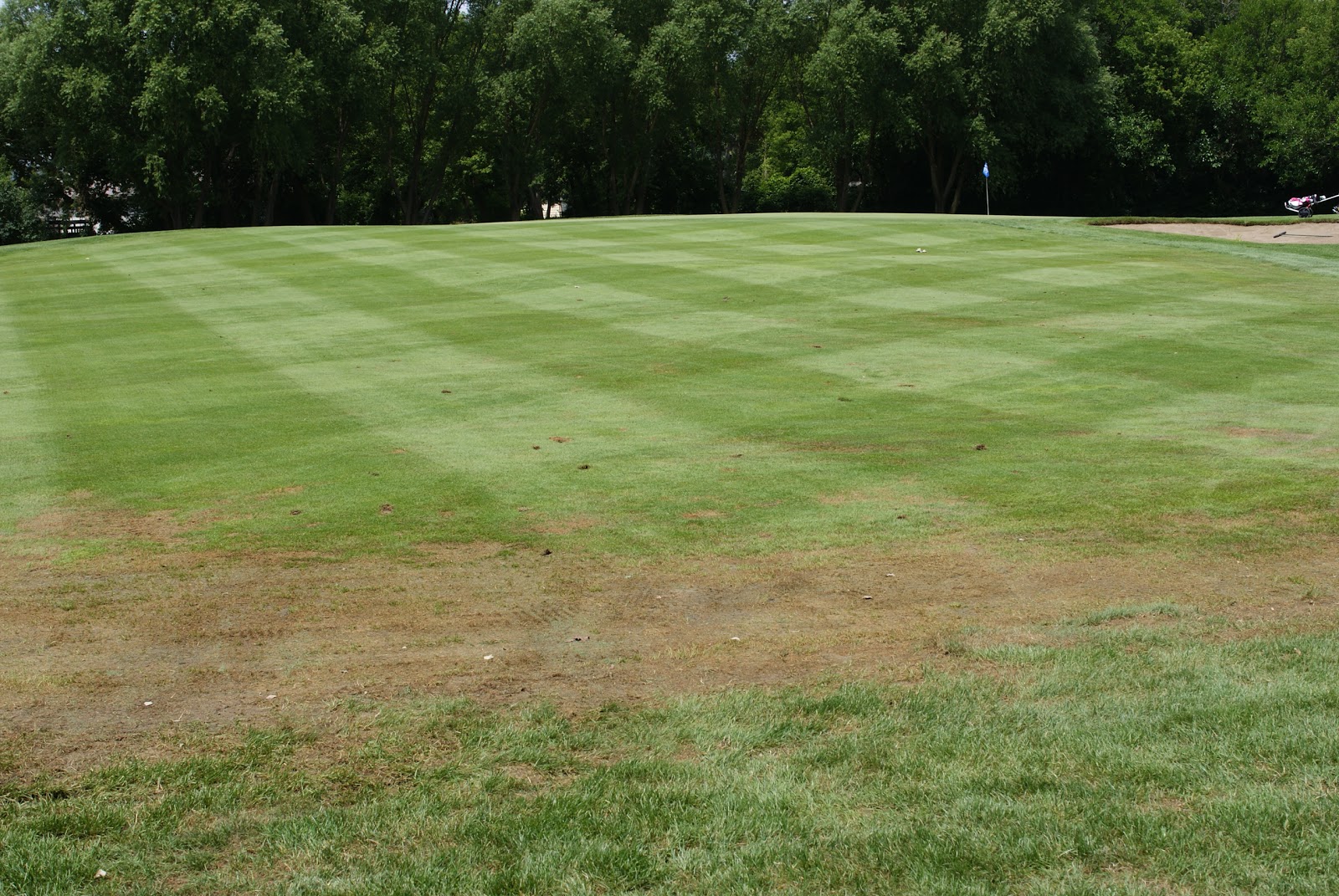
On a positive note, the greens have healed quickly from aerification last week.  After one week's time, they now look like this:
1 Week after Aerification
Close-up of #1 Green
They will be putting nicely once they get a chance to dry out a little.

Flooded bunkers have been common this week:


This is Gary's third time pumping traps this week.  You can also see him pulling weeds while he waits for the double sump pump arrangement to do its job.  Great job, Gary!
Gary's daily ritual : Pumping and weeding!
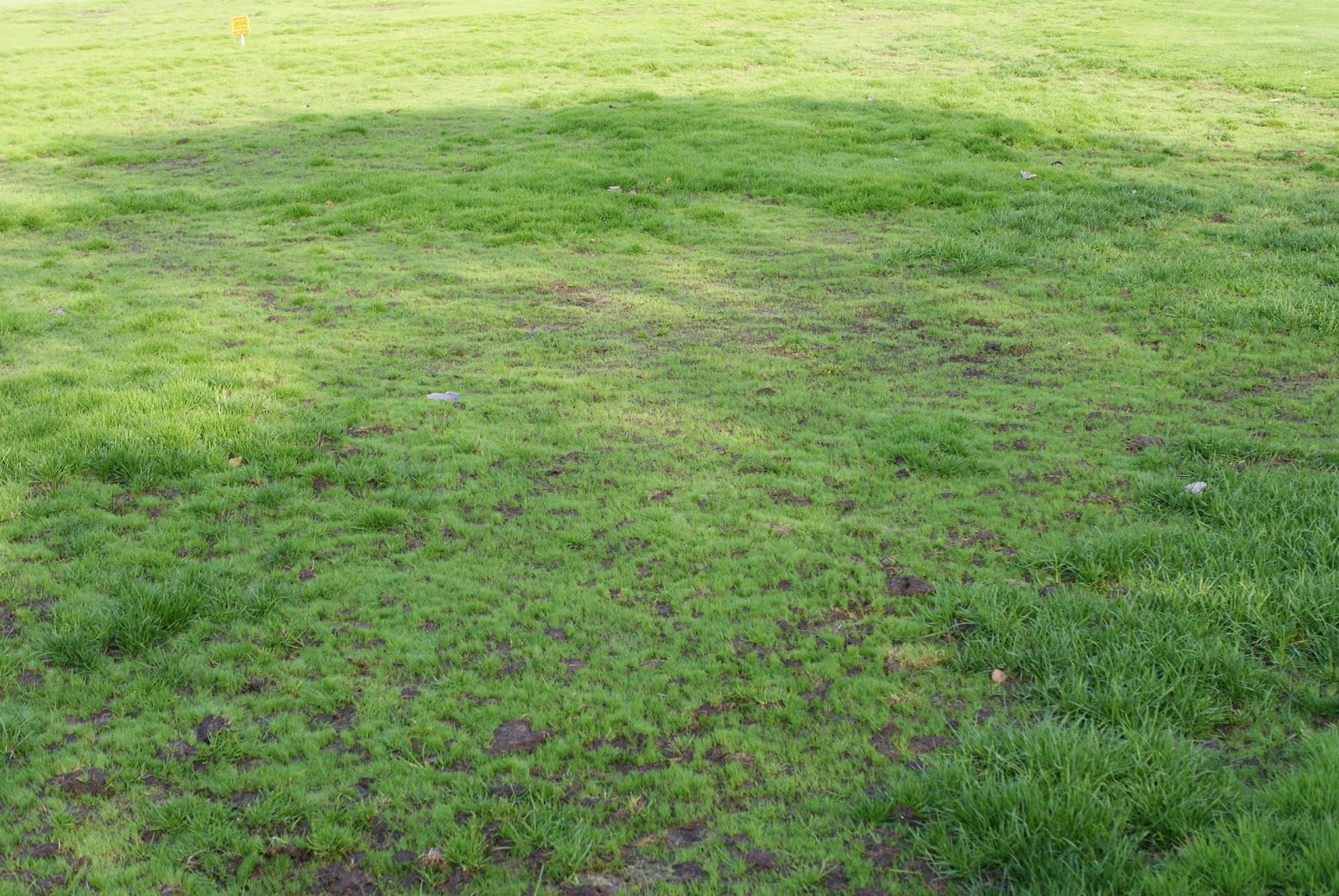
The last problem areas are filling in with slit seeding and aerification:
5 Tee slit seeding
The 5th tee has always been challenging to grow.  It is affected by morning shade, hard subsoil, and heavy use.  Being a short hole, divots are often very large and numerous.  We ask that players refrain from practicing, or taking multiple shots, on this tee for obvious reasons:
Divots on 5 tee
Divots taken during the course of regular play are necessary, but these divots were not between the tee blocks and are probably from just one golfer "practicing".  Ouch.

Looks like we may have one more sprinkle before a nice dry week!

Friday, September 23, 2011

Aerifying Day 2011

It's that time of year again!  The greens at Sugar Creek were aerified on September 21 with a deep tine machine that loosens up the ground up to 8 inches deep.  Aerifying is essential to the long term health of a green.  Here are a few pictures of the process.

We started spreading sand before the deep tine machine this year.  This helped it dry out before brushing.  Here is the deep tine machine on the first green:


Topdressing the greens:


In this photo, you can see the brush in action on the 5th green and the tractor aerifying the 7th green:

After brushing as much sand as possible into the holes, we used some custom built brush reels on the old greens mower.  These reels have a bedknife set to a little under our usual height of cut.  Brushes then come around to pick up extra sand and debris and collect it in the baskets.  These brush reels help to create a puttable surface:


After the first day, the greens look something like this area:


We try hard not to over-sand them even if all the holes aren't full to the top. It is easy to add more sand later but very difficult to get rid of too much.  After testing many spots, the holes almost never interfer with putting after we roll the greens out.  At least in my opinion, excessive sand is more difficult to putt on and can delay recovery. 

At the end of the process, we used a pull behind roller to smooth out any bumps.  One of the difficulties of dealing with recently aerified greens is dew in the morning.  The next two mornings were too dewy to mow or roll the greens without making them clumpy and unputtable.  Instead, we will be brushing and mowing them in the afternoon after they have dried out. 

They are putting smoothly and especially in the dry afternoon are almost too fast.  Some golfers even told me they loved putting them the afternoon after they were done.  Others said they liked the challenge of the different speed.  I hear a rumor that some golfers are not big fans of aerification, but I haven't run into them yet . . .  Well, maybe one or two!

Wednesday, September 14, 2011

Summer of 2011 : Seeding Fairways

Meteorological summer is over and it has definitely cooled off in the Chicago area -- just barely dipped under 50 last night in many areas.  The last month has been a busy one at many golf courses in the area struggling to recover from late July's rain and heat.  Luckily, August was not extreme: 1.1 degrees F over normal and about average rainfall.  This meant that it was possible to get seed to grow in fairway areas.

In the last 5 weeks, we experimented with several methods of seeding and aerification in the fairways.  We used a slicing knives several times in an attempt to break through the thatch into soil.  This worked in some spots.  We also used an Aera-vator with a seeder to spike seed and cultivate areas.  Other areas we used a Ryan Mataway slit seeder.  All three methods worked to one extent or another.  The trick is to get seed-to-soil contact without making the situation worse or delaying recovery. 

Seed growing in aeravator holes
Some of the plants you see are not new seed.  Most of these areas in our fairways are composed of annual bluegrass, or Poa annua, an annual grass with lots of seed in the ground.  It is very aggressive in spring and fall, but often dies in summer.  In some of these areas, our new seed may have gotten started early enough to establish before the annual fall resurgance of Poa annua.  In others, Poa will likely take back over. 

You can identify Poa annua by its bunch-type growth, yellow-green color, and "boat-shaped" tip:

Annual blugrass boat shaped tip
Annual bluegrass is not exactly what we want to see because it is the species that died in the first place, but it is turf and you can play golf on it!  There isn't any way to stop it without stopping our new seed also, so superintendents have to constantly manage it. 

About three weeks ago, we slit-seeded the first fairway and it is starting to fill in:
First Fairway slit seeding

It is easier to see the fuzzy new grass with dew on it
Finally, an area on 7 fairway that suffered from water damage needed more aggressive tactics.  Using an Aeravator, rake, and roller, we essentially cultivated and seeded the area around this drain:

 The seed germinated very quickly and is doing well.  If you click on the image, you can see them more easily:

Seedlings on 7 Fairway
Many other areas have already recovered from early August and the rest are filling in quickly.  September has really been a nice month!

6th Hole

1st Green

Update September 22, 2011:  Seedlings are really filling in on our fairways.  The renovated area on the 7th fairway now looks like this:
7 fairway
Overall, we have had a lot of success this year replacing pesky Poa annua with bentgrass and bluegrass.  Hopefully these seedlings will toughen up before winter and make great turf next year!

Wednesday, August 10, 2011

July Weather Since 1990

One of the interesting parts of working in the golf world is dealing with weather.  It is important to understand weather variations over time when planning future projects and evaluating the success of past projects.  The last two summers have been hot and stormy, so I was curious: How "normal" is this weather?  When was the last summer with high heat and lots of rain?  The chart below summarizes July weather in Chicagoland since 1990.

(Click chart for full size view)

There are lots of ways to measure heat and precipitation, but I looked at the National Weather Service's departure from average figures for July. Out of curiousity, I also added in the number of days with rains over .5" -- big rains, in other words. 

The pattern confirms what I have heard from other Superintendents in the area.  Besides 2010, the last July we saw this extreme combination of high heat and heavy rain was . . . 1995.  Many people remember 1995 for its 100 degree days, but July also saw a lot of storms in this area.  We have had other unpleasant months over the years, but 1995, 2010, and 2011 really stick out for their combination of hot and wet -- one of the toughest situations for golf courses.

Notes on the chart:  Clicking on the chart will open a larger version.  Most of the data came from the National Weather Service.  I made a couple adjustments based on local measurements.  For instance, O'Hare measured over 11 inches July 2011 but we luckily missed a few of those inches.  It is important to note that this chart is only meant to summarize weather in July, not the entire summer.  There are many other factors in turfgrass health and golf playability, but July weather is very significant in our area.  I will take a look at August and its effects later this year.

Monday, August 8, 2011

Interview with a Fairway


A lot of golf course fairways have been hurting since it started raining this summer.  I decided to go straight to the source and ask our fairways some tough questions.  The following is a transcript of our interview:

So, fairway, it looks like you’ve been having a rough time in the past weeks?

Tell me about it!  I was doing great up until it started raining again.  I appreciate a nice shower.  Even a short bath I can tolerate, but I can’t sit in water for a week.  I can’t breathe.  Especially when the sun is out – that water gets hot!  Try holding your breath underwater in a hot tub.  That’s what it’s been like.

How did you cope with the extreme heat?  Was that a problem?

That string of really hot days wasn’t a walk in the park, but I survived.  The maintenance crew tried to give me just the right amount of water.  Too much water would have cooked me and too little would have permanently wilted me.  I made it through those hot days by breathing at night and holding my breath during mid-day.  That way I didn’t wilt to death during the middle of the day.  I’m not saying it was pleasant, but I can handle that for a while as long as the maintenance crew is helping me out. 

If you didn’t mind the extreme heat, when did the trouble start?

Well.  I started getting wet.  The first downpour was alright.  I soaked it up and it was cloudy and not too hot out.  The second one on July 23rd was way too much for me to handle, my roots were saturated and I couldn’t breathe.  Luckily it wasn’t too hot and sunny so you couldn’t really tell how much I was hurting. 

It seemed like you suddenly got sick right after that.  What happened next?

Just when I was starting to dry out and feel good again, I got a combined 2.5 inches of rain on the 28th and 29th.   Those two days were cloudy and not too hot so I just held on partially underwater.  Some of my low spots were starting to get smothered, but I was mostly ok.  And then it happened . . . Saturday and Sunday were the worst!

Did you get a horrible disease or something?

Not really.  The maintenance crew had just helped me out with some protectants that prevented most of the diseases.  I may have had a spot or two of Pythium Blight and Brown Patch, but that wasn’t really a big deal.  It was just the conditions out here on the 30th and 31st.  Remember, I’m plants, I can’t run away from lethal heat like you can -- hiding in your nice air conditioning all day and night!  I have to just sit here and take it.

I remember it was miserable out there in the middle of the day.  Why couldn’t you use the water to cool off?

My roots were still soaked and it was very humid so I couldn’t transpire.  Kind of like humans and your sweat, I need to evaporate some water to cool myself off.

Didn't the maintenance crew just add some drain lines on the first hole to help you out?

Yes they did, and I appreciate the effort.  They put a new line under the cart path and some other lines.  I'm sorry, but the way I'm built, it's going to take a lot more than that to dry me out when it rains this much! 

New drain and sodded area on #1.  Sod didn't make it.
OK.  So what happened?

 I wasn’t dry yet and the sun came out.  July 30th was the sunniest day in a long time and the temperatures hit the low 90’s.  The sun heated up the surface of the water that was partly covering my blades to over 110 degrees and it cooked their insides.  In a four hour span on Saturday afternoon, a lot of my cells turned to useless soup.  Sunday afternoon hurt again with the exact same conditions. 

Can we do anything to help right now?

Well.  The maintenance crew tried to help by aerating some holes for me.  Unfortunately, it has continued to rain so I still haven’t been able to breathe much.  Just rained another 1.5 inches in the last 24 hours.  At least the temperatures have cooled off so I’m not losing any more plants.  I know the maintenance crew is going to aerate and overseed this week once I dry out a little.  I’ve been in this situation before and I always come back with a little help.  Please be patient while I grow some new shoots and roots. 

Why are other areas of the course growing so well and you’re not? 

There are lots of reasons, but most of them go back many years.  If you notice, I’m low and the greens and tees are high – for the most part.  They were built with soil and sand custom made for greens and tees.  I’m all clay, rock, asphalt, and brick.  You might not know this, but I was a rock dump before I was a golf course fairway.  The greens and tees got the benefit of topsoil and there wasn’t much left for me.  I have a rougher life than those pampered greens.  They don't even get driven on by carts!  The tees are less spoiled – at least they have to deal with divots.  Now, if you'll excuse me, I need to grow some roots now.

One more question -- When do you think you'll be back to "normal"?

If past years are any guide, I will probably have one more rough patch in August that will prevent a big recovery.  At the end of August, I will recover and grow new shoots with the help of the maintenance crew.  By October 1, you may not be able to tell that it was another hot, wet summer.

Early October 2010
That was the end of our interview.  You may want to see these post for more information:

Scald and annual bluegrass (Poa annua) problems:
http://sugarcreekgolfcourse.blogspot.com/2010/07/turf-notes-summer-decline-of-annual.html

Pythium Blight:
http://sugarcreekgolfcourse.blogspot.com/2010/08/turf-notes-pythium-blight.html

Drainage project on 1st hole:
http://sugarcreekgolfcourse.blogspot.com/2011/05/1-cart-path-drainage-project-update.html

2010 -- a similar year for us -- in review:
http://sugarcreekgolfcourse.blogspot.com/2010/12/2010-year-in-pictures.html


Monday, August 1, 2011

Venting Fairways and Tees

The past couple weeks have not been kind to most Chicago-area golf courses.  First we had extreme heat and then lots of rain.  While some turf wilted in the heat and the rough went dormant in many areas, we could cope with dry and hot.  The wet period that started on July 22nd was a different matter.  The end of last week (July 27-29) saw significant rain 3 days in a row with warm temperatures.  This created a situation we know well in a wet late summer -- a toxic soup of wet wilt, scald, and pythium.  The high temps this weekend cooked saturated, low-lying fairway areas but the rough is looking fabulous!  Quite a few golfers have commented on how green it is on the course and they are right:  The greens, higher areas, and rough are healthy and growing fast.  It is those lower areas that are the problem.
Scalded low area near the creek on #1.
At the moment, there is only one thing we can do to improve the situation and speed up turf recovery -- Vent!  Not the verbal kind of venting, although that can help, but the mechanical kind.  Venting refers to solid tine aeration done mostly for the purpose of improving gas exchange in the soil.  We have been using a machine called the Planet Air on the fairways that shatters soil while leaving only a slit in the turf and a minimum of mess.  Tees are being treated with solid tines on a conventional aerifier.  So far, I have no plans to needle tine the greens as they are still performing well. 
Aerator uses a slicing motion to vent turf

Slicing Tines on Planet Air
I've noticed a lot of superintendents are doing the same thing and dealing with a lot of the same problems.  Check here for more recent superintendent blog posts (Link).  I especially like this blog post as they seem to be in a similar situation (Link).

In his Scouting Report for July 29, 2011, Dr. Settle writes: "Then there's why overly wet rootzones are our worst enemy. Midsummer is never a good time for cool-season turfgrass because any additional downward spiral of turfgrass health can be difficult to reverse until cooler weather returns. Root biomass/length are at their lowest levels and what's left root-wise has impaired function because of high soil temperature. Turf plants in physiological decline display abnormal photosynthesis and respiration, yet concentrated wear continues on a daily basis (the life of a golf green). Often the only recourse is a well-timed cultural method such as needle-tine aeration. If it sounds as if I'm exaggerating or blaming the weather too much, guess again."

Thanks for telling it how it is!  Wet + Hot + Stress = Unhappy Turf.  These scouting reports a great resource for everyone involved in golf.  You can check them out at Chicago District Golf Association Turfgrass.
Classic water damage in a drainage swail.
Saturated conditions lasted for longer than the turf could tolerate.

Saturday, July 23, 2011

Course Update: July 23, 2011

The rainstorms last night dumped a lot of water on us.  We're not exactly sure of the amount because our rain gauge was knocked over.  My best guess is over 2 inches but way less than the over 6 inches falling at O'hare.  Most of the water drained off as of 7:30am.  The course has remained open so far and many groups have played.  More rain appears to be on the way, so please check with the clubhouse to be sure of the course's status (Phone #: 630-834-3325). 

Last week was very hot and humid, but the course made it through in good shape.  You will hear many superintendents say that they prefer to have it not rain when it is hot.  Too much water combined with heat leads to more severe problems than drought stress (see posts from 2010!).  Last week was a good example of why rain is not always welcome for a golf course.  Through moderate irrigation and spot watering by hand with hoses we were able to get through the week without major problems.  This amount of rain a couple days ago would have lead to severe scald, wet wilt, and probably diseases.  Hopefully it will stay cloudy today and not get too hot until it dries up a little.  It looks like we have a little cool down coming Sunday night through Tuesday which will be a welcome relief for both people and plants.

Tuesday, June 21, 2011

Bug Spray Harms Turf

I have received a few questions about the mysterious patches of light tan turf that appeared over the weekend.  This is one turf problem that has a simple explanation:  Whenever the weather is muggy and buggy, we experience an outbreak of "bug spray disease."  Most golfers do not know that their insect repellent will harm turf, especially when directed at legs and ankles.  The overspray usually leaves a pattern of a green footprint or footprints surrounded by straw-colored injured turf. 

The solution to this problem is to spray legs and ankles on a cart path or other non-turf surface where the overspray will not contact grass.  Depending on conditions and the amount of spray on the grass, these spots usually recover in 1-4 weeks.  In extreme cases, though, they can result in the death of the patch of turf. 
Bug spray injury on a tee with a footprint in the center

Bug spray injury on a green collar

Can you see the footprint?

 Hopefully these pictures will help us all remember to use bug spray on the cart path.  I know it has slipped my mind in the middle of a mosquito attack.  Next time you golf on a buggy day, please help us educate others about the cause of the mysterious green footprint disease.

Thursday, June 16, 2011

Pictures from June 2011

While looking over recent pictures, I noticed that we golf course superintendents tend to take a lot of pictures of problem areas or projects in progress.  I take about 10 times more pictures meant to inform (not so pretty) than pictures meant to impress (pretty ones).  Superintendents are fascinated by pictures of turf disorders, projects involving mud and machines, and rare phenomenon.  We can't help it.  It's our job to deal with the behind-the-scenes stuff that makes golf courses tick.  I realized the other day that if you looked at this blog, you might think that Sugar Creek is always 1) flooded, or 2) under construction.  Definitely not true!  The majority of the time it is a beautiful place with lots of golfers enjoying themselves.  I decided to lead with the good stuff this post!

A collection of pretty pictures can be found here : Slideshow

So far, June has been an eventful month at Sugar Creek. We have had many beautiful days for golf. We've also had a tiny flood -- just a little one, no big deal! 

9 Green and Clubhouse on a nice day

2 Green and Clubhouse

4 Tee
June wouldn't be complete without one flood picture.  Let's hope it's the only one!  Thuderstorms gave us over 3 inches with the inevitable result:

4 Fairway
The crew has been very busy working on the sandtraps, mulching landscape beds, preparing the course, and all the other tasks that are part of our in season routine.  The course is in very nice shape thanks to the efforts of our dedicated staff. 

One of our major accomplishments over the past few months was the replacement of our main irrigation pump and the renovation of the pumphouse plumbing.  Thanks to the previous experience of our handy mechanic, we were able to do the work in-house and meticulously go over these pieces of equipment.  I am now 99% sure this plumbing will hold on any given night.  Last year, it was down to about 50/50.  We got it up and running just in time for some dry weather, which all too quickly turned into wet weather. 

Below you can see our beautiful new Berkeley pump and reassembled plumbing.  The pumphouse is really the heart of any golf course.  This pumphouse supplies the rest of the course with life at about 600 gallons per minute:

40hp centrifugal pump

Rebuilt valves and plumbing
We used the new pump for 2 nights before the recent rainy spell hit.  Who knows when we will need it again!  No one is really looking forward to the forecast at the moment:


I'm thinking this has to be a mistake.  The meteorologists are having a good laugh right now.  OK guys, you can change it to the real forecast any time now!

Added June 19, 2011:  I knew the forecast had to be wrong.  It has turned out to be a beautiful Father's Day weekend in our area.  Slight chance of a sprinkle later Sunday but I'm betting on it missing us.

Sunday, June 5, 2011

A Beautiful Sunday Morning

The weather is finally cooperating in our area and many golfers have been coming out to enjoy it.  Here are some pictures from this morning - a typical Sunday morning during the season at Sugar Creek.  You can click on the pictures to enlarge:
Mowing the first green

Jim prepares the greens

View of the clubhouse from the 2nd hole

4th Hole early in the morning

Wednesday, May 25, 2011

#1 Cart Path Drainage Project Update

In March, the maintenance crew added a new drain under the cart path on #1 to prevent flooding and ice related problems along the path.  Almost every year, ice kills a portion of this turf.  Seed was not growing fast enough for us due to our cool, wet April so we decided to sod the area to completely restore it. 

Here are some before and after pictures:
Before
Before
After
This area could still benefit from the addition of some sub-surface drain lines but the new catch basin will greatly reduce the amount of water hung up on the high side of the path.  Something tells me this will not be the last drainage project done in this area, but it is greatly improved. 

5 Tee Results

Last fall, we resurfaced the 5th tee with bentgrass.  It has been open since April, but is just now starting to really look good.  Our cool, wet April delayed its growth for a while.  Soil temperatures have now risen to a point where it is looking happy!


The new Red tee on #1 is also now open.  It takes a while to develop soil fertility and culture when starting with a sandy mix.  These new tees are undergoing the transition from seedlings to an mature turf system and are still developing root mass and a thatch layer.  Some have commented on how firm they can be when dry.  This will go away in time with aerification and normal maturation processes.

Tuesday, April 19, 2011

Rain Days

People often wonder what golf course workers do when it is raining.  Well . . . it's been raining this April so I can answer that question!  Rainy days actually serve an important function for a golf course crew.  I always keep a couple "rain day" jobs on the back burner until there is a suitable day to get them done.  In fact, if it never rained, I think I would have to create "virtual rain days" where the crew stays off the course and focusses on other projects. 

A View from the Maintenance Building
Here's what we've been up to on the past few rain, or snow, days:
  • 3-hour Spring Safety Training and Staff Meeting
  • 1 worker fixed ball marks in the rain
  • 1 worker changed course set up so that we can catch up on mowing when it drys out
  • We disassembled most of the pumphouse in preparation for some repairs
  • Refurbished 50 bunker rakes with Vinyl Guard
  • Investigated the mystery of the bladder tank (see below)
  • Cleaned shop
  • At the moment, the crew is helping me do an alpha sort and file of receipts and PO's from 2010.  I meant to do it over the winter but, you know, didn't get around to it.
  • Blog!
Bunker Rakes

Over time, fiberglass bunker rakes start to fade and splinter.  They last longer than the old aluminum handles that would kink and bend, but nobody likes fiberglass splinters.  Paint doesn't stick for long, so we decided to use a product called Vinyl Guard to refurbish the rakes.  Vinyl Guard uses a heat shrrinking process to put a permanent protective coat on the handle.  For a couple bucks per rake, they are like new.
Jimmy's favorite job
Some of our "new" bunker rakes
The Pump House

We are in the process of making some repairs to the irrigation pump system.  Over the past week, we have been disassembling and inspecting all the components of the system.  Most of the piping will be replaced due to its age and condition but some elements can be refurbished. 

Irrigation system components up for replacement

Definitely in the "replace" pile
Particularly interesting has been the "mystery of the bladder tank"!  We have never been able to figure out the manufacturer or model number of our tank because there are no markings.  We also weren't exactly sure if it was working properly or not (we suspected not). 

The red tank in the following pictures is supposed to hold an inflated air bladder that buffers system pressure and protects the pumps from excessive starts and stops.  It is important to maintaining the system's health and longevity.  Unfortunately, the air cavity was slowly leaking pressure and had been contaminated with water and sludge.  The tank weighed at least 800 pounds in its waterlogged state so our mechanic had to do some rigging to move it.  Using a combination of chainfalls, sleds, chains, and rollers, he moved the tank out of the pumphouse without breaking a sweat. 

The tank on a "sled" with rollers
Out the door and in the air
With the tank at the shop, it was time to investigate.  Many of these tanks are repairable if you can find the manufacturer and replace the "bladder" inside.  We carefully removed the flanges and drained the air compartment of water so we could take out the bladder.  Here is what it looks like:
Pressure tank bladder
After a lot of searching, we found the slit that was leaking.  Unfortunately these are not patchable.  They have to hold 120 psi while expanding and contracting constantly so they have to be in one piece.  We had to consult with a few experienced pump contractors to figure out the manufacturer.  After calling the manufacturer, we determined a replacement bladder is available.  Now we have the option to replace the bladder and rebuild this tank instead of buying a whole new tank.  Neither option is exactly "cheap" but the mystery has been solved!