Showing posts with label Golf. Show all posts

Saturday, October 22, 2011

Frost Delays

Reposted from April 2010:


Since we have a frost delay today, I thought I would post some information on frost and frost delays.  No one likes frost delays - maintenance workers especially - but they are necessary for the health of the course.  Golf course employees ask for your understanding during frost delays.  We don't like them either.

Here are some key points from the Golf Course Superintendent Association:
• Frost is basically frozen dew that has crystallized on the grass, making it hard and brittle. A grass blade is actually 90 percent water, therefore it also freezes.

• Walking on frost-covered greens causes the plant to break and cell walls to rupture, thereby losing its ability to function normally.

• When damaged, the putting surface weakens and becomes more susceptible to disease and weeds.

• One foursome can leave several hundred footprints on each green, causing extensive damage.

• A short delay while the frost melts can preserve the quality of the greens and prevent needless repairs.
You can find a more detailed article on frost formation and effects in this article - "The Big Chill"

The following is a video from the USGA:

Thursday, September 29, 2011

A Week after Aerification : Update

For the last few days, a low pressure system has been swirling over Chicagoland.  At Sugar Creek, we have had around 3 inches of rain in total.  Not all at once, though, but in six hour soakers spaced about 12 hours apart.  Wonderful!  Believe it or not, these are very busy weeks for a maintenance crew -- in a different way than usual.  We have not been able to mow fairways, but we have been able to mow everythings else very slowly.  Sand traps have been a constant battle.  In weather like this, we pump them just to give us a shot at drying them faster after it stops raining.  Since you never know when will be the last shower for the week, sometimes we pump them only to have them fill up again.  That's just the chance you take.

On a positive note, the greens have healed quickly from aerification last week.  After one week's time, they now look like this:
1 Week after Aerification
Close-up of #1 Green
They will be putting nicely once they get a chance to dry out a little.

Flooded bunkers have been common this week:


This is Gary's third time pumping traps this week.  You can also see him pulling weeds while he waits for the double sump pump arrangement to do its job.  Great job, Gary!
Gary's daily ritual : Pumping and weeding!
The last problem areas are filling in with slit seeding and aerification:
5 Tee slit seeding
The 5th tee has always been challenging to grow.  It is affected by morning shade, hard subsoil, and heavy use.  Being a short hole, divots are often very large and numerous.  We ask that players refrain from practicing, or taking multiple shots, on this tee for obvious reasons:
Divots on 5 tee
Divots taken during the course of regular play are necessary, but these divots were not between the tee blocks and are probably from just one golfer "practicing".  Ouch.

Looks like we may have one more sprinkle before a nice dry week!

Friday, September 23, 2011

Aerifying Day 2011

It's that time of year again!  The greens at Sugar Creek were aerified on September 21 with a deep tine machine that loosens up the ground up to 8 inches deep.  Aerifying is essential to the long term health of a green.  Here are a few pictures of the process.

We started spreading sand before the deep tine machine this year.  This helped it dry out before brushing.  Here is the deep tine machine on the first green:


Topdressing the greens:


In this photo, you can see the brush in action on the 5th green and the tractor aerifying the 7th green:

After brushing as much sand as possible into the holes, we used some custom built brush reels on the old greens mower.  These reels have a bedknife set to a little under our usual height of cut.  Brushes then come around to pick up extra sand and debris and collect it in the baskets.  These brush reels help to create a puttable surface:


After the first day, the greens look something like this area:


We try hard not to over-sand them even if all the holes aren't full to the top. It is easy to add more sand later but very difficult to get rid of too much.  After testing many spots, the holes almost never interfer with putting after we roll the greens out.  At least in my opinion, excessive sand is more difficult to putt on and can delay recovery. 

At the end of the process, we used a pull behind roller to smooth out any bumps.  One of the difficulties of dealing with recently aerified greens is dew in the morning.  The next two mornings were too dewy to mow or roll the greens without making them clumpy and unputtable.  Instead, we will be brushing and mowing them in the afternoon after they have dried out. 

They are putting smoothly and especially in the dry afternoon are almost too fast.  Some golfers even told me they loved putting them the afternoon after they were done.  Others said they liked the challenge of the different speed.  I hear a rumor that some golfers are not big fans of aerification, but I haven't run into them yet . . .  Well, maybe one or two!

Tuesday, June 21, 2011

Bug Spray Harms Turf

I have received a few questions about the mysterious patches of light tan turf that appeared over the weekend.  This is one turf problem that has a simple explanation:  Whenever the weather is muggy and buggy, we experience an outbreak of "bug spray disease."  Most golfers do not know that their insect repellent will harm turf, especially when directed at legs and ankles.  The overspray usually leaves a pattern of a green footprint or footprints surrounded by straw-colored injured turf. 

The solution to this problem is to spray legs and ankles on a cart path or other non-turf surface where the overspray will not contact grass.  Depending on conditions and the amount of spray on the grass, these spots usually recover in 1-4 weeks.  In extreme cases, though, they can result in the death of the patch of turf. 
Bug spray injury on a tee with a footprint in the center

Bug spray injury on a green collar

Can you see the footprint?

 Hopefully these pictures will help us all remember to use bug spray on the cart path.  I know it has slipped my mind in the middle of a mosquito attack.  Next time you golf on a buggy day, please help us educate others about the cause of the mysterious green footprint disease.

Thursday, June 16, 2011

Pictures from June 2011

While looking over recent pictures, I noticed that we golf course superintendents tend to take a lot of pictures of problem areas or projects in progress.  I take about 10 times more pictures meant to inform (not so pretty) than pictures meant to impress (pretty ones).  Superintendents are fascinated by pictures of turf disorders, projects involving mud and machines, and rare phenomenon.  We can't help it.  It's our job to deal with the behind-the-scenes stuff that makes golf courses tick.  I realized the other day that if you looked at this blog, you might think that Sugar Creek is always 1) flooded, or 2) under construction.  Definitely not true!  The majority of the time it is a beautiful place with lots of golfers enjoying themselves.  I decided to lead with the good stuff this post!

A collection of pretty pictures can be found here : Slideshow

So far, June has been an eventful month at Sugar Creek. We have had many beautiful days for golf. We've also had a tiny flood -- just a little one, no big deal! 

9 Green and Clubhouse on a nice day

2 Green and Clubhouse

4 Tee
June wouldn't be complete without one flood picture.  Let's hope it's the only one!  Thuderstorms gave us over 3 inches with the inevitable result:

4 Fairway
The crew has been very busy working on the sandtraps, mulching landscape beds, preparing the course, and all the other tasks that are part of our in season routine.  The course is in very nice shape thanks to the efforts of our dedicated staff. 

One of our major accomplishments over the past few months was the replacement of our main irrigation pump and the renovation of the pumphouse plumbing.  Thanks to the previous experience of our handy mechanic, we were able to do the work in-house and meticulously go over these pieces of equipment.  I am now 99% sure this plumbing will hold on any given night.  Last year, it was down to about 50/50.  We got it up and running just in time for some dry weather, which all too quickly turned into wet weather. 

Below you can see our beautiful new Berkeley pump and reassembled plumbing.  The pumphouse is really the heart of any golf course.  This pumphouse supplies the rest of the course with life at about 600 gallons per minute:

40hp centrifugal pump

Rebuilt valves and plumbing
We used the new pump for 2 nights before the recent rainy spell hit.  Who knows when we will need it again!  No one is really looking forward to the forecast at the moment:


I'm thinking this has to be a mistake.  The meteorologists are having a good laugh right now.  OK guys, you can change it to the real forecast any time now!

Added June 19, 2011:  I knew the forecast had to be wrong.  It has turned out to be a beautiful Father's Day weekend in our area.  Slight chance of a sprinkle later Sunday but I'm betting on it missing us.

Sunday, June 5, 2011

A Beautiful Sunday Morning

The weather is finally cooperating in our area and many golfers have been coming out to enjoy it.  Here are some pictures from this morning - a typical Sunday morning during the season at Sugar Creek.  You can click on the pictures to enlarge:
Mowing the first green

Jim prepares the greens

View of the clubhouse from the 2nd hole

4th Hole early in the morning

Wednesday, May 25, 2011

#1 Cart Path Drainage Project Update

In March, the maintenance crew added a new drain under the cart path on #1 to prevent flooding and ice related problems along the path.  Almost every year, ice kills a portion of this turf.  Seed was not growing fast enough for us due to our cool, wet April so we decided to sod the area to completely restore it. 

Here are some before and after pictures:
Before
Before
After
This area could still benefit from the addition of some sub-surface drain lines but the new catch basin will greatly reduce the amount of water hung up on the high side of the path.  Something tells me this will not be the last drainage project done in this area, but it is greatly improved. 

Monday, March 14, 2011

The Golf Course is Open

With the rising temperatures, golfers have started coming out in increasing numbers.  We had our first significant amount of rounds on Sunday.  This week looks to be a good one for golf. 

If you would like to golf, we are open and the course is looking and playing well for this time of year.  The maintenance crew has been busy cleaning greens, tees, and fairways and finishing our winter tree work.  The grass isn't growing yet, but it looks like spring is just around the corner.

You can always check availability or make tee times at our website (Click here).

Saturday, November 27, 2010

Tree Trimming and Buckthorn Removal on #7

Now that the grass has stopped growing, it is tree trimming season again!  Last week, we started work on some trees that were resulting in some unfair tee shots on #7 and some buckthorn that was encroaching on the course from the fenceline.  A few overhanging branches were rendering the back of 7 tee almost unusable during the season.  After removal, the health of the tee will also probably improve due to increase sun exposure.

You can see from this photo that the view from the tee will be significantly improved in 2011:
7 Tee
Last winter, I wrote a post about buckthorn that answers many questions about the undesirable nature of this plant (Link to article). In addition to the ecological reasons for controling buckthorn, this fenceline in particular often resulted lost balls.  Lost balls ofen cause slow play so we began our winter buckthorn removal here.

A portion of the fence line cleared

Buckthorn along 7 fence line


Saturday, October 30, 2010

2010 Fall Scramble

It is a beautiful day for the Fall Scramble at Sugar Creek!

These golfers try their luck on the third hole's risk vs. reward bonus. They may gain a 1/2 stroke advantage over the competition for shooting at the difficult far pin placement (Blue Flag).  Which one will it be, guys?

If you look close, there are 2 flags on the 3rd green! (Just for today).

It may be October 30th, but Mr. Hoffman is not ready to give up his shorts for winter gear:


Thursday, August 5, 2010

Rain, Rain, Go Away

As everyone in the Chicagoland area knows, we've had a lot of rain recently.  According to our rain gauge readings, we've had somewhere around 15 inches since July 23rd, including 7.5 inches on July 23-24 and another 5 inches in the past two days.  Finally, it looks like we will have a chance to dry out!

The crew is out pumping and reconstructing the traps again:


Despite all the rain, golfers are still out having fun.  This brave golfer shows off her mud splattered legs and shoes as a badge of honor:


At least the next few days look dry, so it should dry out soon!

Tuesday, July 27, 2010

Update on the Flood

The ground is drying out fast after the flood last weekend.  We were lucky the water went down fairly quickly.  The maintenance crew has now fixed all the sand traps and mowed almost all the rough.  The course is starting to look like normal.

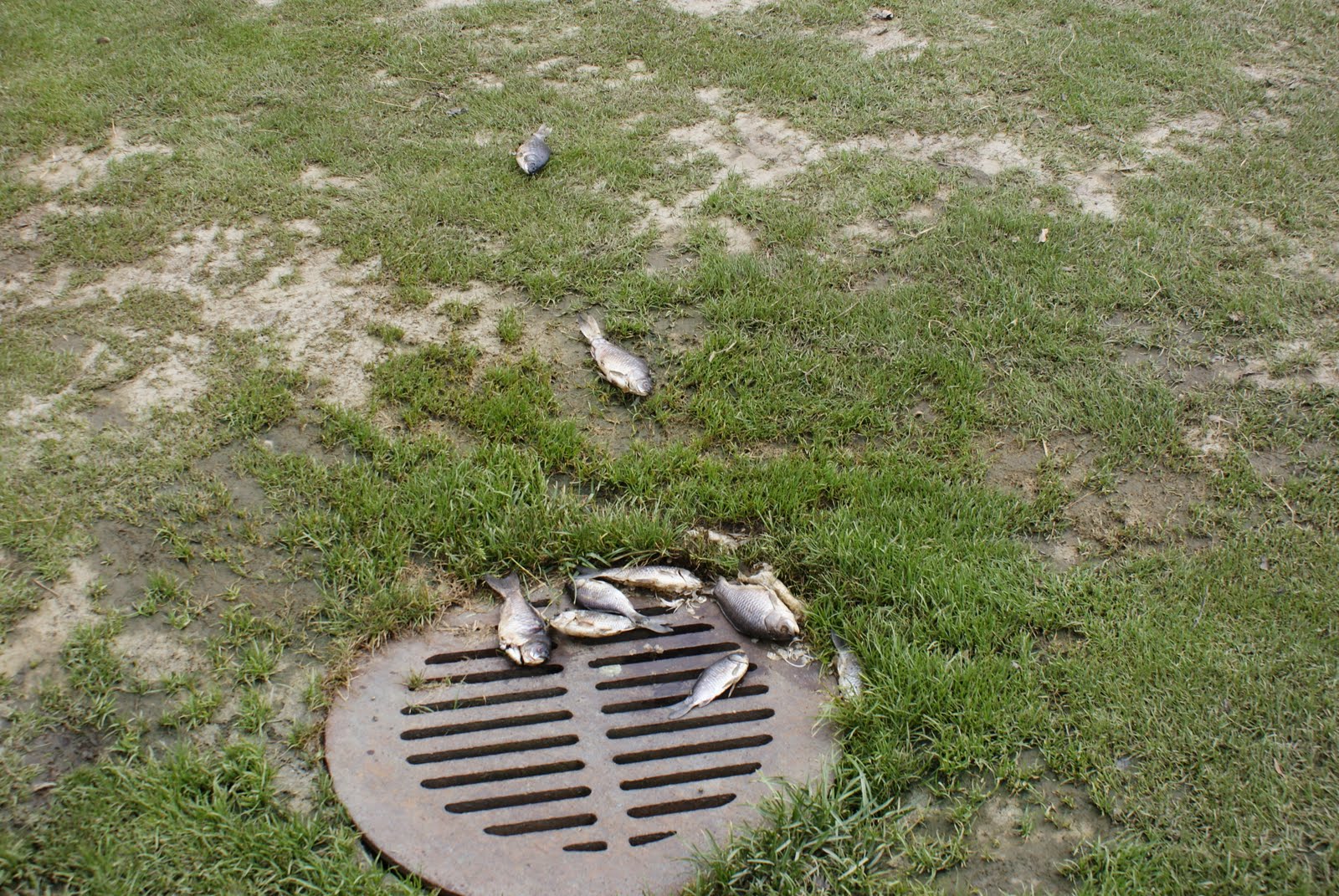
Loads of debris were removed after the flood, but we still keep finding things where they are not supposed to be.  One of the most unpleasant jobs of flood cleanup:  Fish duty!  (See photo below)


Don't worry.  They have been removed!

Wednesday, July 14, 2010

Junior League Superintendent Demonstration Day

Thanks to the efforts of our golf pros and staff, we have a very popular Junior League at Sugar Creek.  Juniors are introduced to everything from putting technique to course etiquette.  This year, we added a new element to the program involving the superintendent and course maintenance. 

During a 15 minute talk, I had an opportunity to explain the basics of course maintenance, show the junior golfers the greens mower, demonstrate how to fix a ball mark, and answer questions.  I think it was as fun for them as it was for me.  It's never too early to start educating golfers about what they can do to become part of the golf course community and improve playing conditions for themselves and other golfers. 

The most commonly asked question:  "How fast does that thing go?"  I think they were a little disappointed when I said 3 miles-per-hour! 

Here's some photos of the demonstration:


Saturday, July 10, 2010

Update: July 10, 2010

Over the last month, we have really seen some ups and downs in moisture.  After a wet June, we had a very dry week, then a little more rain.  For a while, it seemed like the maintenance crew was pumping and reconstructing sand traps almost every day.  See Update: May 15, 2010.  I am happy to say we are back in what I call the "sweet spot" - not too wet and not overly dry.  We have been having some beautiful golf weather.  More pictures and articles to come . . .

Monday, May 24, 2010

How to Fix a Ball Mark

Have you ever been involved in a heated debate about the best way to fix a ball mark?  I know I have!  In general, superintendents would prefer that golfers use any method as opposed to doing nothing, but there is a method endorsed by the golf community that is considered the official way. 

Here are some quick facts on ballmarks:
  • Unfixed ball marks result in an uneven and scarred putting surface
  • It is the responsibility of every golfer to fix at least their own ball mark
  • It can take 2 or 3 weeks for an unfixed ball mark to heal
  • Fixing ball marks vastly improves the putting surface for everyone
The best way to fix a ball mark

When I first started golfing in grade school, I assumed the best way to fix a ball mark was to use a tool to pry up the middle of the indentation.  This seems logical but it can result in torn roots and more recovery time.  The best way is the "twist" method endorsed by the Golf Course Superintendents Association (GCSAA). 

Here is the secret:  Your goal is to stretch the undamaged surface back into the depression, not to lift the depression by prying.  The putting surface is actually a fairly elastic thing.  Ball impact pushes the surface out to form the ridges around the depression, so you can fix it by stretching the surface back in.  In the process, the indentation or depression should flatten out.

Here is a graphic from the GCSAA.  Please click the image for a larger image:


I think many people are reluctant to try this method because it is difficult to visualize.  As a result, many golfers may not attempt to fix their ball marks because they are afraid of doing it the "wrong" way.  I am going to go out on a limb and say "If you have a method that works for you and results in a puttable surface, go for it!"  If you don't, try this method.  You may be suprised by how easy it is.

Sunday, May 16, 2010

Update: May 15, 2010

After a relatively warm and dry April, the first half of May has been a little cool and wet.  Many golf courses flooded last Thursday, May 13th.  The average rainfall for May 1-13 is 1.5 inches and we have seen around 4.5 inches at Sugar Creek (WGN).  Areas north of us have seen even more. 

At Sugar Creek, we were fairly lucky.  The water rose on Thursday morning after the thunderstorms but receded by the end of the day.  With some modifications to our normal mowing schedule due to wet conditions, we were able to have the course in good shape on Friday for an outing. 

One of the mosts time consuming jobs after a thunderstorm is fixing sandtraps.  After a good downpour, the sand from the upper parts of the traps wash down and the traps are filled with water.  Drains in the sandtraps will remove the water eventually but not immediately.  To make the traps playable quickly, they need to be pumped, resculpted, and raked.

On Friday morning, our traps looked like this:


Or like this one that has already been pumped out:


Pumping, pushing up sand, and raking takes at least 2 people from 30 minutes to an hour per trap, depending on thier size.  It can take a couple days to restore the traps to thier usual state, or more like this:


Excessive rain also interupts our mowing schedule temporarily leading to some catch-up work when it dries out.  However, adjusting the mowing schedule is not nearly as time-consuming as sand trap restoration.

Saturday, May 8, 2010

Frost Advisories

There is a frost advisory for this Sunday morning.  I was hoping we had already seen the last frost, but you never can tell.  I usually check National Weather Service Chicago at http://www.crh.noaa.gov/lot/ for frost and severe weather information.

For information on golf and frost delays, check out Frost Delays on this blog.
Here is the advisory for Saturday night and Sunday morning:

THE NATIONAL WEATHER SERVICE IN CHICAGO HAS ISSUED A FROST
ADVISORY...WHICH IS IN EFFECT FROM 3 AM CDT /4 AM EDT/ TO 8 AM
CDT /9 AM EDT/ SUNDAY.

* TEMPERATURE...OVERNIGHT LOWS TONIGHT WILL DROP TO NEAR 30 AT
SOME SPOTS FROM THE FOX VALLEY...WESTWARD ACROSS NORTH CENTRAL
ILLINOIS. OVER NORTHEAST ILLINOIS...LOWS WILL DROP INTO THE
LOWER 30S BY DAYBREAK...EXCEPT IN DOWNTOWN CHICAGO WHERE
TEMPERATURES WILL HOLD UP AROUND 40. OVER NORTHWEST
INDIANA...WEST TO NORTHWEST WINDS WILL REMAIN ELEVATED UNTIL
LATE IN THE NIGHT...HELPING OVERNIGHT LOWS TO ONLY DROP TO THE
MID 30S.

* IMPACTS...WIDESPREAD FROST IS EXPECTED TO BE A DANGER TO
SENSITIVE VEGETATION ACROSS NORTH CENTRAL AND MUCH OF NORTHEAST
ILLINOIS. THE RISK TO VEGETATION WILL DECREASE HEADING EASTWARD
ACROSS NORTHWEST INDIANA WHERE OVERNIGHT LOWS AND WIND SPEEDS
ARE EXPECTED TO BE A BIT HIGHER...MAKING THE FROST MORE
SCATTERED.

PRECAUTIONARY/PREPAREDNESS ACTIONS...

A FROST ADVISORY MEANS THAT FROST WILL BE A THREAT TO SENSITIVE
OUTDOOR PLANTS LEFT UNPROTECTED.