Showing posts with label Articles. Show all posts

Monday, March 18, 2013

Emerald Ash Borer Tree Removals

This winter, we began removing Ash trees infected with the Emerald Ash Borer (EAB) that were visibly declining or dead in 2012 and deemed hazardous to people or property. So far, 44 of 286 Fraxinus (Ash) species trees have been removed leaving 242.  All of the remaining are infected and in various states of decline.

The EAB is a non-native, phloem-feeding insect that aggressively kills both healthy and stressed Ash trees of all ages. The EAB adult, a metallic green beetle, lays eggs in the bark of Ash trees. These eggs hatch into larvae which bore through the bark and into the cambium where they feed, overwinter, and pupate. It is the larval stage which kills the tree once the cambium is girdled by feeding. See the USDA’s “Emerald Ash Borer Program Manual” for more information.

Emerald Ash Borer S-shaped galleries
Emerald Ash Borer larvae IL
Emerald Ash Borer larvae
The EAB was first identified in Villa Park in the summer of 2011 but we did not have conclusive proof on the golf course until February 2012 last year.  During the winter from 2011 to 2012, woodpeckers were seen attacking Ash trees and leaving light-colored marks where the bark had been peeled away.  These marks are the easiest way to identify EAB infection over the winter.  While the woodpeckers may be feeding on native borers that attack stressed trees, if the tree was previously healthy, EAB is strongly indicated.  By the time you see woodpecker damage, the borer has already done significant damage during the year.  It is best to call a professional arborist as soon as possible to determine a course of action.
Many people ask me whether they should treat their Ash trees with pesticides or remove them.  There is no easy answer to that questions.  Ash trees can be saved even after infection with the right treatments -- this is true.  The important thing to remember is that treatment is forever or, more accurately, for the life of the tree.  If you miss treatments or happen to be in the small percentage where the treatment is ineffective, the tree will again be at risk of infection.  The other important thing to remember is this: no matter what you do, you still have an Ash tree.  Ash trees are not long-lived or structurally strong.  They tend to suffer severe storm damage later in life and can be hazardous. 
The factors that need to be considered include:
  • Cost
  • Location, location, location
  • Size of the tree
  • Age of the tree
  • Condition of the tree
  • Potential hazards
  • Environmental impact of pesticide use
  • Willingness to commit to treatment for decades, or the life of the tree
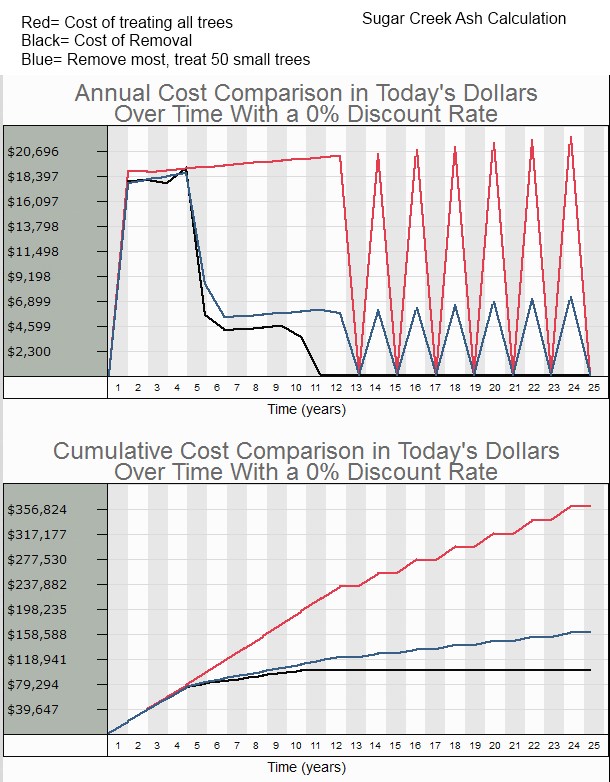
As you might have guessed from the above, it is my opinion, verified by a lot of calculations, that it is almost always more desirable and cost-effective to remove an Ash tree and replace it with a more disease-resistant, longer-lived, and safer tree.  I know many arborists selling treatment will argue with me, but the math is not on the side of treatment in the vast majority of cases.  If you have an Ash tree that you consider invaluable to your property and it is in good condition and it isn't too old and it is not likely to become a hazard, then I would consider treatment.  If not, cut your losses and plant something else!

The graphs below were created using the Purdue EAB Cost Calculator.  As you can see, with Sugar Creek's large Ash population it is not cost effective to try and save all of our Ash trees.  These costs are Purdue's estimate and may be higher than we could do the work for, but the relative costs are what counts.  With a removal program combined with replacement of the landscape trees over time, the cost of the strategy disappears in 10 years or so.  With treatment, it never disappears and the trees will still die some day with age and storm damage.
Comparison of EAB removal vs treatment

Below is a picture of Ash storm damage. After almost every wind event, some older Ash trees need to be pruned or removed. This is true for both golf course trees and street trees. Most of the Ash trees at Sugar Creek are older and were in decline before the borer arrived. They were becoming hazardous to the clubhouse and driving range net, so their removal will give us a chance to plant trees more suited to the location.
Typical Ash tree storm damage
Most of the Ash trees at Sugar Creek are located along the fencelines around the driving range and on the 6th hole. Over the next few years, these trees will be removed and replaced with a variety of disease-resistant trees and shrubs.  We are beginning replacements for the 44 trees removed this winter this spring behind the 6th green.

Map of Ash trees at Sugar Creek Golf Course

Sunday, July 8, 2012

Week of July 4th Brings Wind Storm and Heat Wave

The week of July 4th, 2012, is not one we are going to forget any time soon.  It started with 1.5 inches of rain and a violent wind storm on Sunday afternoon.  Power was knocked out in the area for at least a day -- many days for some residents.  To add insult to injury, a heat wave set in making the work of clean-up crews uncomfortable and potentially dangerous.  At Sugar Creek, the crew quickly went from storm clean-up on Monday and Tuesday to trying to cool extremely hot turf the rest of the week.
The wind storm on July 1st left the course covered in debris.  Most of the greens looked like this: 
Sugar Creek wind storm 5 Green with debris
5 Green - July 1, 2012
The storm brought down many large limbs that had to be cut up and chipped.  4 fairway in particular was covered in limbs from the large Cottonwoods on that hole. 
Golf Course fairway with cottonwood limbs down after wind storm
4 Fairway - July 1, 2012
On the 9th tee, the wind knocked over a Norway Spruce.  Spruce are shallow rooted in clay soil and can be pushed over in heavy winds.  We were successful in standing this tree back up, but it may still decline from the loss of roots on one side. 
Norway Spruce on 9th tee
This poor Bald Cypress had its top taken off.  It has a vertical branch that looks like it will turn into a new leader.  It will have a "unique" shape but will survive. 
Bald Cypress on 6th fairway
The rain came down so hard that it washed out all of the sandtraps.  Events like these are why our sand has become mixed with debris and clay from the top edge of the trap.  I was just reading an article that stated: "Principle one is that no surface water should enter the trap.  Of all principles in sand trap construction, this one is paramount" (Daniel, Golf Superintendent).  The designers and builders of our sand traps must not have read that article.  To be fair, I'm sure they were aware of the surface water issue but sometimes visual impact, construction cost, and placement of the hazard are put before playability, maintenance cost, life span, and reality. 
Golf Course sand trap bunker washed out after thunderstorm
July 1, 2012
The grounds crew had the course playable by Monday morning at 6:30 am using a combination of mowers, blowers, chainsaws, tractors, rakes, and pitchforks.  Tree work continued into Tuesday, but then it was time to turn our attention to the extreme heat on July 4th, 5th, and 6th.  Around 3pm each day, I measured 2 inch soil temperatures over 100 degrees in our historically weakest areas.  The underlying soil in these areas was still moist from the 1.5 inches of rain on Sunday so lack of water was not the issue.  Cool season grass roots simply cease to function at these temperatures.  All we could do is syringe these areas carefully to cool them down.  Syringing lowered the canopy temperatures in these areas to 94 degrees temporarily.  Not great, but an improvement over 100. 
You know the turf is under extreme stress when your footprints stick in previously very healthy turf: 
Golf course turf footprints stick in grass during extreme heat
Stressed turf - July 6, 2012
 Below Gary is syringing, or misting, stressed portions of fairway.  Last week, we were hand watering dry soil and drought stressed turf with high flow nozzles meant to re-wet dry soil.  This week, we are using misting nozzles to cool the turf through evaporation and perhaps get the plant to take in small amounts of water during this cooler period.  The cooling effect lasts only a short period of time.  Significant effects are gone after 15 minutes but this can be enough to get some turf through the stress period. 
Gary syringing #1 fairway
This picture was taken on July 6th at 1pm in the shade!  I would expect this temperature when solar radiation was added to the mix, but I was surprised to see temperatures over 100 degrees in healthy turf with some shade during mid-day. 

One thing is for sure: Next week will be just as busy at Sugar Creek.  With cooler weather, we can take steps to speed up the recovery process on tees and fairways through cautious solid tine aerification and irrigation practices.  We have to be careful not to do more harm than good in our attempts to help the turf recover. 
We are definitely thankful for this forecast.  Especially the night time lows in the 60's.  Looks like a beautiful week for golf -- and turf recovery:


Monday, June 25, 2012

Dry Weather, Great Golf


Northern Illinois has been very dry for the entire first half of the year.  Here at Sugar Creek Golf Course, we have had only a 1/2 inch of rain in June so far.  Combined with days of very low humidity and high wind, the soil is as dry as we've ever seen it.  It has kept us busy in the maintenance department trying to relieve the stress on the turf through hand-watering and targeted irrigation.  For us this is good news after the last 3 years of excessive rainfall.
In the following shot you can see some dormant rough on the high side of the hill:


Dry rough!  It's beautiful!  Why do I say that?  I have not seen this area dry out since 2007, but I also haven't seen the fairways as firm and consistently playable either.  Areas of rough that are out of play and at the margins of the irrigation system should be dormant in a drought.  It is only natural and indicates that playing conditions are probably outstanding where it counts.
The course is weathering the drought thanks to some great root growth this spring.  We are glad this drought didn't come after the cool, wet, rootless springs of 2010 and 2011.  We could certainly use some rain soon, but the course is holding up well to the dry conditions.


The 7th fairway in the shot above is healthier than it has been in a long time after the many projects and aerifications we have given it in the past two years.
The new sand trap in front of #8 is functioning well so far.  Thankfully it has yet to be tested by too many thunderstorms.  It did handle a rain event over an inch in May with zero puddles. 

The 6th fairway is also looking good and enjoying the dry weather:

It looks like this dry period is going to get a little worse before it gets better, but we are looking at the bright side of things.  Too dry is much better than too wet!

Wednesday, September 14, 2011

Summer of 2011 : Seeding Fairways

Meteorological summer is over and it has definitely cooled off in the Chicago area -- just barely dipped under 50 last night in many areas.  The last month has been a busy one at many golf courses in the area struggling to recover from late July's rain and heat.  Luckily, August was not extreme: 1.1 degrees F over normal and about average rainfall.  This meant that it was possible to get seed to grow in fairway areas.

In the last 5 weeks, we experimented with several methods of seeding and aerification in the fairways.  We used a slicing knives several times in an attempt to break through the thatch into soil.  This worked in some spots.  We also used an Aera-vator with a seeder to spike seed and cultivate areas.  Other areas we used a Ryan Mataway slit seeder.  All three methods worked to one extent or another.  The trick is to get seed-to-soil contact without making the situation worse or delaying recovery. 

Seed growing in aeravator holes
Some of the plants you see are not new seed.  Most of these areas in our fairways are composed of annual bluegrass, or Poa annua, an annual grass with lots of seed in the ground.  It is very aggressive in spring and fall, but often dies in summer.  In some of these areas, our new seed may have gotten started early enough to establish before the annual fall resurgance of Poa annua.  In others, Poa will likely take back over. 

You can identify Poa annua by its bunch-type growth, yellow-green color, and "boat-shaped" tip:

Annual blugrass boat shaped tip
Annual bluegrass is not exactly what we want to see because it is the species that died in the first place, but it is turf and you can play golf on it!  There isn't any way to stop it without stopping our new seed also, so superintendents have to constantly manage it. 

About three weeks ago, we slit-seeded the first fairway and it is starting to fill in:
First Fairway slit seeding

It is easier to see the fuzzy new grass with dew on it
Finally, an area on 7 fairway that suffered from water damage needed more aggressive tactics.  Using an Aeravator, rake, and roller, we essentially cultivated and seeded the area around this drain:

 The seed germinated very quickly and is doing well.  If you click on the image, you can see them more easily:

Seedlings on 7 Fairway
Many other areas have already recovered from early August and the rest are filling in quickly.  September has really been a nice month!

6th Hole

1st Green

Update September 22, 2011:  Seedlings are really filling in on our fairways.  The renovated area on the 7th fairway now looks like this:
7 fairway
Overall, we have had a lot of success this year replacing pesky Poa annua with bentgrass and bluegrass.  Hopefully these seedlings will toughen up before winter and make great turf next year!

Wednesday, August 10, 2011

July Weather Since 1990

One of the interesting parts of working in the golf world is dealing with weather.  It is important to understand weather variations over time when planning future projects and evaluating the success of past projects.  The last two summers have been hot and stormy, so I was curious: How "normal" is this weather?  When was the last summer with high heat and lots of rain?  The chart below summarizes July weather in Chicagoland since 1990.

(Click chart for full size view)

There are lots of ways to measure heat and precipitation, but I looked at the National Weather Service's departure from average figures for July. Out of curiousity, I also added in the number of days with rains over .5" -- big rains, in other words. 

The pattern confirms what I have heard from other Superintendents in the area.  Besides 2010, the last July we saw this extreme combination of high heat and heavy rain was . . . 1995.  Many people remember 1995 for its 100 degree days, but July also saw a lot of storms in this area.  We have had other unpleasant months over the years, but 1995, 2010, and 2011 really stick out for their combination of hot and wet -- one of the toughest situations for golf courses.

Notes on the chart:  Clicking on the chart will open a larger version.  Most of the data came from the National Weather Service.  I made a couple adjustments based on local measurements.  For instance, O'Hare measured over 11 inches July 2011 but we luckily missed a few of those inches.  It is important to note that this chart is only meant to summarize weather in July, not the entire summer.  There are many other factors in turfgrass health and golf playability, but July weather is very significant in our area.  I will take a look at August and its effects later this year.

Monday, August 8, 2011

Interview with a Fairway


A lot of golf course fairways have been hurting since it started raining this summer.  I decided to go straight to the source and ask our fairways some tough questions.  The following is a transcript of our interview:

So, fairway, it looks like you’ve been having a rough time in the past weeks?

Tell me about it!  I was doing great up until it started raining again.  I appreciate a nice shower.  Even a short bath I can tolerate, but I can’t sit in water for a week.  I can’t breathe.  Especially when the sun is out – that water gets hot!  Try holding your breath underwater in a hot tub.  That’s what it’s been like.

How did you cope with the extreme heat?  Was that a problem?

That string of really hot days wasn’t a walk in the park, but I survived.  The maintenance crew tried to give me just the right amount of water.  Too much water would have cooked me and too little would have permanently wilted me.  I made it through those hot days by breathing at night and holding my breath during mid-day.  That way I didn’t wilt to death during the middle of the day.  I’m not saying it was pleasant, but I can handle that for a while as long as the maintenance crew is helping me out. 

If you didn’t mind the extreme heat, when did the trouble start?

Well.  I started getting wet.  The first downpour was alright.  I soaked it up and it was cloudy and not too hot out.  The second one on July 23rd was way too much for me to handle, my roots were saturated and I couldn’t breathe.  Luckily it wasn’t too hot and sunny so you couldn’t really tell how much I was hurting. 

It seemed like you suddenly got sick right after that.  What happened next?

Just when I was starting to dry out and feel good again, I got a combined 2.5 inches of rain on the 28th and 29th.   Those two days were cloudy and not too hot so I just held on partially underwater.  Some of my low spots were starting to get smothered, but I was mostly ok.  And then it happened . . . Saturday and Sunday were the worst!

Did you get a horrible disease or something?

Not really.  The maintenance crew had just helped me out with some protectants that prevented most of the diseases.  I may have had a spot or two of Pythium Blight and Brown Patch, but that wasn’t really a big deal.  It was just the conditions out here on the 30th and 31st.  Remember, I’m plants, I can’t run away from lethal heat like you can -- hiding in your nice air conditioning all day and night!  I have to just sit here and take it.

I remember it was miserable out there in the middle of the day.  Why couldn’t you use the water to cool off?

My roots were still soaked and it was very humid so I couldn’t transpire.  Kind of like humans and your sweat, I need to evaporate some water to cool myself off.

Didn't the maintenance crew just add some drain lines on the first hole to help you out?

Yes they did, and I appreciate the effort.  They put a new line under the cart path and some other lines.  I'm sorry, but the way I'm built, it's going to take a lot more than that to dry me out when it rains this much! 

New drain and sodded area on #1.  Sod didn't make it.
OK.  So what happened?

 I wasn’t dry yet and the sun came out.  July 30th was the sunniest day in a long time and the temperatures hit the low 90’s.  The sun heated up the surface of the water that was partly covering my blades to over 110 degrees and it cooked their insides.  In a four hour span on Saturday afternoon, a lot of my cells turned to useless soup.  Sunday afternoon hurt again with the exact same conditions. 

Can we do anything to help right now?

Well.  The maintenance crew tried to help by aerating some holes for me.  Unfortunately, it has continued to rain so I still haven’t been able to breathe much.  Just rained another 1.5 inches in the last 24 hours.  At least the temperatures have cooled off so I’m not losing any more plants.  I know the maintenance crew is going to aerate and overseed this week once I dry out a little.  I’ve been in this situation before and I always come back with a little help.  Please be patient while I grow some new shoots and roots. 

Why are other areas of the course growing so well and you’re not? 

There are lots of reasons, but most of them go back many years.  If you notice, I’m low and the greens and tees are high – for the most part.  They were built with soil and sand custom made for greens and tees.  I’m all clay, rock, asphalt, and brick.  You might not know this, but I was a rock dump before I was a golf course fairway.  The greens and tees got the benefit of topsoil and there wasn’t much left for me.  I have a rougher life than those pampered greens.  They don't even get driven on by carts!  The tees are less spoiled – at least they have to deal with divots.  Now, if you'll excuse me, I need to grow some roots now.

One more question -- When do you think you'll be back to "normal"?

If past years are any guide, I will probably have one more rough patch in August that will prevent a big recovery.  At the end of August, I will recover and grow new shoots with the help of the maintenance crew.  By October 1, you may not be able to tell that it was another hot, wet summer.

Early October 2010
That was the end of our interview.  You may want to see these post for more information:

Scald and annual bluegrass (Poa annua) problems:
http://sugarcreekgolfcourse.blogspot.com/2010/07/turf-notes-summer-decline-of-annual.html

Pythium Blight:
http://sugarcreekgolfcourse.blogspot.com/2010/08/turf-notes-pythium-blight.html

Drainage project on 1st hole:
http://sugarcreekgolfcourse.blogspot.com/2011/05/1-cart-path-drainage-project-update.html

2010 -- a similar year for us -- in review:
http://sugarcreekgolfcourse.blogspot.com/2010/12/2010-year-in-pictures.html


Monday, August 1, 2011

Venting Fairways and Tees

The past couple weeks have not been kind to most Chicago-area golf courses.  First we had extreme heat and then lots of rain.  While some turf wilted in the heat and the rough went dormant in many areas, we could cope with dry and hot.  The wet period that started on July 22nd was a different matter.  The end of last week (July 27-29) saw significant rain 3 days in a row with warm temperatures.  This created a situation we know well in a wet late summer -- a toxic soup of wet wilt, scald, and pythium.  The high temps this weekend cooked saturated, low-lying fairway areas but the rough is looking fabulous!  Quite a few golfers have commented on how green it is on the course and they are right:  The greens, higher areas, and rough are healthy and growing fast.  It is those lower areas that are the problem.
Scalded low area near the creek on #1.
At the moment, there is only one thing we can do to improve the situation and speed up turf recovery -- Vent!  Not the verbal kind of venting, although that can help, but the mechanical kind.  Venting refers to solid tine aeration done mostly for the purpose of improving gas exchange in the soil.  We have been using a machine called the Planet Air on the fairways that shatters soil while leaving only a slit in the turf and a minimum of mess.  Tees are being treated with solid tines on a conventional aerifier.  So far, I have no plans to needle tine the greens as they are still performing well. 
Aerator uses a slicing motion to vent turf

Slicing Tines on Planet Air
I've noticed a lot of superintendents are doing the same thing and dealing with a lot of the same problems.  Check here for more recent superintendent blog posts (Link).  I especially like this blog post as they seem to be in a similar situation (Link).

In his Scouting Report for July 29, 2011, Dr. Settle writes: "Then there's why overly wet rootzones are our worst enemy. Midsummer is never a good time for cool-season turfgrass because any additional downward spiral of turfgrass health can be difficult to reverse until cooler weather returns. Root biomass/length are at their lowest levels and what's left root-wise has impaired function because of high soil temperature. Turf plants in physiological decline display abnormal photosynthesis and respiration, yet concentrated wear continues on a daily basis (the life of a golf green). Often the only recourse is a well-timed cultural method such as needle-tine aeration. If it sounds as if I'm exaggerating or blaming the weather too much, guess again."

Thanks for telling it how it is!  Wet + Hot + Stress = Unhappy Turf.  These scouting reports a great resource for everyone involved in golf.  You can check them out at Chicago District Golf Association Turfgrass.
Classic water damage in a drainage swail.
Saturated conditions lasted for longer than the turf could tolerate.

Thursday, March 17, 2011

Turf Notes: Annual Bluegrass and Winter Hardiness

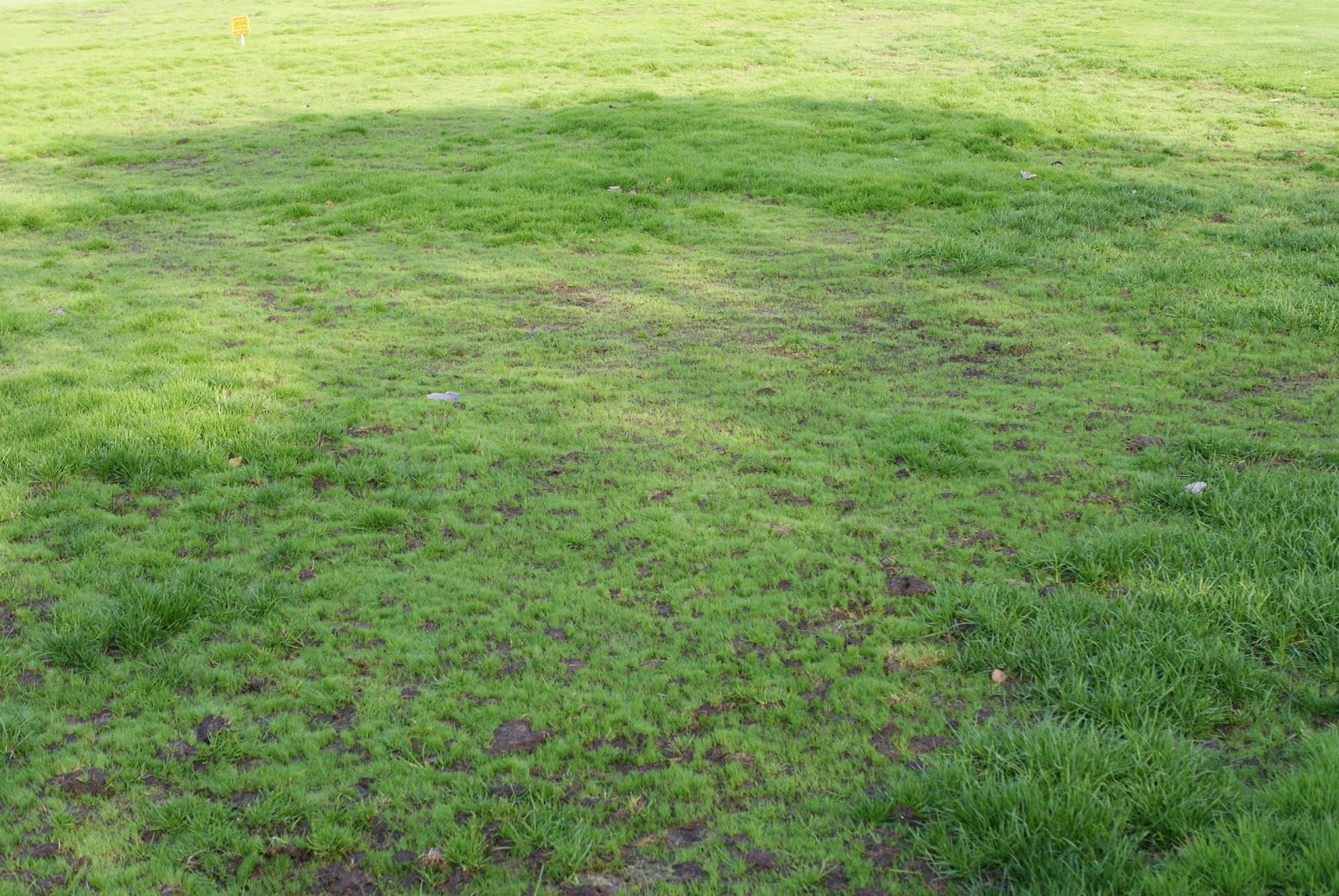
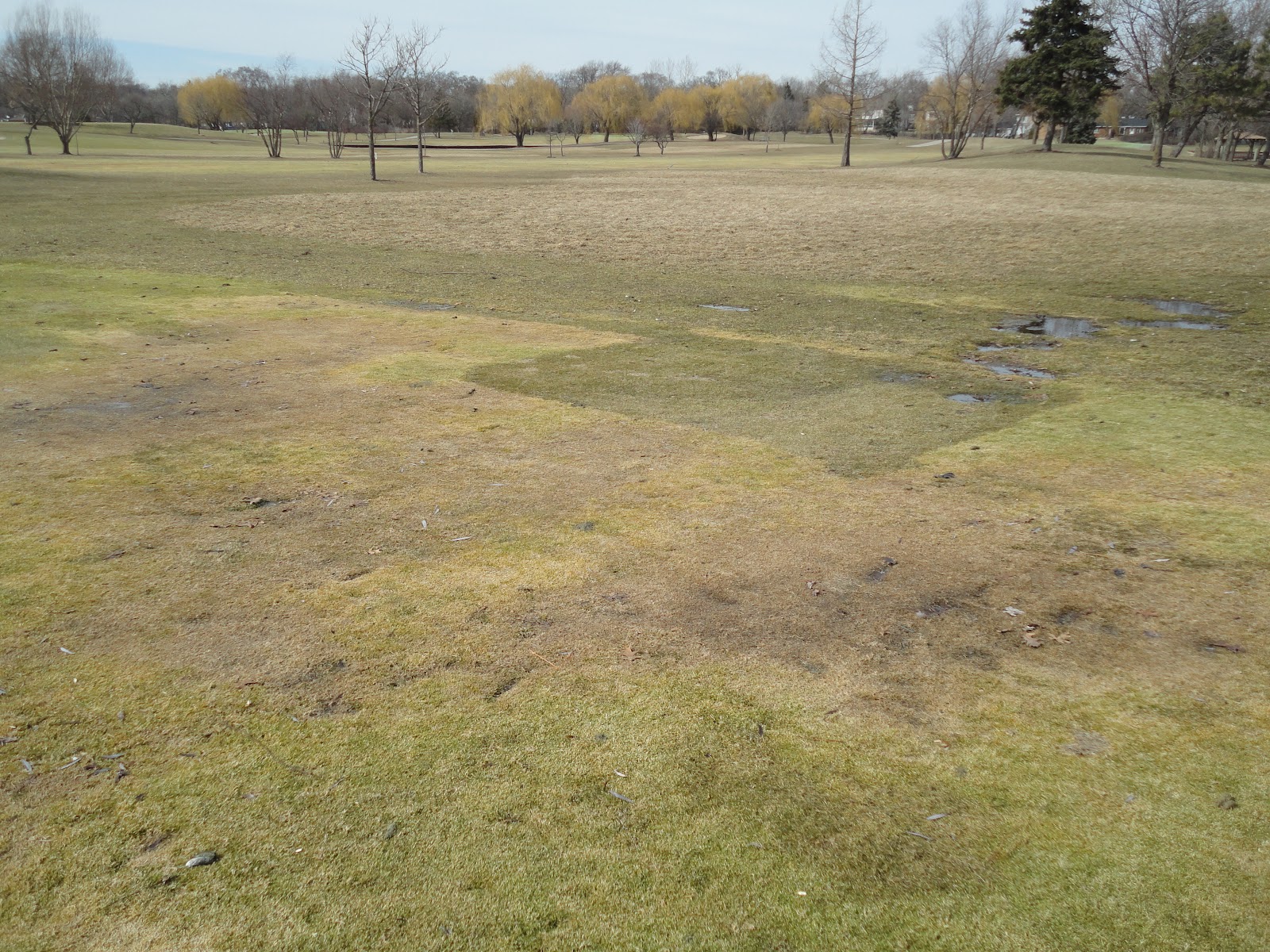
Compared to last year, it looks like we will have only limited areas of winterkill this spring.  In 2010, a long period of snow cover and a long period of freezing and thawing of ice sheets resulted in a lot of lost annual bluegrass (Poa annua).  We sodded the worst areas and slit seeded the rest.  For pictures from 2010, see "7th Fairway- Update."  
Sodding areas of the 6th fairway in 2010
If you see any strange patterns or lines in the fairways this March or April, it may be areas sodded with bentgrass in 2010.  Pictures like the ones below really illustrate the weaknesses of annual bluegrass compared to creeping bentgrass or Kentucky bluegrass. 

Bentgrass sod design on 6 fairway

Another square on 6 fairway from 2010

Creeping bent on the left -- Annual bluegrass on the right

Large square sodded in 2010
These areas have 2 problems that go together: poor drainage (they are naturally low and almost flat) and poor turf species.  While it will take a combination of approaches to improve these areas of the fairways, I am glad to see that bentgrass is capable of surviving the winter in these difficult spots.  It shows that keeping up with our current strategies will improve these areas in the long term.

Right now, you can really see the contrast between different grass species and their reaction to cold temperatures.  Unfortunately, most of the brown areas around our sod from 2010 will green up with warmer temperatures.  I say "unfortunately" because it would be a lot easier to get rid of annual bluegrass if it would die off and stay dead.  Its persistance is amazing.  It will die in a heartbeat in the winter and summer and re-germinate just as fast in the spring and fall.

Tuesday, July 20, 2010

Turf Notes: Summer Decline of Annual Bluegrass

So far, 2010 has been very different than 2009 or 2008 for turf managers.  2010 soil tempuratures have been on average 10 degrees higher than 2009.  The same goes for air tempuratures and humidity.  We have also experienced extreme fluctuations in moisture - excessive rain followed by dry periods.  While most turfgrasses can handle this sort of stress given decent soil conditions, there are a few that can't.  The most notable being annual bluegrass, or Poa annua:


Photo: University of Kentucky Annual Bluegrass Profile

Introduction
Most turf is composed of different species of grass, unless it is a new construction planted as a monoculture.  In most older golf course fairways, you can observe different types of bentgrass, Kentucky bluegrass, rye, Poa annua, and Poa trivialis all within a 500 square foot plot of turf.  This has some benefits.  Often when one species declines, another will take over.  It is the transition period that causes problems for turf managers.  Of the above listed species Poa annua (annual bluegrass) is the most problematic.

The life cycle of annual bluegrass is important to understanding its summer decline.  Annual bluegrass grows aggressively in spring and germinates aggressively in fall.  Summer and winter are its weak points.  It does not survive cold temperatures or ice cover like perennial species, and it is genetically programmed to die during the summer.  Some years, like 2009, it survived all year under cultivation (like at a golf course).  This year, its weaknesses are more clear.  Unlike creeping bentgrass or Kentucky bluegrass, annual bluegrass does not have a physiological mechanism like dormancy for dealing with heat stress.  It doesn't have to since it relies on seed to perpetuate the species. 

Turf managers often look at soil tempurature to determine the likelihood of turf stress.  Significant root growth stops at 70 degrees F in cool season grasses, and completely shuts down at 80 degrees.  Turf is in serious trouble at 90, especially annual bluegrass.  Our soil tempuratures at the 4" level have been reaching 84 degrees with surface temperatures over 100 degrees some days.  In the presence of water, this leads to scald or wet wilt.  According to Dr. Beard, a well-known turf expert, "cool-season grasses - such as bentgrasses (Agrostis spp.) and annual bluegrass (Poa annua) - are physiologically adapted to optimum growth at temperatures of 60 to 75 degrees F. Even so, cool-season grass species demonstrate various capacities for heat resistance, ranging from medium for grasses such as Kentucky bluegrass to very poor for annual bluegrass and rough bluegrass, among others."  See his article "Dealing with heat stress on golf course turf" for a great discussion of summer decline.

A lot of factors contribute to the growth of annual bluegrass in fairways.  Low mowing heights allow annual bluegrass to invade other types of grass, along with irrigation, fertilization, and low areas with poor drainage.  A 2.5 inch bluegrass lawn is in little danger of being invaded, but it is inevitable on a 1/2 inch fairway.  In a classic turfgrass catch-22, a lot of golf course maintenance practices like mowing, fertilization, and irrigation even when done right allow annual bluegrass to survive making the situation worse, not better. 

Recent Case Studies
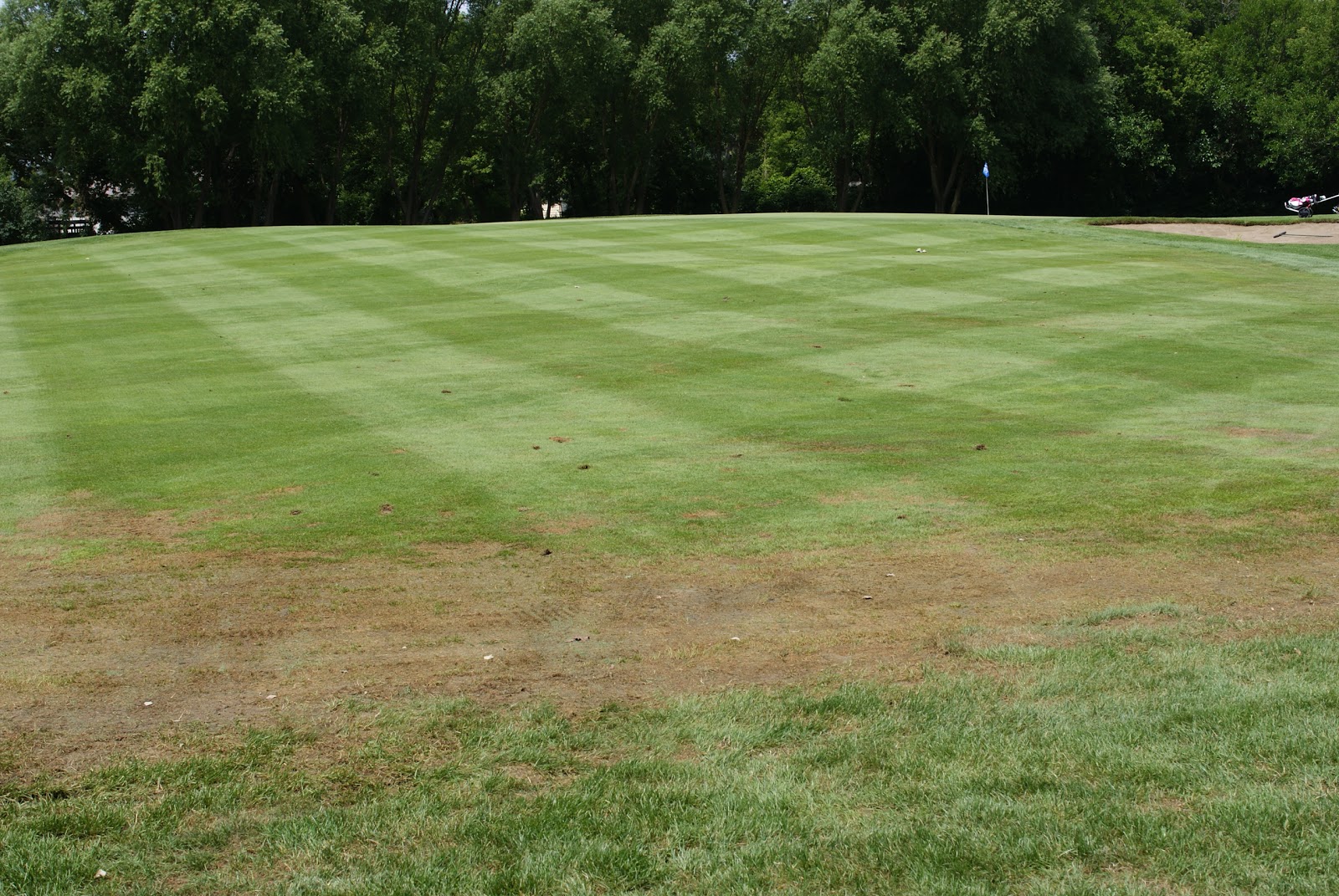
At Sugar Creek and many area golf courses of similar construction, a lot of Poa annua declined over the last two weeks.  We had an abnormally wet June followed by a dry period.  Often turfgrass benefits from rainfall, but not in excess.  The prolonged wet, warm period encouraged shallow rooting in many low-lying areas.  During the period from July 6th to the 13th, it rained here every day but one including a soaking 1" rainfall on the 11th.  The turf did not have a chance to dry out before we had 5 days of 90 degree temperatures from July 14th to 18th.  Solar radiation plus excessive moisture plus high soil temperatures = "physiological decline of Poa annua."  Another fancy term for it is "necrosis due to abiotic environmental factors."  Many superintendents like myself prefer a simpler term: "It baked."  The Poa baked on certain tees and fairways in areas with saturated soil.  The spike in soil temperature literally cooks the cells of the plant.  Often when we see brown grass, our first instinct is to put water on it.  That is why you may see superintendents using soil probes to determine if the stress is caused by too little water or too much.  More often than not, the cause is too much water.

While these areas of Poa annua are suffering right now, they will come back from their own seed once soil temperatures go down and the days shorten.  That is what they are genetically programmed to do.  Looking back at photos from 2005, another rough year for turf, the same areas suffered during the summer but came back quickly in September. 

Through the following pictures, I'll try to give my diagnosis and answer that important question: "Why did that grass die?"

#4 Tee

Back tee on the 4th hole:  This tee is somewhat shaded with inadequate drainage.  It is, or was, mostly comprised of Poa trivialis (Roughstalk bluegrass) and Poa annua (annual bluegrass).  The green turf is the Roughstalk bluegrass which is only slightly more heat tolerant than annual bluegrass.  I watched the Poa annua on this tee decline over the course of 1 day on July 14th.  There were no signs of disease or other causes and the surface moisture under the turf canopy was hot to the touch. 

Diagnosis: Scald of Poa annua.  From "Understanding Wet Wilt" by Dr. Peter H. Dernoeden: "On sunny days when air temperatures exceed 90°F, the temperature in the upper 2.0 inches of wet soil can range from 95°F to 100°F. These conditions led to root dysfunction and/or a rapid loss of roots."  And later: "Indeed, turf almost literally 'cooks' in hot and wet soils.  Affected greens initially appeared brownish and water-soaked. Turf soon thinned out in irregular shapes, but damage often followed the natural drainage pattern of the green." 

#5 Tee

The 5th tee was sodded in 2003 with a low-mow cultivar of bluegrass.  Unfortunately, the soil settled and created a drainage problem.  With low mowing heights and excess water, Poa annua took over this tee.  Over the years, we aerified, topdressed, and seeded  frequently to try to improve the situation, but to no avail.  You can see some algae growth on the scalded Poa annua which died in the presence of water on the same days as the 4th tee -- July 14th through the 18th.

Here's a soil plug from July 19th:


It is difficult to tell from the photo, but the soil was still moist even after several days of drying.  You can see the layer of top dressing to the left of the photo.  Even with this layer, areas of the tee are still lower than the rest causing water to sit there for long periods. 

Diagnosis:  Scald of Poa annua.  Again.

#1 Fairway


This area is often soaked after rains.  There is only about a foot of elevation difference between here and the creek and the contour is not consistent.  There are ridges that hold the water here for extended periods.  The interesting part of this photo is not the what went wrong but what didn't go wrong.  Why did some patches survive and others did not?  They had the same soil conditions, moisture levels, fertility and maintenance.  What is different about them?  The answer is genetics.


This isolated patch of creeping bent clearly illustrates the difference between the two grasses.  Even though this patch is not an intentionally seeded cultivar - it simply drifted here on its own - it was able to take what nature threw at it while the annual bluegrass could not.  Due to the grading of the fairway, this will always be tough spot to grow grass, but this photo indicates to me that bentgrass would be a better species for the area than Poa annua.  While it is difficult to establish turf during the summer months, slit seeding some bentgrass just might increase the percentage of quality turf in the area.  Once fall hits, the annual bluegrass will germinate with a vengeance and fill in the remaining area.  It's a never ending battle. 

Further Reading

Recent turf reports from the Chicago District Golf Association address this issue: See July 16 - From this report: "Even if we do everything correctly, Mother Nature may not play fair. I am sure we will have issues, but to what extent it is hard to say.  Clearly Poa annua, which does not like hot weather, will die."

WARM (Water and Atmospheric Resources Monitoring Program) - This site tracks soil temperature and evapotranspiration in Illinois.  I use it all time as a resource before going out and taking local readings. 


Search the USGA Green Section Record for "annual bluegrass" to find everything you would ever want to know about Poa.

Sunday, May 16, 2010

Cart Path Restrictions

After heavy rains, golf courses often have to restrict cart traffic.  There are generally two types of restrictions: no carts available or cart path only.  We do this to limit damage to the course and ensure playability for the season. 

The following is from the Golf Course Superintendents Association:

For the sake of your golf course, remember that golf car traffic can cause damage to the golf course that is both unsightly and expensive to repair. Tire ruts in soft, wet areas can take weeks to heal. Compaction caused by heavy traffic can ruin the playing surface. As a result, most courses have a standard golf car policy and sometimes employ temporary restrictions due to weather, construction or other factors.

Golf course superintendents only put restrictions such as "Paths Only" rules in place when they feel it's necessary to protect the turf from damage. (GCSAA Article)
After the heavy rains Thursday, we had to restrict carts to paths only for two days.  During that time, we had some golfers stray from the paths with visible results. 

The pictures below show why we occasionally have to restrict cart usage:


As a superintendent, I really dislike having to restrict cart usage to the paths but you can see why it is important.  Imagine if 10 people decided to go off the path instead of the 2 or 3 that probably did.  If the areas you can see in the pictures were driven over multiple times, these areas would be damaged for weeks or even months. 

To summarize, cart path restrictions are put in place by the people who really know the condition of the golf course and they are for every one's benefit.  Just like frost delays, no one likes them -- but they are necessary for the health of the course.