Showing posts with label Sand Traps. Show all posts

Sunday, July 27, 2014

July 2014: On the course

After a lot of rain in early July, the last couple weeks have been beautiful.  We are especially grateful for the moderate temperatures this year since the harsh winter left us with weaker turf than usual.  The National Weather Service is predicting a similarly mild August with average rainfall which should equate to great conditions for golf.

Below is the putting green on June 27th.  I am often asked about the ornamental grasses you can see in the background along the first tee.  They are Calamagrostis x acutiflora 'Karl Foerster'.


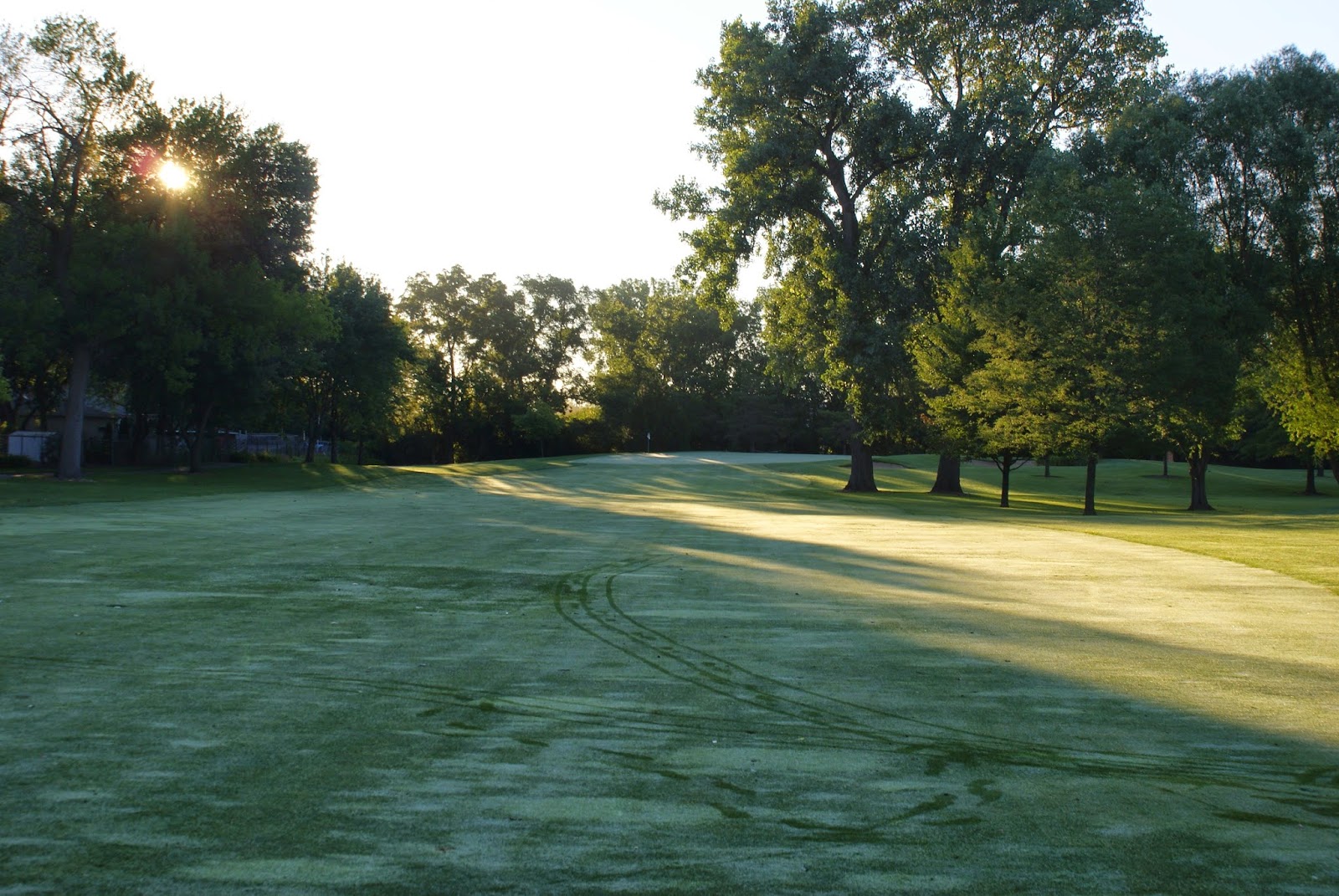
Early mornings have been beautiful lately:

5 Green

4th Hole

Karl changing cups on the 4th green

Below is the 9th hole and clubhouse.  On the left you can see some of the Ash trees that were killed by the Emerald Ash Borer over the last year.  For more on this destructive insect see here.


The renovated bunkers are performing very well.  Improved drainage, new sand, and a sod "face" have greatly improved this sand trap on the first green.  A small amount of rain used to wash this trap out and make it unplayable. Now it is playable hours after a strong thunderstorm.


Even the infamous 7th fairway has been cooperating this year after starting out more than 50% dead.  So far, we have not experienced the deadly combination of excessive rainfall, high heat, and solar radiation that damaged this floodplain fairway in 2010 and 2011.
7th Fairway enjoying 2014

And finally . . . Safety first!  Two junior greenkeepers try on bump caps before inspecting the course:


Sunday, July 8, 2012

Week of July 4th Brings Wind Storm and Heat Wave

The week of July 4th, 2012, is not one we are going to forget any time soon.  It started with 1.5 inches of rain and a violent wind storm on Sunday afternoon.  Power was knocked out in the area for at least a day -- many days for some residents.  To add insult to injury, a heat wave set in making the work of clean-up crews uncomfortable and potentially dangerous.  At Sugar Creek, the crew quickly went from storm clean-up on Monday and Tuesday to trying to cool extremely hot turf the rest of the week.
The wind storm on July 1st left the course covered in debris.  Most of the greens looked like this: 
Sugar Creek wind storm 5 Green with debris
5 Green - July 1, 2012
The storm brought down many large limbs that had to be cut up and chipped.  4 fairway in particular was covered in limbs from the large Cottonwoods on that hole. 
Golf Course fairway with cottonwood limbs down after wind storm
4 Fairway - July 1, 2012
On the 9th tee, the wind knocked over a Norway Spruce.  Spruce are shallow rooted in clay soil and can be pushed over in heavy winds.  We were successful in standing this tree back up, but it may still decline from the loss of roots on one side. 
Norway Spruce on 9th tee
This poor Bald Cypress had its top taken off.  It has a vertical branch that looks like it will turn into a new leader.  It will have a "unique" shape but will survive. 
Bald Cypress on 6th fairway
The rain came down so hard that it washed out all of the sandtraps.  Events like these are why our sand has become mixed with debris and clay from the top edge of the trap.  I was just reading an article that stated: "Principle one is that no surface water should enter the trap.  Of all principles in sand trap construction, this one is paramount" (Daniel, Golf Superintendent).  The designers and builders of our sand traps must not have read that article.  To be fair, I'm sure they were aware of the surface water issue but sometimes visual impact, construction cost, and placement of the hazard are put before playability, maintenance cost, life span, and reality. 
Golf Course sand trap bunker washed out after thunderstorm
July 1, 2012
The grounds crew had the course playable by Monday morning at 6:30 am using a combination of mowers, blowers, chainsaws, tractors, rakes, and pitchforks.  Tree work continued into Tuesday, but then it was time to turn our attention to the extreme heat on July 4th, 5th, and 6th.  Around 3pm each day, I measured 2 inch soil temperatures over 100 degrees in our historically weakest areas.  The underlying soil in these areas was still moist from the 1.5 inches of rain on Sunday so lack of water was not the issue.  Cool season grass roots simply cease to function at these temperatures.  All we could do is syringe these areas carefully to cool them down.  Syringing lowered the canopy temperatures in these areas to 94 degrees temporarily.  Not great, but an improvement over 100. 
You know the turf is under extreme stress when your footprints stick in previously very healthy turf: 
Golf course turf footprints stick in grass during extreme heat
Stressed turf - July 6, 2012
 Below Gary is syringing, or misting, stressed portions of fairway.  Last week, we were hand watering dry soil and drought stressed turf with high flow nozzles meant to re-wet dry soil.  This week, we are using misting nozzles to cool the turf through evaporation and perhaps get the plant to take in small amounts of water during this cooler period.  The cooling effect lasts only a short period of time.  Significant effects are gone after 15 minutes but this can be enough to get some turf through the stress period. 
Gary syringing #1 fairway
This picture was taken on July 6th at 1pm in the shade!  I would expect this temperature when solar radiation was added to the mix, but I was surprised to see temperatures over 100 degrees in healthy turf with some shade during mid-day. 

One thing is for sure: Next week will be just as busy at Sugar Creek.  With cooler weather, we can take steps to speed up the recovery process on tees and fairways through cautious solid tine aerification and irrigation practices.  We have to be careful not to do more harm than good in our attempts to help the turf recover. 
We are definitely thankful for this forecast.  Especially the night time lows in the 60's.  Looks like a beautiful week for golf -- and turf recovery:


Tuesday, April 24, 2012

Tale of the Trap -- Part 2

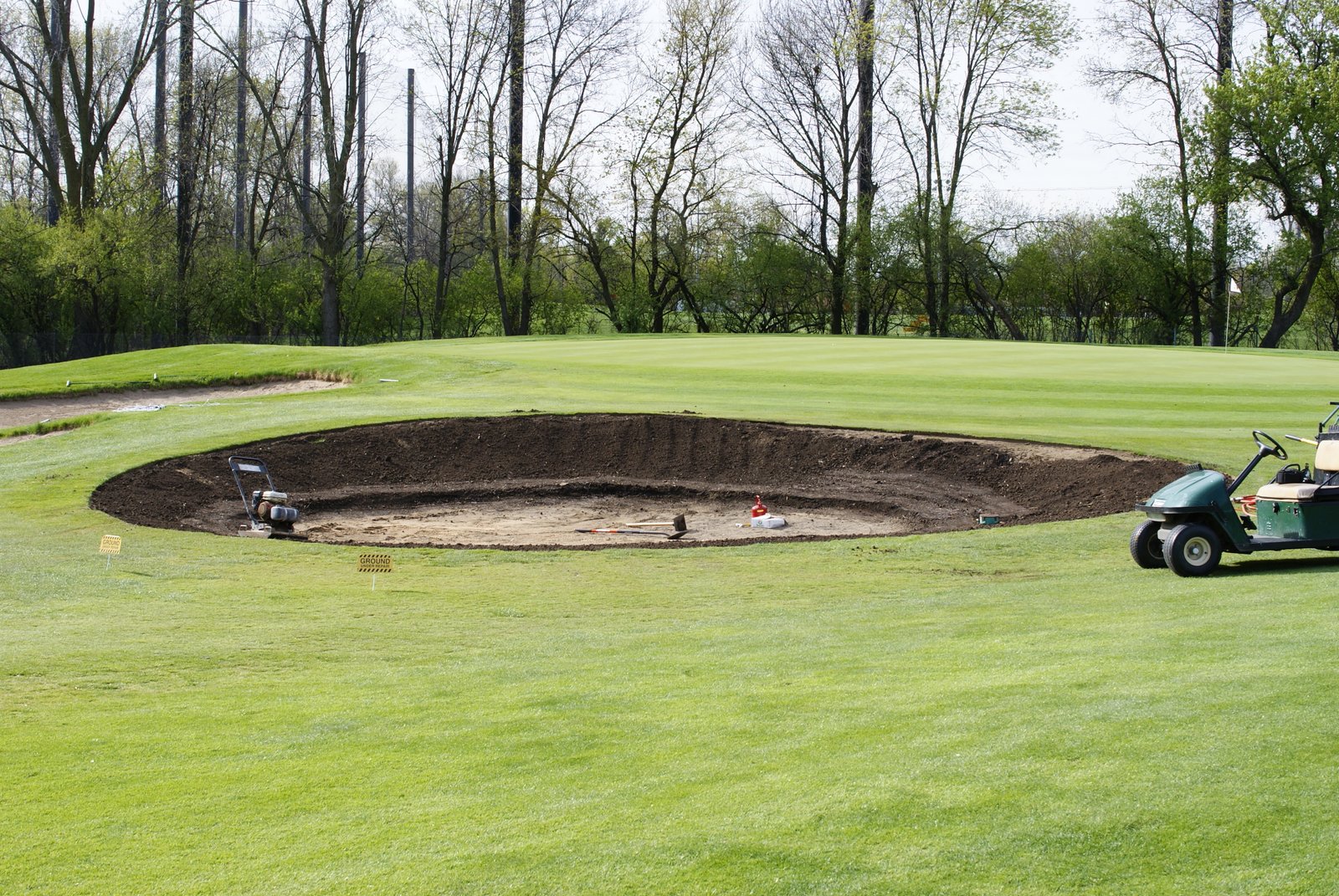
Work is complete on the sand trap in front of the green on the 8th hole.  Many golfers have commented that the new trap and surrounding area will be easier to play from in some ways and more difficult in others.  Of course, the idea is to avoid it altogether! 
Here are some pictures of the construction process:
Moving soil and compacting
The new trap takes shape
The new banks are sodded
The sand has arrived!
Once the sod has fully rooted, this trap will be open for business.  Currently, it is still marked Ground Under Repair so golfers can take a free drop if they enter the area. 

Thursday, March 22, 2012

The Tale of a Trap

Today, we began work on the sand bunker in front of the 8th green.  This area is currently "Ground Under Repair," meaning any golfer who 'accidentally' hits a ball into the trap may drop a ball no closer to the hole with no penalty.  If you would like to learn more about the history of this bunker, read on. . .
History

The bunkers at Sugar Creek were built in 2004 as part of the course improvements.  The trap in front of the 8th green is a vital element of the hole's design as a short but challenging par 4.  Without the bunker, golfers could "go for the green" with a driver without much risk -- if hit straight of course!  The bunker creates a nice "risk versus reward" situation for the long drive hitter and doesn't penalize the short drive hitter.  The placement of this bunker makes good sense for the hole.  It has, however, been difficult to maintain since it was built.

Here is the bunker at its best last year:

Unfortunately, the crew can only get the bunker in this condition with Mother Nature's help.  This picture was taken during a dry spell with no rain for 2 weeks.  The trap is playable under those circumstances, but any rain puts this in jeopardy.

This bunker has several problems:  
  1. The top lip is dug into the sub-surface of the green so it is always crumbing
  2. An old drainline from the green oozes water into the trap
  3. The trap has been "over-edged." Every time the top lip crumbled, it was edged back a foot or two. From digging around, I can tell the original shape of the trap was a full 10 feet smaller! This edging has only made the situation worse.
  4. During a heavy thunderstorm, water flows off the green straight into the trap.  This fills it with water and mixes soil with the sand stopping drainage.
 In short, this happened too many times:


Every time the bunker "washes out," the sand becomes mixed with soil and loses more and more of its ability to dry out. 

The Fix

To solve these problems, we are going to . . .
  1. Restore the bunker to its original shape
  2. Build a soil barrier between the green's sub-soil and the bunker
  3. Clean sand and soil from drain lines and add clean-out ports so we can keep the lines clean
  4. Shape the top lip to route as much water as possible away from the trap
  5. Sod the top lip with bluegrass to slow sheet flow during a storm
  6. Replace the contaminated sand and pea gravel with clean materials
With these modifications, the bunker should drain and function better than ever.  Stay posted for "Before and After" pictures!

Update:

A golfer just asked me not to fix this trap.  He said he enjoyed the "Combo hazard" -- you never knew if it was going to be water or sand!  Unfortunately we are too far along to stop now.

Sunday, May 16, 2010

Update: May 15, 2010

After a relatively warm and dry April, the first half of May has been a little cool and wet.  Many golf courses flooded last Thursday, May 13th.  The average rainfall for May 1-13 is 1.5 inches and we have seen around 4.5 inches at Sugar Creek (WGN).  Areas north of us have seen even more. 

At Sugar Creek, we were fairly lucky.  The water rose on Thursday morning after the thunderstorms but receded by the end of the day.  With some modifications to our normal mowing schedule due to wet conditions, we were able to have the course in good shape on Friday for an outing. 

One of the mosts time consuming jobs after a thunderstorm is fixing sandtraps.  After a good downpour, the sand from the upper parts of the traps wash down and the traps are filled with water.  Drains in the sandtraps will remove the water eventually but not immediately.  To make the traps playable quickly, they need to be pumped, resculpted, and raked.

On Friday morning, our traps looked like this:


Or like this one that has already been pumped out:


Pumping, pushing up sand, and raking takes at least 2 people from 30 minutes to an hour per trap, depending on thier size.  It can take a couple days to restore the traps to thier usual state, or more like this:


Excessive rain also interupts our mowing schedule temporarily leading to some catch-up work when it dries out.  However, adjusting the mowing schedule is not nearly as time-consuming as sand trap restoration.