Showing posts with label Turf. Show all posts

Friday, February 19, 2016

Interesting colors in turf this winter

Since early January, we have been seeing some interesting color patterns on a few tees at Sugar Creek.  In late January, after a snow melt, I was asked if the patches on the 4th tee were snow mold.  From a distance, they did resemble pink snow mold patches, but I did not think that was possible given the conditions we've had.

This was the first area I looked at:

4th tee
It became obvious that they had to have been caused by footprints -- but how?  This area gave another clue:

4th tee
 The snow in these areas melted first in the footprints.  This tee is shaded, so snow lasts here longer than open areas.  There must have been a time when the the snow protected the green areas from freeze injury.  A look at the weather history allowed me to narrow the date of the event to January 17th and 18th. 

January 2016 weather looked like this:

Turf at the course was green all of December and into January.  In mid January, it was covered by snow and still green underneath.  Then we had a real cold snap on the 17th and 18th and most areas turned brown.  The few areas under snow remained green.  I kept expecting the color difference to even out, but for a while the difference became more pronounced due to above average temperatures.

1st tee - February 4th

1st tee - February 4th
These spots are still visible, but less obvious as of this writing - February 19th.  Often you can see this phenomenon where there are snow piles or drifts melting, but it is rare to see pronounced footsteps like this.  It took a very specific weather pattern to cause this, so I thought it was worth memorializing.

Sunday, July 27, 2014

July 2014: On the course

After a lot of rain in early July, the last couple weeks have been beautiful.  We are especially grateful for the moderate temperatures this year since the harsh winter left us with weaker turf than usual.  The National Weather Service is predicting a similarly mild August with average rainfall which should equate to great conditions for golf.

Below is the putting green on June 27th.  I am often asked about the ornamental grasses you can see in the background along the first tee.  They are Calamagrostis x acutiflora 'Karl Foerster'.


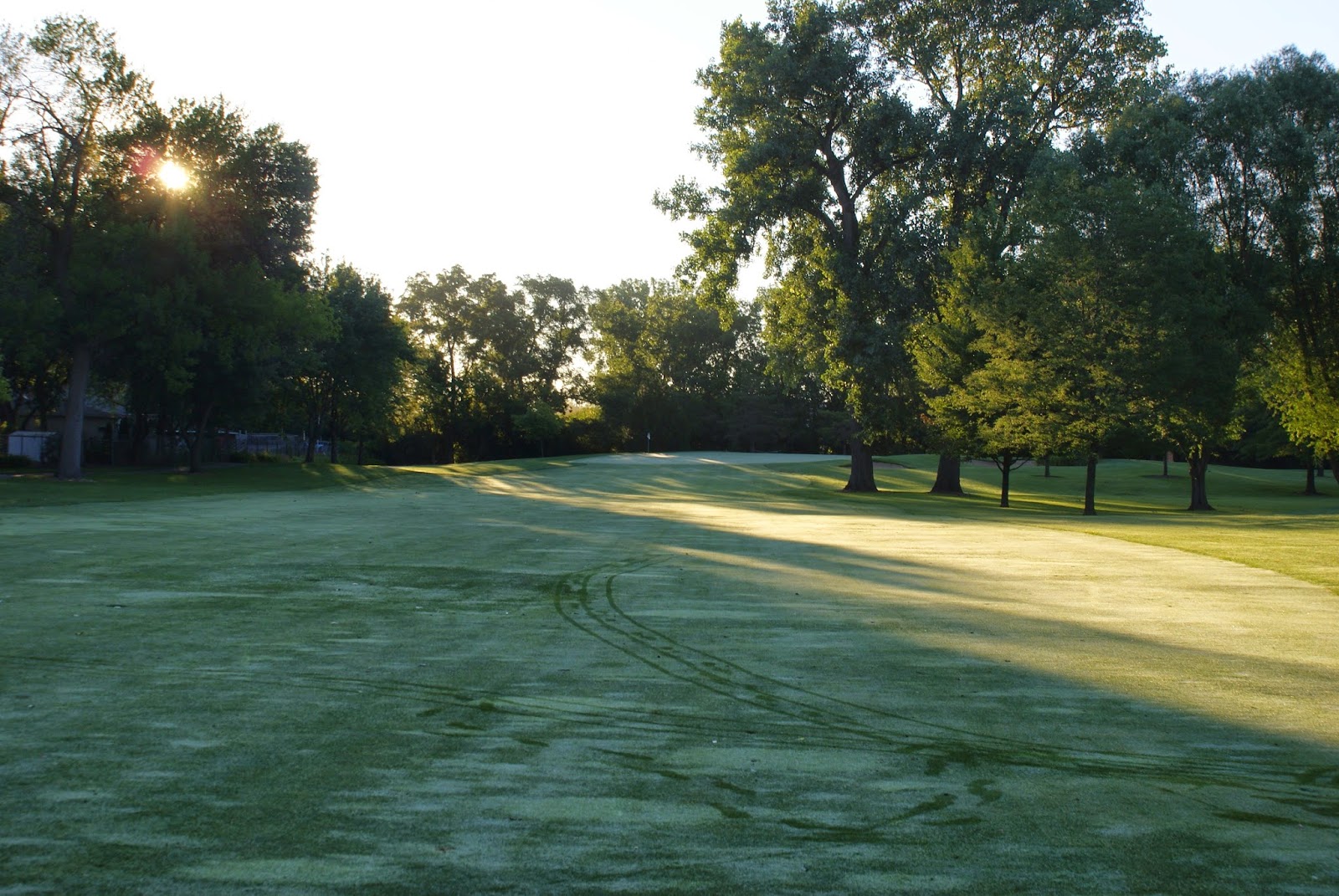
Early mornings have been beautiful lately:

5 Green

4th Hole

Karl changing cups on the 4th green

Below is the 9th hole and clubhouse.  On the left you can see some of the Ash trees that were killed by the Emerald Ash Borer over the last year.  For more on this destructive insect see here.


The renovated bunkers are performing very well.  Improved drainage, new sand, and a sod "face" have greatly improved this sand trap on the first green.  A small amount of rain used to wash this trap out and make it unplayable. Now it is playable hours after a strong thunderstorm.


Even the infamous 7th fairway has been cooperating this year after starting out more than 50% dead.  So far, we have not experienced the deadly combination of excessive rainfall, high heat, and solar radiation that damaged this floodplain fairway in 2010 and 2011.
7th Fairway enjoying 2014

And finally . . . Safety first!  Two junior greenkeepers try on bump caps before inspecting the course:


Wednesday, July 2, 2014

Drainage Repairs

When it is too wet to mow fairways, one of our favorite pastimes is finding and fixing old drain lines.  There are very few in the fairways so we have been finding the ones that are there and testing them.

We just found the old lines on the 4th fairway.  The good news is that the 4 inch line going to the creek works!  The bad news is that the rest of the system is thin 2 inch spiral corrugated tube that is not flowing.  It is crushed in many places.  There is a good reason 4 inch is the standard size.

2 inch drain line

In a situation like this we will get the system working as well as it can and install a catch basin here.  At least the 4 inch line heading off toward the top of the picture will take water and the pea gravel around the 2 inch lines is collecting some water.  In the future, reinstalling 4 inch lines in this area would help dry it out more quickly after heavy rain.  At least now we have a better idea what is here to work with.

Saturday, June 28, 2014

Spring 2014 Turf Recovery in Pictures

The winter of 2013-2014 was tough on turf.   The cold temperatures and snowfall lead to a lot of dead Poa. Many golf courses were left with large areas of dead turf that had to be seeded, sodded, or otherwise coaxed back into playable shape.  At Sugar Creek, the rough, greens, and most tees survived the winter fine but the fairways are another story.  In areas of shady floodplain, solid layers of ice sometimes a foot thick formed and eventually suffocated the Poa annua that calls these areas home.  After a lot of aerifying (3 times), slit-seeding, levelling, watering, and sodding, the fairways were almost 100% filled in by the end of May.  I'll be the first to admit that Mother Nature did most of the work -- we can't do anything without the right temperatures, moisture levels, and sunlight to grow plants -- but we significantly sped up the process and made some progress against Poa.

Here are some pictures from the last 3 months that dramatically illustrate the recovery:

7 Fairway - April 12, 2014
Here you can see some of the creeping bentgrass we have been able to get growing after the floods in 2010 and 2013 (and the heat wave in 2012).  Everything green in the fairway is bentgrass. Everything brown is Poa annua. 

7 Fairway - April 12, 2014

7 Fairway after slit-seeding  - April 25, 2014
Below you can see the fairway filling in with new seedlings.  We wish they were all bentgrass seedlings, but many are coming from the dormant Poa annua seedbank in the soil.  At this point, you take what you can get!

7 Fairway filling in - May 30, 2014
 
And below is now.  You can tell we had moderate temps and a lot of rain recently!

7 Fairway - June 27, 2014
7 Fairway from the reverse angle:


The first fairway suffered similar damage but not as extensive.  As an experiment, we slit-seeded T-1 creeping bentgrass when it was still very cold at the end of March and had seed coming up in April.  It filled in quickly after that.

Slit-seeding germination - April 25, 2014
 
These photos were taken of the 1st fairway toward the tee:


Wednesday, July 25, 2012

Turf Notes: Poa trivialis

Above is a look at roughstalk bluegrass (Poa trivialis) which makes up a large portion of our fairways and tees at Sugar Creek.  It is considered a weed and was not planted intentionally.  The "trivialis" in the plant's Latin name indicates that it is very common, not trivial.  This member of the bluegrass genus is an invasive species from Europe that can be found growing wild in most areas of North America.  It spreads aggressively by seed and stolons (stems that run along the ground) during the spring and fall.  It does not, however, like our summers.
In many previous posts, I have discussed the difficulties of dealing with Poa annua, or annual bluegrass, on golf course turf.  I occasionally mentioned Poa trivialis (or roughstalk bluegrass) along with its annual, bunch-type cousin.  Because Poa annua affects putting greens it often gets more press than P. trivialis.  You may hear superintendents just say "Poa" as shorthand for both weeds, but there are major differences in the their life cycle and growth habit.  After working with both for quite some time, I am finding that P. trivialis is a far greater problem for our fairways and tees than annual bluegrass.
The problem with Poa
 Poa trivialis is commonly called roughstalk bluegrass -- but not due to any roughness of its shoot tissues.  The rough "stalks" are the stolons that creep along the ground sending tender shoots upward and tiny roots downward.  Roughstalk bluegrass actually has soft, fine blades that are tightly spaced when mowed regularly.  It can easily be mistaken for creeping bentgrass without close inspection.  Below is the 4th tee looking good in June.  It is mostly Poa trivialis.
Golf Course poa trivialis tee in June
4th tee - Mostly Poa trivialis
Poa trivialis looks good and plays well most of the year.  It would make a decent turfgrass -- except for one BIG problem.  It completely shuts down during hot weather.  The grounds crew successfully kept it going through very dry conditions by handwatering and syringing through the day, but the heat wave in early July with 3 consecutive 100 degree days caused large areas of Poa trivialis to decline from heat stress.
July 5th and 6th -- the 2nd and 3rd 100 degree days -- were brutal on cool-season turfgrass.  Simply put, grass species in our area are not adapted for optimal growth during the summer.  They are adapted for the cooler seasons of spring and fall.  Kentucky bluegrass, creeping bentgrass, and ryegrass can often take one extremely hot day under the right conditions, but several in a row is a different story.  Turf managers attempt to coax an often unwilling plant through the rough patch of summer when stress and play are at their highest.  It doesn't always work. 
In the photo below taken the morning of July 6th you can see patches of turf in the process of going dormant due to heat stress.  You can also see some cart tire tracks turning purplish-brown.  That afternoon was the breaking point for a lot of Poa trivialis and Poa annua:
Golf Course poa trivialis fairway going dormant
7th fairway morning of July 6th - Patches going dormant
Why is it here? 
Poa trivialis is everywhere.  Small amounts can come with regular Kentucky bluegrass and ryegrass seed -- especially in the past.  It is possible that it was in the original seed used on the course, but it is just as likely that seed and stolons were already here before the golf course.  These areas have been seeded and sodded many times over the years just to be over-taken by Poa species.
We have the perfect conditions for Poa.  Poa trivialis thrives during spring and fall in compacted and poorly drained soils.  Many of our fairways are made up of clay mixed with rock, asphalt, brick, and concrete from the old rock dump on the site.  Here is a soil profile from a random spot on this fairway:
Clay mixed with bits of asphalt, brick, and gravel
This picture was taken 12 hours after a heavy rain.  The soil problems are compounded by poor drainage.  Unfortunately, the design of the course routes a large amount of water through the middle of the fairway.  Some drains have been added over the years in these wet spots but they are not adequate to move lots of water quickly.  The result is that puddles stay in the fairway for days after a thunderstorm.  The 7th fairway is especially bad.
Poa trivialis fairway poor drainage
7 fairway after heavy rain
The puddles perfectly line up with the areas of dormant Poa trivialis because the poor drainage encouraged this grass in the first place and discouraged desirable species of bentgrass or bluegrass.  Under the right conditions these puddles also heat up and scald the turf.
The turf in these areas is not technically dead.  It is just dormant.  When it dries out, you can peal up the turf and see new shoots forming on the stolons and some seedling germinating.
Poa trivialis dormant stolons
These seedlings may be Poa annua or trivialis, but they are seedlings and not connected to stolons:
So far, we have used slicing tines on the fairways and tees to encourage some gas exchange.  We will also be slit seeding and aerifying during August to speed recovery and try to establish hardier species of grass.
Can you get rid of it
Poa trivialis is almost diabolically difficult to control because it can lay dormant for long periods.  In 2010 and 2011, we slit seeded these areas with bentgrass.  The seed germinated in August and began establishing only to be overwhelmed by Poa annua and Poa trivialis in September and October.  Without removing the existing turf and starting fresh, it is difficult to impossible to permanently establish a desirable turfgrass. 
There are two ways to get rid of it: Multiple applications of non-selective herbicide (Round Up) or physical removal (total renovation).  There is research on a selective herbicide (Velocity) that can weaken it in a mixed stand but would not be effective in this situation.  The underlying cause of Poa also needs to be dealt with: poor drainage and poor soil.  
Because it is not possible to eradicate without a total renovation, we try to keep as much alive as possible during the summer months.  In years like 2009, it was possible to keep it all alive.  The past two summers it has not been possible due to extremes in heat and moisture
How can we speed up recovery?
We do several things to speed up recovery and limit further damage:
  • Maintain adequate moisture when it does not rain
  • Limit cart traffic to affected areas
  • Use lighter mowers or walk mowers on affected areas
  • Aerify multiple times
  • Topdress affected areas
  • Slit seed
  • Sod worst areas if necessary
  • Maintain proper fertility
In 2011, August was fairly mild with only 3 days over 90.  An August like that would be ideal for recovery.  Here is some slit seeding from 2011:
bentgrass slit seeding golf course fairway
Slit seeding on #1 fairway in 2011
Most of these seedlings were overwhelmed by Poa the following spring, but the slit seeding did significantly speed up recovery last fall.  We are going to keep experimenting with techniques to establish more desirable turfgrasses in the middle of Poa trivialis this year.  Stay tuned . . .

Sunday, July 8, 2012

Week of July 4th Brings Wind Storm and Heat Wave

The week of July 4th, 2012, is not one we are going to forget any time soon.  It started with 1.5 inches of rain and a violent wind storm on Sunday afternoon.  Power was knocked out in the area for at least a day -- many days for some residents.  To add insult to injury, a heat wave set in making the work of clean-up crews uncomfortable and potentially dangerous.  At Sugar Creek, the crew quickly went from storm clean-up on Monday and Tuesday to trying to cool extremely hot turf the rest of the week.
The wind storm on July 1st left the course covered in debris.  Most of the greens looked like this: 
Sugar Creek wind storm 5 Green with debris
5 Green - July 1, 2012
The storm brought down many large limbs that had to be cut up and chipped.  4 fairway in particular was covered in limbs from the large Cottonwoods on that hole. 
Golf Course fairway with cottonwood limbs down after wind storm
4 Fairway - July 1, 2012
On the 9th tee, the wind knocked over a Norway Spruce.  Spruce are shallow rooted in clay soil and can be pushed over in heavy winds.  We were successful in standing this tree back up, but it may still decline from the loss of roots on one side. 
Norway Spruce on 9th tee
This poor Bald Cypress had its top taken off.  It has a vertical branch that looks like it will turn into a new leader.  It will have a "unique" shape but will survive. 
Bald Cypress on 6th fairway
The rain came down so hard that it washed out all of the sandtraps.  Events like these are why our sand has become mixed with debris and clay from the top edge of the trap.  I was just reading an article that stated: "Principle one is that no surface water should enter the trap.  Of all principles in sand trap construction, this one is paramount" (Daniel, Golf Superintendent).  The designers and builders of our sand traps must not have read that article.  To be fair, I'm sure they were aware of the surface water issue but sometimes visual impact, construction cost, and placement of the hazard are put before playability, maintenance cost, life span, and reality. 
Golf Course sand trap bunker washed out after thunderstorm
July 1, 2012
The grounds crew had the course playable by Monday morning at 6:30 am using a combination of mowers, blowers, chainsaws, tractors, rakes, and pitchforks.  Tree work continued into Tuesday, but then it was time to turn our attention to the extreme heat on July 4th, 5th, and 6th.  Around 3pm each day, I measured 2 inch soil temperatures over 100 degrees in our historically weakest areas.  The underlying soil in these areas was still moist from the 1.5 inches of rain on Sunday so lack of water was not the issue.  Cool season grass roots simply cease to function at these temperatures.  All we could do is syringe these areas carefully to cool them down.  Syringing lowered the canopy temperatures in these areas to 94 degrees temporarily.  Not great, but an improvement over 100. 
You know the turf is under extreme stress when your footprints stick in previously very healthy turf: 
Golf course turf footprints stick in grass during extreme heat
Stressed turf - July 6, 2012
 Below Gary is syringing, or misting, stressed portions of fairway.  Last week, we were hand watering dry soil and drought stressed turf with high flow nozzles meant to re-wet dry soil.  This week, we are using misting nozzles to cool the turf through evaporation and perhaps get the plant to take in small amounts of water during this cooler period.  The cooling effect lasts only a short period of time.  Significant effects are gone after 15 minutes but this can be enough to get some turf through the stress period. 
Gary syringing #1 fairway
This picture was taken on July 6th at 1pm in the shade!  I would expect this temperature when solar radiation was added to the mix, but I was surprised to see temperatures over 100 degrees in healthy turf with some shade during mid-day. 

One thing is for sure: Next week will be just as busy at Sugar Creek.  With cooler weather, we can take steps to speed up the recovery process on tees and fairways through cautious solid tine aerification and irrigation practices.  We have to be careful not to do more harm than good in our attempts to help the turf recover. 
We are definitely thankful for this forecast.  Especially the night time lows in the 60's.  Looks like a beautiful week for golf -- and turf recovery:


Friday, July 6, 2012

Extreme Heat and Golf Carts

Many area courses are restricting cart traffic during extreme heat.  A few photos from this morning show why.  On days of extreme heat, grass plants are so stressed that simply driving over them causes death.  This type of damage usually occurs during the middle of the day when conditions are the most uncomfortable for people and plants. 
If your local golf course is restricting cart use, please understand they are trying to save the course for the rest of the year.  Tire tracks like this take a long time to heal:
Riding carts and extreme heat causes turf damage on golf course fairway
July 6

Tire tracks from riding carts and extreme heat causes turf damage on golf course fairway
July 6
In these areas, I measured soil temperatures at a 2 inch depth close to 100 degrees on July 4 and 5.  Healthier areas of fairway were 94 degrees.  Soil composition and characteristics very widely on our fairways so it is impossible to tell without a probe where the hot spots are.
In most areas, the course is holding up to the heat but areas are starting to run out of energy reserves and root mass.  100 degree soil temperatures literally cooks the cells of cool season grass plants.  Our fairways are the most sensitive due to how they were built and the soil they were built on.  They also contain a fairly high percentage of Poa annua or annual bluegrass.  In most areas the soil is heavy clay mixed with pulverised concrete and asphalt.  As you can imagine, they tend to heat up fast.

Sugar Creek Golf Course #8 Fairway
July 6
The grounds crew is very busy trying to keep as much turf alive as possible through this period of record high temperatures.  You may also see hand watering or irrigation heads running to cool the turf.  The purpose of this "syringing" is to cool the plants through evaporation -- not to wet the soil.  This practice works only in certain circumstances and must be employed carefully.  During these hot periods, too much water is just as bad as too little. 
See more posts about heat stress and turf.

Saturday, October 22, 2011

Frost Delays

Reposted from April 2010:


Since we have a frost delay today, I thought I would post some information on frost and frost delays.  No one likes frost delays - maintenance workers especially - but they are necessary for the health of the course.  Golf course employees ask for your understanding during frost delays.  We don't like them either.

Here are some key points from the Golf Course Superintendent Association:
• Frost is basically frozen dew that has crystallized on the grass, making it hard and brittle. A grass blade is actually 90 percent water, therefore it also freezes.

• Walking on frost-covered greens causes the plant to break and cell walls to rupture, thereby losing its ability to function normally.

• When damaged, the putting surface weakens and becomes more susceptible to disease and weeds.

• One foursome can leave several hundred footprints on each green, causing extensive damage.

• A short delay while the frost melts can preserve the quality of the greens and prevent needless repairs.
You can find a more detailed article on frost formation and effects in this article - "The Big Chill"

The following is a video from the USGA:

Thursday, September 29, 2011

A Week after Aerification : Update

For the last few days, a low pressure system has been swirling over Chicagoland.  At Sugar Creek, we have had around 3 inches of rain in total.  Not all at once, though, but in six hour soakers spaced about 12 hours apart.  Wonderful!  Believe it or not, these are very busy weeks for a maintenance crew -- in a different way than usual.  We have not been able to mow fairways, but we have been able to mow everythings else very slowly.  Sand traps have been a constant battle.  In weather like this, we pump them just to give us a shot at drying them faster after it stops raining.  Since you never know when will be the last shower for the week, sometimes we pump them only to have them fill up again.  That's just the chance you take.

On a positive note, the greens have healed quickly from aerification last week.  After one week's time, they now look like this:
1 Week after Aerification
Close-up of #1 Green
They will be putting nicely once they get a chance to dry out a little.

Flooded bunkers have been common this week:


This is Gary's third time pumping traps this week.  You can also see him pulling weeds while he waits for the double sump pump arrangement to do its job.  Great job, Gary!
Gary's daily ritual : Pumping and weeding!
The last problem areas are filling in with slit seeding and aerification:
5 Tee slit seeding
The 5th tee has always been challenging to grow.  It is affected by morning shade, hard subsoil, and heavy use.  Being a short hole, divots are often very large and numerous.  We ask that players refrain from practicing, or taking multiple shots, on this tee for obvious reasons:
Divots on 5 tee
Divots taken during the course of regular play are necessary, but these divots were not between the tee blocks and are probably from just one golfer "practicing".  Ouch.

Looks like we may have one more sprinkle before a nice dry week!