Showing posts with label Poa. Show all posts

Wednesday, July 25, 2012

Turf Notes: Poa trivialis

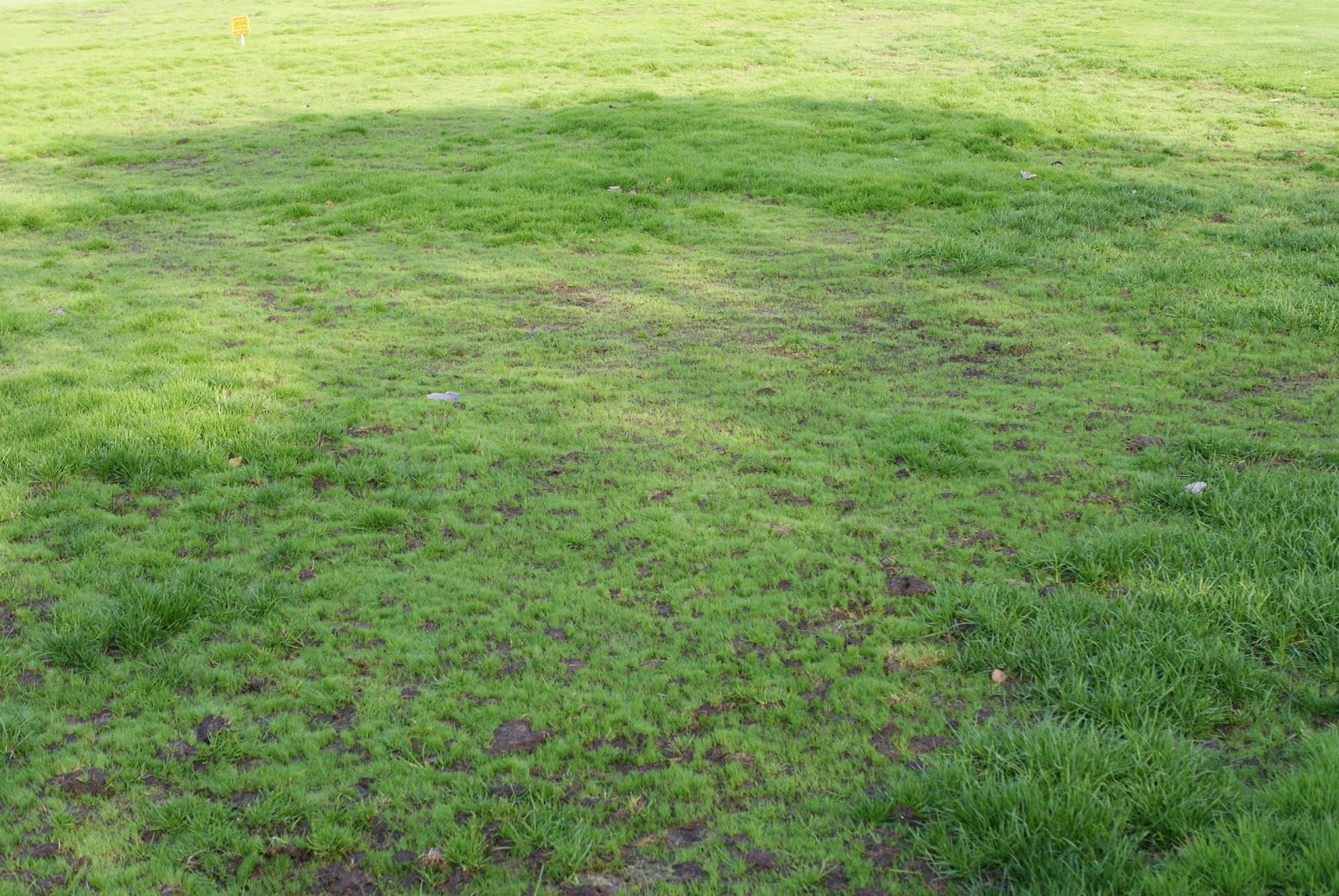
Above is a look at roughstalk bluegrass (Poa trivialis) which makes up a large portion of our fairways and tees at Sugar Creek.  It is considered a weed and was not planted intentionally.  The "trivialis" in the plant's Latin name indicates that it is very common, not trivial.  This member of the bluegrass genus is an invasive species from Europe that can be found growing wild in most areas of North America.  It spreads aggressively by seed and stolons (stems that run along the ground) during the spring and fall.  It does not, however, like our summers.
In many previous posts, I have discussed the difficulties of dealing with Poa annua, or annual bluegrass, on golf course turf.  I occasionally mentioned Poa trivialis (or roughstalk bluegrass) along with its annual, bunch-type cousin.  Because Poa annua affects putting greens it often gets more press than P. trivialis.  You may hear superintendents just say "Poa" as shorthand for both weeds, but there are major differences in the their life cycle and growth habit.  After working with both for quite some time, I am finding that P. trivialis is a far greater problem for our fairways and tees than annual bluegrass.
The problem with Poa
 Poa trivialis is commonly called roughstalk bluegrass -- but not due to any roughness of its shoot tissues.  The rough "stalks" are the stolons that creep along the ground sending tender shoots upward and tiny roots downward.  Roughstalk bluegrass actually has soft, fine blades that are tightly spaced when mowed regularly.  It can easily be mistaken for creeping bentgrass without close inspection.  Below is the 4th tee looking good in June.  It is mostly Poa trivialis.
Golf Course poa trivialis tee in June
4th tee - Mostly Poa trivialis
Poa trivialis looks good and plays well most of the year.  It would make a decent turfgrass -- except for one BIG problem.  It completely shuts down during hot weather.  The grounds crew successfully kept it going through very dry conditions by handwatering and syringing through the day, but the heat wave in early July with 3 consecutive 100 degree days caused large areas of Poa trivialis to decline from heat stress.
July 5th and 6th -- the 2nd and 3rd 100 degree days -- were brutal on cool-season turfgrass.  Simply put, grass species in our area are not adapted for optimal growth during the summer.  They are adapted for the cooler seasons of spring and fall.  Kentucky bluegrass, creeping bentgrass, and ryegrass can often take one extremely hot day under the right conditions, but several in a row is a different story.  Turf managers attempt to coax an often unwilling plant through the rough patch of summer when stress and play are at their highest.  It doesn't always work. 
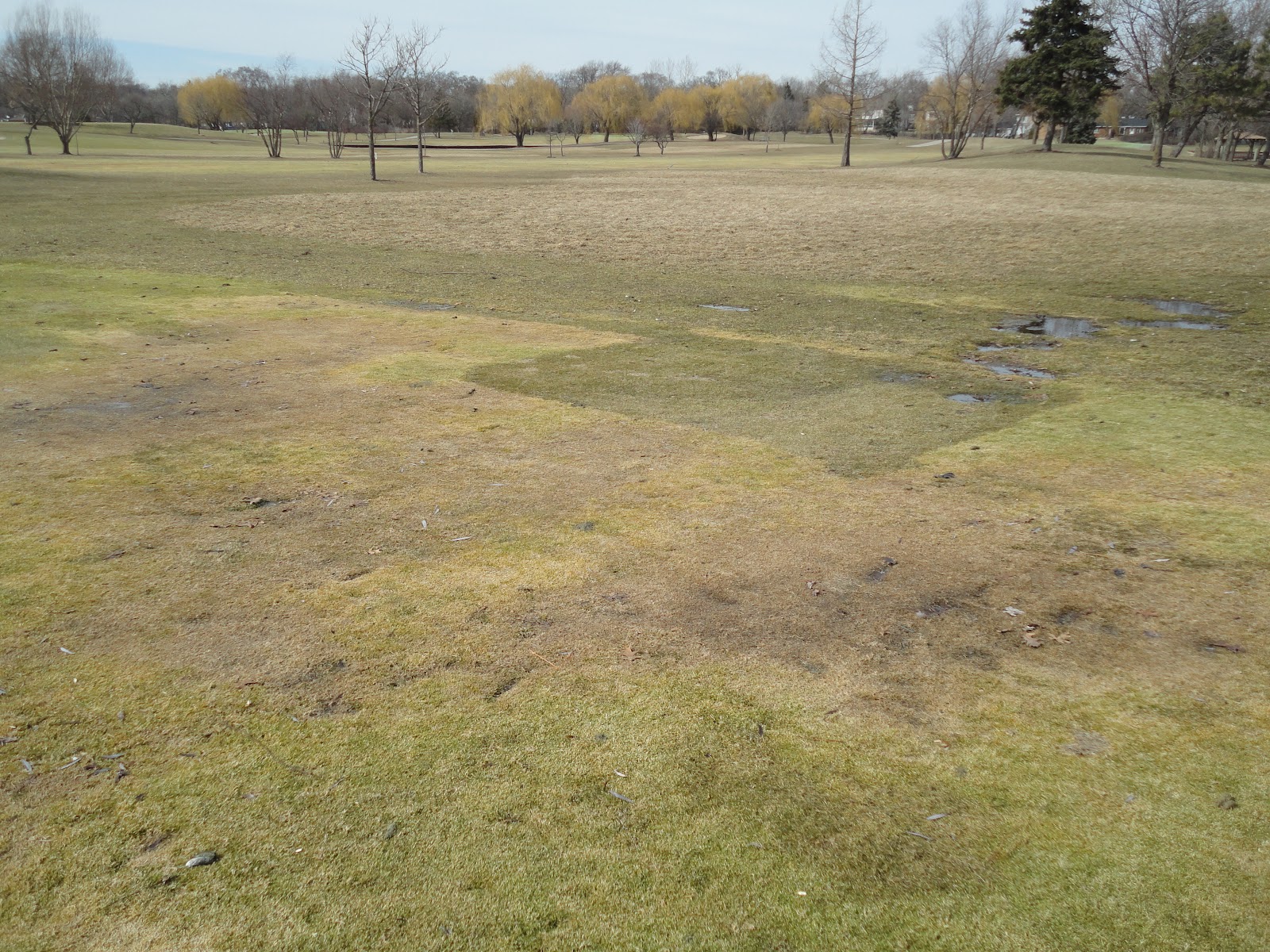
In the photo below taken the morning of July 6th you can see patches of turf in the process of going dormant due to heat stress.  You can also see some cart tire tracks turning purplish-brown.  That afternoon was the breaking point for a lot of Poa trivialis and Poa annua:
Golf Course poa trivialis fairway going dormant
7th fairway morning of July 6th - Patches going dormant
Why is it here? 
Poa trivialis is everywhere.  Small amounts can come with regular Kentucky bluegrass and ryegrass seed -- especially in the past.  It is possible that it was in the original seed used on the course, but it is just as likely that seed and stolons were already here before the golf course.  These areas have been seeded and sodded many times over the years just to be over-taken by Poa species.
We have the perfect conditions for Poa.  Poa trivialis thrives during spring and fall in compacted and poorly drained soils.  Many of our fairways are made up of clay mixed with rock, asphalt, brick, and concrete from the old rock dump on the site.  Here is a soil profile from a random spot on this fairway:
Clay mixed with bits of asphalt, brick, and gravel
This picture was taken 12 hours after a heavy rain.  The soil problems are compounded by poor drainage.  Unfortunately, the design of the course routes a large amount of water through the middle of the fairway.  Some drains have been added over the years in these wet spots but they are not adequate to move lots of water quickly.  The result is that puddles stay in the fairway for days after a thunderstorm.  The 7th fairway is especially bad.
Poa trivialis fairway poor drainage
7 fairway after heavy rain
The puddles perfectly line up with the areas of dormant Poa trivialis because the poor drainage encouraged this grass in the first place and discouraged desirable species of bentgrass or bluegrass.  Under the right conditions these puddles also heat up and scald the turf.
The turf in these areas is not technically dead.  It is just dormant.  When it dries out, you can peal up the turf and see new shoots forming on the stolons and some seedling germinating.
Poa trivialis dormant stolons
These seedlings may be Poa annua or trivialis, but they are seedlings and not connected to stolons:
So far, we have used slicing tines on the fairways and tees to encourage some gas exchange.  We will also be slit seeding and aerifying during August to speed recovery and try to establish hardier species of grass.
Can you get rid of it
Poa trivialis is almost diabolically difficult to control because it can lay dormant for long periods.  In 2010 and 2011, we slit seeded these areas with bentgrass.  The seed germinated in August and began establishing only to be overwhelmed by Poa annua and Poa trivialis in September and October.  Without removing the existing turf and starting fresh, it is difficult to impossible to permanently establish a desirable turfgrass. 
There are two ways to get rid of it: Multiple applications of non-selective herbicide (Round Up) or physical removal (total renovation).  There is research on a selective herbicide (Velocity) that can weaken it in a mixed stand but would not be effective in this situation.  The underlying cause of Poa also needs to be dealt with: poor drainage and poor soil.  
Because it is not possible to eradicate without a total renovation, we try to keep as much alive as possible during the summer months.  In years like 2009, it was possible to keep it all alive.  The past two summers it has not been possible due to extremes in heat and moisture
How can we speed up recovery?
We do several things to speed up recovery and limit further damage:
  • Maintain adequate moisture when it does not rain
  • Limit cart traffic to affected areas
  • Use lighter mowers or walk mowers on affected areas
  • Aerify multiple times
  • Topdress affected areas
  • Slit seed
  • Sod worst areas if necessary
  • Maintain proper fertility
In 2011, August was fairly mild with only 3 days over 90.  An August like that would be ideal for recovery.  Here is some slit seeding from 2011:
bentgrass slit seeding golf course fairway
Slit seeding on #1 fairway in 2011
Most of these seedlings were overwhelmed by Poa the following spring, but the slit seeding did significantly speed up recovery last fall.  We are going to keep experimenting with techniques to establish more desirable turfgrasses in the middle of Poa trivialis this year.  Stay tuned . . .

Wednesday, September 14, 2011

Summer of 2011 : Seeding Fairways

Meteorological summer is over and it has definitely cooled off in the Chicago area -- just barely dipped under 50 last night in many areas.  The last month has been a busy one at many golf courses in the area struggling to recover from late July's rain and heat.  Luckily, August was not extreme: 1.1 degrees F over normal and about average rainfall.  This meant that it was possible to get seed to grow in fairway areas.

In the last 5 weeks, we experimented with several methods of seeding and aerification in the fairways.  We used a slicing knives several times in an attempt to break through the thatch into soil.  This worked in some spots.  We also used an Aera-vator with a seeder to spike seed and cultivate areas.  Other areas we used a Ryan Mataway slit seeder.  All three methods worked to one extent or another.  The trick is to get seed-to-soil contact without making the situation worse or delaying recovery. 

Seed growing in aeravator holes
Some of the plants you see are not new seed.  Most of these areas in our fairways are composed of annual bluegrass, or Poa annua, an annual grass with lots of seed in the ground.  It is very aggressive in spring and fall, but often dies in summer.  In some of these areas, our new seed may have gotten started early enough to establish before the annual fall resurgance of Poa annua.  In others, Poa will likely take back over. 

You can identify Poa annua by its bunch-type growth, yellow-green color, and "boat-shaped" tip:

Annual blugrass boat shaped tip
Annual bluegrass is not exactly what we want to see because it is the species that died in the first place, but it is turf and you can play golf on it!  There isn't any way to stop it without stopping our new seed also, so superintendents have to constantly manage it. 

About three weeks ago, we slit-seeded the first fairway and it is starting to fill in:
First Fairway slit seeding

It is easier to see the fuzzy new grass with dew on it
Finally, an area on 7 fairway that suffered from water damage needed more aggressive tactics.  Using an Aeravator, rake, and roller, we essentially cultivated and seeded the area around this drain:

 The seed germinated very quickly and is doing well.  If you click on the image, you can see them more easily:

Seedlings on 7 Fairway
Many other areas have already recovered from early August and the rest are filling in quickly.  September has really been a nice month!

6th Hole

1st Green

Update September 22, 2011:  Seedlings are really filling in on our fairways.  The renovated area on the 7th fairway now looks like this:
7 fairway
Overall, we have had a lot of success this year replacing pesky Poa annua with bentgrass and bluegrass.  Hopefully these seedlings will toughen up before winter and make great turf next year!

Monday, August 8, 2011

Interview with a Fairway


A lot of golf course fairways have been hurting since it started raining this summer.  I decided to go straight to the source and ask our fairways some tough questions.  The following is a transcript of our interview:

So, fairway, it looks like you’ve been having a rough time in the past weeks?

Tell me about it!  I was doing great up until it started raining again.  I appreciate a nice shower.  Even a short bath I can tolerate, but I can’t sit in water for a week.  I can’t breathe.  Especially when the sun is out – that water gets hot!  Try holding your breath underwater in a hot tub.  That’s what it’s been like.

How did you cope with the extreme heat?  Was that a problem?

That string of really hot days wasn’t a walk in the park, but I survived.  The maintenance crew tried to give me just the right amount of water.  Too much water would have cooked me and too little would have permanently wilted me.  I made it through those hot days by breathing at night and holding my breath during mid-day.  That way I didn’t wilt to death during the middle of the day.  I’m not saying it was pleasant, but I can handle that for a while as long as the maintenance crew is helping me out. 

If you didn’t mind the extreme heat, when did the trouble start?

Well.  I started getting wet.  The first downpour was alright.  I soaked it up and it was cloudy and not too hot out.  The second one on July 23rd was way too much for me to handle, my roots were saturated and I couldn’t breathe.  Luckily it wasn’t too hot and sunny so you couldn’t really tell how much I was hurting. 

It seemed like you suddenly got sick right after that.  What happened next?

Just when I was starting to dry out and feel good again, I got a combined 2.5 inches of rain on the 28th and 29th.   Those two days were cloudy and not too hot so I just held on partially underwater.  Some of my low spots were starting to get smothered, but I was mostly ok.  And then it happened . . . Saturday and Sunday were the worst!

Did you get a horrible disease or something?

Not really.  The maintenance crew had just helped me out with some protectants that prevented most of the diseases.  I may have had a spot or two of Pythium Blight and Brown Patch, but that wasn’t really a big deal.  It was just the conditions out here on the 30th and 31st.  Remember, I’m plants, I can’t run away from lethal heat like you can -- hiding in your nice air conditioning all day and night!  I have to just sit here and take it.

I remember it was miserable out there in the middle of the day.  Why couldn’t you use the water to cool off?

My roots were still soaked and it was very humid so I couldn’t transpire.  Kind of like humans and your sweat, I need to evaporate some water to cool myself off.

Didn't the maintenance crew just add some drain lines on the first hole to help you out?

Yes they did, and I appreciate the effort.  They put a new line under the cart path and some other lines.  I'm sorry, but the way I'm built, it's going to take a lot more than that to dry me out when it rains this much! 

New drain and sodded area on #1.  Sod didn't make it.
OK.  So what happened?

 I wasn’t dry yet and the sun came out.  July 30th was the sunniest day in a long time and the temperatures hit the low 90’s.  The sun heated up the surface of the water that was partly covering my blades to over 110 degrees and it cooked their insides.  In a four hour span on Saturday afternoon, a lot of my cells turned to useless soup.  Sunday afternoon hurt again with the exact same conditions. 

Can we do anything to help right now?

Well.  The maintenance crew tried to help by aerating some holes for me.  Unfortunately, it has continued to rain so I still haven’t been able to breathe much.  Just rained another 1.5 inches in the last 24 hours.  At least the temperatures have cooled off so I’m not losing any more plants.  I know the maintenance crew is going to aerate and overseed this week once I dry out a little.  I’ve been in this situation before and I always come back with a little help.  Please be patient while I grow some new shoots and roots. 

Why are other areas of the course growing so well and you’re not? 

There are lots of reasons, but most of them go back many years.  If you notice, I’m low and the greens and tees are high – for the most part.  They were built with soil and sand custom made for greens and tees.  I’m all clay, rock, asphalt, and brick.  You might not know this, but I was a rock dump before I was a golf course fairway.  The greens and tees got the benefit of topsoil and there wasn’t much left for me.  I have a rougher life than those pampered greens.  They don't even get driven on by carts!  The tees are less spoiled – at least they have to deal with divots.  Now, if you'll excuse me, I need to grow some roots now.

One more question -- When do you think you'll be back to "normal"?

If past years are any guide, I will probably have one more rough patch in August that will prevent a big recovery.  At the end of August, I will recover and grow new shoots with the help of the maintenance crew.  By October 1, you may not be able to tell that it was another hot, wet summer.

Early October 2010
That was the end of our interview.  You may want to see these post for more information:

Scald and annual bluegrass (Poa annua) problems:
http://sugarcreekgolfcourse.blogspot.com/2010/07/turf-notes-summer-decline-of-annual.html

Pythium Blight:
http://sugarcreekgolfcourse.blogspot.com/2010/08/turf-notes-pythium-blight.html

Drainage project on 1st hole:
http://sugarcreekgolfcourse.blogspot.com/2011/05/1-cart-path-drainage-project-update.html

2010 -- a similar year for us -- in review:
http://sugarcreekgolfcourse.blogspot.com/2010/12/2010-year-in-pictures.html


Thursday, March 17, 2011

Turf Notes: Annual Bluegrass and Winter Hardiness

Compared to last year, it looks like we will have only limited areas of winterkill this spring.  In 2010, a long period of snow cover and a long period of freezing and thawing of ice sheets resulted in a lot of lost annual bluegrass (Poa annua).  We sodded the worst areas and slit seeded the rest.  For pictures from 2010, see "7th Fairway- Update."  
Sodding areas of the 6th fairway in 2010
If you see any strange patterns or lines in the fairways this March or April, it may be areas sodded with bentgrass in 2010.  Pictures like the ones below really illustrate the weaknesses of annual bluegrass compared to creeping bentgrass or Kentucky bluegrass. 

Bentgrass sod design on 6 fairway

Another square on 6 fairway from 2010

Creeping bent on the left -- Annual bluegrass on the right

Large square sodded in 2010
These areas have 2 problems that go together: poor drainage (they are naturally low and almost flat) and poor turf species.  While it will take a combination of approaches to improve these areas of the fairways, I am glad to see that bentgrass is capable of surviving the winter in these difficult spots.  It shows that keeping up with our current strategies will improve these areas in the long term.

Right now, you can really see the contrast between different grass species and their reaction to cold temperatures.  Unfortunately, most of the brown areas around our sod from 2010 will green up with warmer temperatures.  I say "unfortunately" because it would be a lot easier to get rid of annual bluegrass if it would die off and stay dead.  Its persistance is amazing.  It will die in a heartbeat in the winter and summer and re-germinate just as fast in the spring and fall.

Tuesday, March 1, 2011

Thawing and Freezing

Since the snow has mostly melted, we have been assessing the health of our turf coming out of winter.  Last year, I wrote about the factors that influence turf health coming out of winter in Good or Bad Winter for Turf and A Long, Difficult Winter for Turf.  As it turned out, we had to do a lot seeding and sodding last April to repair ice damage in the fairways.  After a tough summer in 2010, it would be nice to have favorable conditions for turf growth this spring.

Like most golf courses, we have a few areas that tend to weaken or die over the winter.  About every other year, the 7th fairway exhibits significant ice damage.  My theory is that this ice damage is caused by crown hydration of mostly Poa annua during freeze/thaw cycles.  During our last thaw after the first of the year, the grass plants appeared healthy.  While it is difficult to assess health during the winter, ice damaged plants often take on a mushy, soupy texture due to their ruptured cell walls.  This month's freezing and thawing are starting to concern golf course superintendents, but I am still hoping we will have less damage than last year when the ice didn't melt until the middle of March.

On February 28th, the fairways were covered in ice after a heavy rain.  Luckily most of the ice has melted and drained overnight.

Here are two spots we are watching closely:

Draining areas on 7 fairway


Melting ice on 6 fairway
In 2010, we tried to improve the drainage in these areas and re-seeded them with creeping bentgrass.  Because bentgrass has a greater tolerance for ice cover and cold temperatures than Poa annua, we are hoping to see less ice damage this year in the places where the bentgrass took.  More improvements will need to be made to drain these areas more quickly, but planting a hardier species should help these areas survive the winter in the meantime.

Besides these areas, the turf is looking good after a snowy February.  Our newly planted tees are looking healthy and the greens are free of snow mold.

Tuesday, July 20, 2010

Turf Notes: Summer Decline of Annual Bluegrass

So far, 2010 has been very different than 2009 or 2008 for turf managers.  2010 soil tempuratures have been on average 10 degrees higher than 2009.  The same goes for air tempuratures and humidity.  We have also experienced extreme fluctuations in moisture - excessive rain followed by dry periods.  While most turfgrasses can handle this sort of stress given decent soil conditions, there are a few that can't.  The most notable being annual bluegrass, or Poa annua:


Photo: University of Kentucky Annual Bluegrass Profile

Introduction
Most turf is composed of different species of grass, unless it is a new construction planted as a monoculture.  In most older golf course fairways, you can observe different types of bentgrass, Kentucky bluegrass, rye, Poa annua, and Poa trivialis all within a 500 square foot plot of turf.  This has some benefits.  Often when one species declines, another will take over.  It is the transition period that causes problems for turf managers.  Of the above listed species Poa annua (annual bluegrass) is the most problematic.

The life cycle of annual bluegrass is important to understanding its summer decline.  Annual bluegrass grows aggressively in spring and germinates aggressively in fall.  Summer and winter are its weak points.  It does not survive cold temperatures or ice cover like perennial species, and it is genetically programmed to die during the summer.  Some years, like 2009, it survived all year under cultivation (like at a golf course).  This year, its weaknesses are more clear.  Unlike creeping bentgrass or Kentucky bluegrass, annual bluegrass does not have a physiological mechanism like dormancy for dealing with heat stress.  It doesn't have to since it relies on seed to perpetuate the species. 

Turf managers often look at soil tempurature to determine the likelihood of turf stress.  Significant root growth stops at 70 degrees F in cool season grasses, and completely shuts down at 80 degrees.  Turf is in serious trouble at 90, especially annual bluegrass.  Our soil tempuratures at the 4" level have been reaching 84 degrees with surface temperatures over 100 degrees some days.  In the presence of water, this leads to scald or wet wilt.  According to Dr. Beard, a well-known turf expert, "cool-season grasses - such as bentgrasses (Agrostis spp.) and annual bluegrass (Poa annua) - are physiologically adapted to optimum growth at temperatures of 60 to 75 degrees F. Even so, cool-season grass species demonstrate various capacities for heat resistance, ranging from medium for grasses such as Kentucky bluegrass to very poor for annual bluegrass and rough bluegrass, among others."  See his article "Dealing with heat stress on golf course turf" for a great discussion of summer decline.

A lot of factors contribute to the growth of annual bluegrass in fairways.  Low mowing heights allow annual bluegrass to invade other types of grass, along with irrigation, fertilization, and low areas with poor drainage.  A 2.5 inch bluegrass lawn is in little danger of being invaded, but it is inevitable on a 1/2 inch fairway.  In a classic turfgrass catch-22, a lot of golf course maintenance practices like mowing, fertilization, and irrigation even when done right allow annual bluegrass to survive making the situation worse, not better. 

Recent Case Studies
At Sugar Creek and many area golf courses of similar construction, a lot of Poa annua declined over the last two weeks.  We had an abnormally wet June followed by a dry period.  Often turfgrass benefits from rainfall, but not in excess.  The prolonged wet, warm period encouraged shallow rooting in many low-lying areas.  During the period from July 6th to the 13th, it rained here every day but one including a soaking 1" rainfall on the 11th.  The turf did not have a chance to dry out before we had 5 days of 90 degree temperatures from July 14th to 18th.  Solar radiation plus excessive moisture plus high soil temperatures = "physiological decline of Poa annua."  Another fancy term for it is "necrosis due to abiotic environmental factors."  Many superintendents like myself prefer a simpler term: "It baked."  The Poa baked on certain tees and fairways in areas with saturated soil.  The spike in soil temperature literally cooks the cells of the plant.  Often when we see brown grass, our first instinct is to put water on it.  That is why you may see superintendents using soil probes to determine if the stress is caused by too little water or too much.  More often than not, the cause is too much water.

While these areas of Poa annua are suffering right now, they will come back from their own seed once soil temperatures go down and the days shorten.  That is what they are genetically programmed to do.  Looking back at photos from 2005, another rough year for turf, the same areas suffered during the summer but came back quickly in September. 

Through the following pictures, I'll try to give my diagnosis and answer that important question: "Why did that grass die?"

#4 Tee

Back tee on the 4th hole:  This tee is somewhat shaded with inadequate drainage.  It is, or was, mostly comprised of Poa trivialis (Roughstalk bluegrass) and Poa annua (annual bluegrass).  The green turf is the Roughstalk bluegrass which is only slightly more heat tolerant than annual bluegrass.  I watched the Poa annua on this tee decline over the course of 1 day on July 14th.  There were no signs of disease or other causes and the surface moisture under the turf canopy was hot to the touch. 

Diagnosis: Scald of Poa annua.  From "Understanding Wet Wilt" by Dr. Peter H. Dernoeden: "On sunny days when air temperatures exceed 90°F, the temperature in the upper 2.0 inches of wet soil can range from 95°F to 100°F. These conditions led to root dysfunction and/or a rapid loss of roots."  And later: "Indeed, turf almost literally 'cooks' in hot and wet soils.  Affected greens initially appeared brownish and water-soaked. Turf soon thinned out in irregular shapes, but damage often followed the natural drainage pattern of the green." 

#5 Tee

The 5th tee was sodded in 2003 with a low-mow cultivar of bluegrass.  Unfortunately, the soil settled and created a drainage problem.  With low mowing heights and excess water, Poa annua took over this tee.  Over the years, we aerified, topdressed, and seeded  frequently to try to improve the situation, but to no avail.  You can see some algae growth on the scalded Poa annua which died in the presence of water on the same days as the 4th tee -- July 14th through the 18th.

Here's a soil plug from July 19th:


It is difficult to tell from the photo, but the soil was still moist even after several days of drying.  You can see the layer of top dressing to the left of the photo.  Even with this layer, areas of the tee are still lower than the rest causing water to sit there for long periods. 

Diagnosis:  Scald of Poa annua.  Again.

#1 Fairway


This area is often soaked after rains.  There is only about a foot of elevation difference between here and the creek and the contour is not consistent.  There are ridges that hold the water here for extended periods.  The interesting part of this photo is not the what went wrong but what didn't go wrong.  Why did some patches survive and others did not?  They had the same soil conditions, moisture levels, fertility and maintenance.  What is different about them?  The answer is genetics.


This isolated patch of creeping bent clearly illustrates the difference between the two grasses.  Even though this patch is not an intentionally seeded cultivar - it simply drifted here on its own - it was able to take what nature threw at it while the annual bluegrass could not.  Due to the grading of the fairway, this will always be tough spot to grow grass, but this photo indicates to me that bentgrass would be a better species for the area than Poa annua.  While it is difficult to establish turf during the summer months, slit seeding some bentgrass just might increase the percentage of quality turf in the area.  Once fall hits, the annual bluegrass will germinate with a vengeance and fill in the remaining area.  It's a never ending battle. 

Further Reading

Recent turf reports from the Chicago District Golf Association address this issue: See July 16 - From this report: "Even if we do everything correctly, Mother Nature may not play fair. I am sure we will have issues, but to what extent it is hard to say.  Clearly Poa annua, which does not like hot weather, will die."

WARM (Water and Atmospheric Resources Monitoring Program) - This site tracks soil temperature and evapotranspiration in Illinois.  I use it all time as a resource before going out and taking local readings. 


Search the USGA Green Section Record for "annual bluegrass" to find everything you would ever want to know about Poa.