Monday, January 18, 2016

Greens Mower Engine Rebuild

One of the many things that golf course maintenance crews do over the winter is repair machinery.  At Sugar Creek, we have a few machines to overhaul this winter including the greens mower.  The greens mower is arguably the most important machine in the fleet.  You certainly don't have a golf course without something to mow and groom greens.

Since 2008, we have mowed the greens with a John Deere 2500B with 11-blade reels and turf conditioners(or "groomers").  This unit has been used for 3650 hours so far and we are going to need it to continue to function for at least the next 2 seasons, maybe more.  We rebuilt the reels two years ago, so they are in fine condition.  The engine, however, was starting to show its age.

Gary on the greens mower
This unit is powered by a liquid cooled, 2-cylinder, gasoline-powered Kawasaki FD620D.  This engine has performed admirably for thousands of hours but, late last year, it began to leak oil from the crankshaft seals.  A compression test revealed one cylinder had low compression and the other was marginal.  I also discovered from other superintendents and message boards on the internet that this engine tends to lose oil pressure somewhere between 3500 and 4000 hours due to a worn out oil pump spur gear.  This gear is plastic but is driven by the metal crankshaft.  Eventually, the metal wins.  See this thread on My Tractor Forum for an example of what happens.

To avoid dripping oil on the green and a mid-season surprise, this engine either needed to be rebuilt or replaced.  Replacing the engine and old exhaust was going to cost at least $3000.  Since we have rebuilt a few v-twin engines recently, I was pretty confident we could rebuild for a lot less.  A big thanks to Gary and Felix who did most of the work on this project.

Here is the greens mower after they pulled the engine:

John Deere 2500B
Here is the engine partially disassembled.  There was a lot of gunk behind the flywheel due to the leaking crankshaft seal:

Kawasaki FD620D


Luckily, the major components of the engine were in good enough shape.  We just needed a gasket set, new cylinder rings, and new valves.  The cylinder walls just needed honing.  Most of the important stuff -- cylinder size, crankshaft measurements, piston diameter, inside diameter of bearings, etc. -- were very close to factory specification and well within wear tolerances.

Cylinder and piston after the head was removed
Piston after cleaning and ring removal
Cylinder head with new seals and valves
Inside of engine
We decided to replace the valves instead of regrinding because the exhaust valves showed an uneven wear pattern indicating they were warped or the stem slightly bent.  An engine shop with the right equipment could probably have saved them, but they are cheaper to replace at this point:

Engine valves
The oil pump gear was indeed wearing out.  If you look closely at the following pictures, you can see some teeth are smaller than others.  The wear was all on one side of the teeth because that was the surface that provided resistance on the crankshaft gear.  All it takes is one tooth to break or the gears to mesh wrong and the oil pump stops pumping.  After that, it is not long before the engine seizes up.  And believe me . . . you don't want to be stuck in the middle of the 4th green at 6 a.m. wondering how you are going to get a mower with a seized engine off a putting green before the golfers catch up to you.  And without leaving ruts in the green 4 inches deep.

FD620D oil pump gear with worn teeth

You can see the worn surfaces on the right side
After everything was cleaned and inspected, reassembly was pretty easy.

Engine ready for reassembly

Ready to close it up!
The engine started up right away, after filling with oil and coolant of course.  We tested the compression after running for an hour and got good results - about 190psi both sides.  This engine should be good for many more hours now.  We just have to cross our fingers that the electrical and hydraulic components hang in there.

Back in action!

Thursday, November 19, 2015

Photos from 2015

Cell phones have made it easy to have a camera when you need one, and often the golf course maintenance crew is at the right place at the right time.  Here is a collection of the maintenance crew's best cell phone photography from 2015.  Many thanks to Felix for his great sunrise shots.


Monday, June 22, 2015

A Little Bit of History

While researching the history of the Sugar Creek watershed, I came across an album of faded construction photos from 1975-1976.  After some digital photo restoration, they look good and reveal a lot about the golf course and the people who built it 40 years ago.  As a golf course superintendent, I find the pictures of dirt and sand extremely interesting but I also enjoy the snappy outfits of the founders of the golf course in 1975.

Click Here for the Complete Slideshow.

There are 48 photos in all.  Here are some of my favorites:

Construction of 6th Green (1975)
This is most likely from the Groundbreaking Ceremony on May 12, 1975


3rd Hole during grow-in (1975)

2nd Green with the pond filled for the first time


Wednesday, March 18, 2015

2015 Emerald Ash Borer Tree Removals

Tree crews are currently removing the dead Ash trees around the driving range net at Sugar Creek. These trees died because of the Emerald Ash Borer which began killing Ash trees in our area in 2011.  Most of the dead Ash trees in playable areas have also been removed.  We started with 286 infected trees in 2012.  As of today, we are down to around 150 trees.

The following was originally posted in March of 2013:

This winter, we began removing Ash trees infected with the Emerald Ash Borer (EAB) that were visibly declining or dead in 2012 and deemed hazardous to people or property. So far, 44 of 286 Fraxinus (Ash) species trees have been removed leaving 242.  All of the remaining are infected and in various states of decline.

The EAB is a non-native, phloem-feeding insect that aggressively kills both healthy and stressed Ash trees of all ages. The EAB adult, a metallic green beetle, lays eggs in the bark of Ash trees. These eggs hatch into larvae which bore through the bark and into the cambium where they feed, overwinter, and pupate. It is the larval stage which kills the tree once the cambium is girdled by feeding. See the USDA’s “Emerald Ash Borer Program Manual” for more information.

Emerald Ash Borer S-shaped galleries
Emerald Ash Borer larvae IL
Emerald Ash Borer larvae
The EAB was first identified in Villa Park in the summer of 2011 but we did not have conclusive proof on the golf course until February 2012 last year.  During the winter from 2011 to 2012, woodpeckers were seen attacking Ash trees and leaving light-colored marks where the bark had been peeled away.  These marks are the easiest way to identify EAB infection over the winter.  While the woodpeckers may be feeding on native borers that attack stressed trees, if the tree was previously healthy, EAB is strongly indicated.  By the time you see woodpecker damage, the borer has already done significant damage during the year.  It is best to call a professional arborist as soon as possible to determine a course of action.
Many people ask me whether they should treat their Ash trees with pesticides or remove them.  There is no easy answer to that questions.  Ash trees can be saved even after infection with the right treatments -- this is true.  The important thing to remember is that treatment is forever or, more accurately, for the life of the tree.  If you miss treatments or happen to be in the small percentage where the treatment is ineffective, the tree will again be at risk of infection.  The other important thing to remember is this: no matter what you do, you still have an Ash tree.  Ash trees are not long-lived or structurally strong.  They tend to suffer severe storm damage later in life and can be hazardous. 
The factors that need to be considered include:
  • Cost
  • Location, location, location
  • Size of the tree
  • Age of the tree
  • Condition of the tree
  • Potential hazards
  • Environmental impact of pesticide use
  • Willingness to commit to treatment for decades, or the life of the tree
As you might have guessed from the above, it is my opinion, verified by a lot of calculations, that it is almost always more desirable and cost-effective to remove an Ash tree and replace it with a more disease-resistant, longer-lived, and safer tree.  I know many arborists selling treatment will argue with me, but the math is not on the side of treatment in the vast majority of cases.  If you have an Ash tree that you consider invaluable to your property and it is in good condition and it isn't too old and it is not likely to become a hazard, then I would consider treatment.  If not, cut your losses and plant something else!

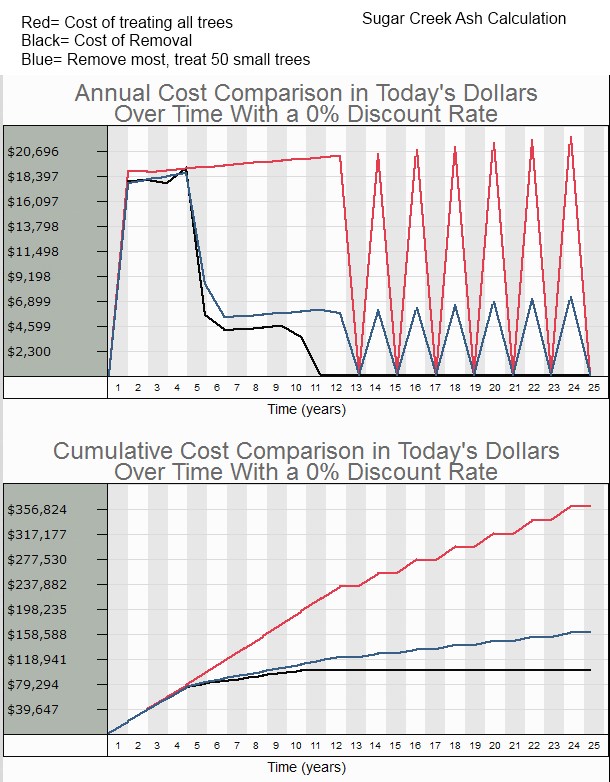
The graphs below were created using the Purdue EAB Cost Calculator.  As you can see, with Sugar Creek's large Ash population it is not cost effective to try and save all of our Ash trees.  These costs are Purdue's estimate and may be higher than we could do the work for, but the relative costs are what counts.  With a removal program combined with replacement of the landscape trees over time, the cost of the strategy disappears in 10 years or so.  With treatment, it never disappears and the trees will still die some day with age and storm damage.
Comparison of EAB removal vs treatment

Below is a picture of Ash storm damage. After almost every wind event, some older Ash trees need to be pruned or removed. This is true for both golf course trees and street trees. Most of the Ash trees at Sugar Creek are older and were in decline before the borer arrived. They were becoming hazardous to the clubhouse and driving range net, so their removal will give us a chance to plant trees more suited to the location.
Typical Ash tree storm damage
Most of the Ash trees at Sugar Creek are located along the fencelines around the driving range and on the 6th hole. Over the next few years, these trees will be removed and replaced with a variety of disease-resistant trees and shrubs.  We are beginning replacements for the 44 trees removed this winter this spring behind the 6th green.

Map of Ash trees at Sugar Creek Golf Course

Sunday, August 17, 2014

August 2014

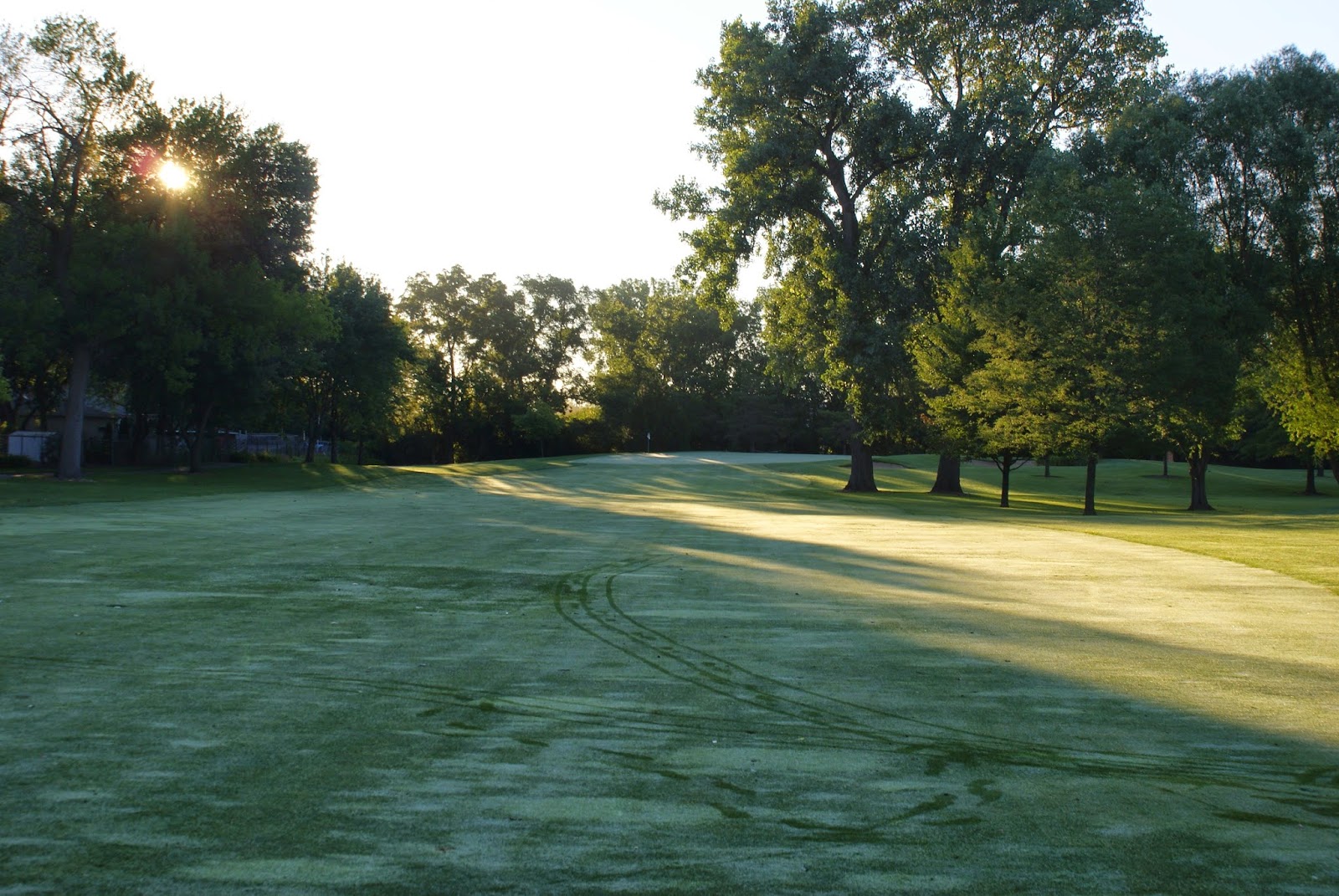
Mild temperatures have sent turf growth into overdrive early this year.  It has almost felt like September many days.  After rain early this week, it has been difficult keeping up with the bluegrass rough.  It is loving the cool soil temperatures and sunshine.  This is perfect weather for the maintenance pratices we have scheduled for the next week: topdressing, brushing, and grooming greens and tees.  In the next couple weeks, we may also aerify tees a little earlier than normal to remove some thatch and firm up the surface. 

Here is what it looks like this week:

1st Hole
#7 fairway, which had a rough winter and spring, has had a great summer:

#7 Fairway

Here is #8, a 250 yard par 4.  You can go for the green, but watch out!  That is a deep bunker right in front of the green.  Even worse -- go over the green and you roll down the hill leaving you with a very difficult wedge shot to keep it on the green.  It really is best to play it short of the bunker and stay below the hole going into the green.  Next time I play, I'll try to listen to my own advice and keep the woods in the bag!

#8 at Sugar Creek

Sunday, July 27, 2014

July 2014: On the course

After a lot of rain in early July, the last couple weeks have been beautiful.  We are especially grateful for the moderate temperatures this year since the harsh winter left us with weaker turf than usual.  The National Weather Service is predicting a similarly mild August with average rainfall which should equate to great conditions for golf.

Below is the putting green on June 27th.  I am often asked about the ornamental grasses you can see in the background along the first tee.  They are Calamagrostis x acutiflora 'Karl Foerster'.


Early mornings have been beautiful lately:

5 Green

4th Hole

Karl changing cups on the 4th green

Below is the 9th hole and clubhouse.  On the left you can see some of the Ash trees that were killed by the Emerald Ash Borer over the last year.  For more on this destructive insect see here.


The renovated bunkers are performing very well.  Improved drainage, new sand, and a sod "face" have greatly improved this sand trap on the first green.  A small amount of rain used to wash this trap out and make it unplayable. Now it is playable hours after a strong thunderstorm.


Even the infamous 7th fairway has been cooperating this year after starting out more than 50% dead.  So far, we have not experienced the deadly combination of excessive rainfall, high heat, and solar radiation that damaged this floodplain fairway in 2010 and 2011.
7th Fairway enjoying 2014

And finally . . . Safety first!  Two junior greenkeepers try on bump caps before inspecting the course: