Wednesday, March 18, 2015

2015 Emerald Ash Borer Tree Removals

Tree crews are currently removing the dead Ash trees around the driving range net at Sugar Creek. These trees died because of the Emerald Ash Borer which began killing Ash trees in our area in 2011.  Most of the dead Ash trees in playable areas have also been removed.  We started with 286 infected trees in 2012.  As of today, we are down to around 150 trees.

The following was originally posted in March of 2013:

This winter, we began removing Ash trees infected with the Emerald Ash Borer (EAB) that were visibly declining or dead in 2012 and deemed hazardous to people or property. So far, 44 of 286 Fraxinus (Ash) species trees have been removed leaving 242.  All of the remaining are infected and in various states of decline.

The EAB is a non-native, phloem-feeding insect that aggressively kills both healthy and stressed Ash trees of all ages. The EAB adult, a metallic green beetle, lays eggs in the bark of Ash trees. These eggs hatch into larvae which bore through the bark and into the cambium where they feed, overwinter, and pupate. It is the larval stage which kills the tree once the cambium is girdled by feeding. See the USDA’s “Emerald Ash Borer Program Manual” for more information.

Emerald Ash Borer S-shaped galleries
Emerald Ash Borer larvae IL
Emerald Ash Borer larvae
The EAB was first identified in Villa Park in the summer of 2011 but we did not have conclusive proof on the golf course until February 2012 last year.  During the winter from 2011 to 2012, woodpeckers were seen attacking Ash trees and leaving light-colored marks where the bark had been peeled away.  These marks are the easiest way to identify EAB infection over the winter.  While the woodpeckers may be feeding on native borers that attack stressed trees, if the tree was previously healthy, EAB is strongly indicated.  By the time you see woodpecker damage, the borer has already done significant damage during the year.  It is best to call a professional arborist as soon as possible to determine a course of action.
Many people ask me whether they should treat their Ash trees with pesticides or remove them.  There is no easy answer to that questions.  Ash trees can be saved even after infection with the right treatments -- this is true.  The important thing to remember is that treatment is forever or, more accurately, for the life of the tree.  If you miss treatments or happen to be in the small percentage where the treatment is ineffective, the tree will again be at risk of infection.  The other important thing to remember is this: no matter what you do, you still have an Ash tree.  Ash trees are not long-lived or structurally strong.  They tend to suffer severe storm damage later in life and can be hazardous. 
The factors that need to be considered include:
  • Cost
  • Location, location, location
  • Size of the tree
  • Age of the tree
  • Condition of the tree
  • Potential hazards
  • Environmental impact of pesticide use
  • Willingness to commit to treatment for decades, or the life of the tree
As you might have guessed from the above, it is my opinion, verified by a lot of calculations, that it is almost always more desirable and cost-effective to remove an Ash tree and replace it with a more disease-resistant, longer-lived, and safer tree.  I know many arborists selling treatment will argue with me, but the math is not on the side of treatment in the vast majority of cases.  If you have an Ash tree that you consider invaluable to your property and it is in good condition and it isn't too old and it is not likely to become a hazard, then I would consider treatment.  If not, cut your losses and plant something else!

The graphs below were created using the Purdue EAB Cost Calculator.  As you can see, with Sugar Creek's large Ash population it is not cost effective to try and save all of our Ash trees.  These costs are Purdue's estimate and may be higher than we could do the work for, but the relative costs are what counts.  With a removal program combined with replacement of the landscape trees over time, the cost of the strategy disappears in 10 years or so.  With treatment, it never disappears and the trees will still die some day with age and storm damage.
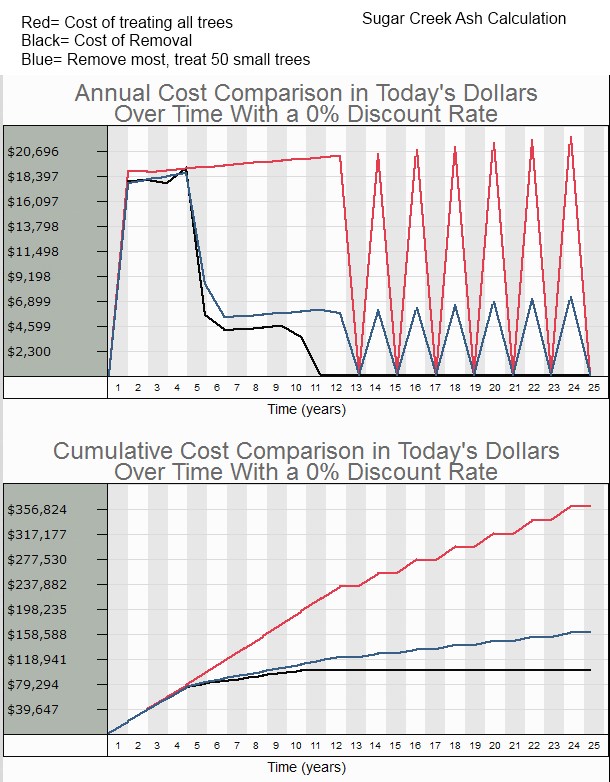
Comparison of EAB removal vs treatment

Below is a picture of Ash storm damage. After almost every wind event, some older Ash trees need to be pruned or removed. This is true for both golf course trees and street trees. Most of the Ash trees at Sugar Creek are older and were in decline before the borer arrived. They were becoming hazardous to the clubhouse and driving range net, so their removal will give us a chance to plant trees more suited to the location.
Typical Ash tree storm damage
Most of the Ash trees at Sugar Creek are located along the fencelines around the driving range and on the 6th hole. Over the next few years, these trees will be removed and replaced with a variety of disease-resistant trees and shrubs.  We are beginning replacements for the 44 trees removed this winter this spring behind the 6th green.

Map of Ash trees at Sugar Creek Golf Course

Sunday, August 17, 2014

August 2014

Mild temperatures have sent turf growth into overdrive early this year.  It has almost felt like September many days.  After rain early this week, it has been difficult keeping up with the bluegrass rough.  It is loving the cool soil temperatures and sunshine.  This is perfect weather for the maintenance pratices we have scheduled for the next week: topdressing, brushing, and grooming greens and tees.  In the next couple weeks, we may also aerify tees a little earlier than normal to remove some thatch and firm up the surface. 

Here is what it looks like this week:

1st Hole
#7 fairway, which had a rough winter and spring, has had a great summer:

#7 Fairway

Here is #8, a 250 yard par 4.  You can go for the green, but watch out!  That is a deep bunker right in front of the green.  Even worse -- go over the green and you roll down the hill leaving you with a very difficult wedge shot to keep it on the green.  It really is best to play it short of the bunker and stay below the hole going into the green.  Next time I play, I'll try to listen to my own advice and keep the woods in the bag!

#8 at Sugar Creek

Sunday, July 27, 2014

July 2014: On the course

After a lot of rain in early July, the last couple weeks have been beautiful.  We are especially grateful for the moderate temperatures this year since the harsh winter left us with weaker turf than usual.  The National Weather Service is predicting a similarly mild August with average rainfall which should equate to great conditions for golf.

Below is the putting green on June 27th.  I am often asked about the ornamental grasses you can see in the background along the first tee.  They are Calamagrostis x acutiflora 'Karl Foerster'.


Early mornings have been beautiful lately:

5 Green

4th Hole

Karl changing cups on the 4th green

Below is the 9th hole and clubhouse.  On the left you can see some of the Ash trees that were killed by the Emerald Ash Borer over the last year.  For more on this destructive insect see here.


The renovated bunkers are performing very well.  Improved drainage, new sand, and a sod "face" have greatly improved this sand trap on the first green.  A small amount of rain used to wash this trap out and make it unplayable. Now it is playable hours after a strong thunderstorm.


Even the infamous 7th fairway has been cooperating this year after starting out more than 50% dead.  So far, we have not experienced the deadly combination of excessive rainfall, high heat, and solar radiation that damaged this floodplain fairway in 2010 and 2011.
7th Fairway enjoying 2014

And finally . . . Safety first!  Two junior greenkeepers try on bump caps before inspecting the course:


Wednesday, July 2, 2014

Drainage Repairs

When it is too wet to mow fairways, one of our favorite pastimes is finding and fixing old drain lines.  There are very few in the fairways so we have been finding the ones that are there and testing them.

We just found the old lines on the 4th fairway.  The good news is that the 4 inch line going to the creek works!  The bad news is that the rest of the system is thin 2 inch spiral corrugated tube that is not flowing.  It is crushed in many places.  There is a good reason 4 inch is the standard size.

2 inch drain line

In a situation like this we will get the system working as well as it can and install a catch basin here.  At least the 4 inch line heading off toward the top of the picture will take water and the pea gravel around the 2 inch lines is collecting some water.  In the future, reinstalling 4 inch lines in this area would help dry it out more quickly after heavy rain.  At least now we have a better idea what is here to work with.

Saturday, June 28, 2014

Spring 2014 Turf Recovery in Pictures

The winter of 2013-2014 was tough on turf.   The cold temperatures and snowfall lead to a lot of dead Poa. Many golf courses were left with large areas of dead turf that had to be seeded, sodded, or otherwise coaxed back into playable shape.  At Sugar Creek, the rough, greens, and most tees survived the winter fine but the fairways are another story.  In areas of shady floodplain, solid layers of ice sometimes a foot thick formed and eventually suffocated the Poa annua that calls these areas home.  After a lot of aerifying (3 times), slit-seeding, levelling, watering, and sodding, the fairways were almost 100% filled in by the end of May.  I'll be the first to admit that Mother Nature did most of the work -- we can't do anything without the right temperatures, moisture levels, and sunlight to grow plants -- but we significantly sped up the process and made some progress against Poa.

Here are some pictures from the last 3 months that dramatically illustrate the recovery:

7 Fairway - April 12, 2014
Here you can see some of the creeping bentgrass we have been able to get growing after the floods in 2010 and 2013 (and the heat wave in 2012).  Everything green in the fairway is bentgrass. Everything brown is Poa annua. 

7 Fairway - April 12, 2014

7 Fairway after slit-seeding  - April 25, 2014
Below you can see the fairway filling in with new seedlings.  We wish they were all bentgrass seedlings, but many are coming from the dormant Poa annua seedbank in the soil.  At this point, you take what you can get!

7 Fairway filling in - May 30, 2014
 
And below is now.  You can tell we had moderate temps and a lot of rain recently!

7 Fairway - June 27, 2014
7 Fairway from the reverse angle:


The first fairway suffered similar damage but not as extensive.  As an experiment, we slit-seeded T-1 creeping bentgrass when it was still very cold at the end of March and had seed coming up in April.  It filled in quickly after that.

Slit-seeding germination - April 25, 2014
 
These photos were taken of the 1st fairway toward the tee:


Wednesday, June 4, 2014

Bug Spray Harms Turf

It's that time of year again!

I have received a few questions about the mysterious patches of light tan turf that appeared over the weekend.  This is one turf problem that has a simple explanation:  Whenever the weather is muggy and buggy, we experience an outbreak of "bug spray disease."  Most golfers do not know that their insect repellent will harm turf, especially when directed at legs and ankles.  The overspray usually leaves a pattern of a green footprint or footprints surrounded by straw-colored injured turf. 

The solution to this problem is to spray legs and ankles on a cart path or other non-turf surface where the overspray will not contact grass.  Depending on conditions and the amount of spray on the grass, these spots usually recover in 1-4 weeks.  In extreme cases, though, they can result in the death of the patch of turf. 
Bug spray injury on a tee with a footprint in the center


Bug spray injury on a green collar


Can you see the footprint?

 Hopefully these pictures will help us all remember to use bug spray on the cart path.  I know it has slipped my mind in the middle of a mosquito attack.  Next time you golf on a buggy day, please help us educate others about the cause of the mysterious green footprint disease.

Tuesday, August 27, 2013

Rocks in Sand Bunkers

We may have dug up the entire bunker:


But we got it out!


We have been trying to get that one out for 10 years.  Good digging, Gary.

Wednesday, May 22, 2013

The Year of Seedheads

I ran across a very relevant blog post discussing Annual bluegrass and its prolific seedheads.  I believe I used the author's exact words -- "I have never witnessed such a seed head explosion" -- or something like it, more than once last week.  They are finally starting to become less noticeable.

See below for more:

The World of Turf: Holy poa batman: The annual bluegrass turf plant is really showing off this year. Our fairways are white with flowers! Annual bluegrass, also known as poa,...

Friday, April 19, 2013

Cleaning up after the flood

Pictures from April 18, 2013
 
Looking toward 7 green from 3 tee

The "creek" on #2

Water almost up to #8 green
The flood yesterday crested at about the same level as one we had July 24th, 2010.  The pictures are almost identical!

Pictures from April 19th, 2013

Still flooded, but much better.  We are starting the clean-up.

The 4th fairway still underwater

Flood debris!  There are several areas like this on 4 and 5

As usual after torrential rains, the bunkers will need lots of work

The creek is much lower today
The crew is busy cleaning up debris so that the course will be ready for play as soon as possible.  The clean-up has been different than usual for this flood.  It is 37 degrees and snowing here.  In April!  We are happy that the turf isn't cooking in the sun like it does for July floods.  That is the silver lining down at the maintenance shop.

Wednesday, March 20, 2013

Spring: Coming Soon

Many of us who love golf are getting impatient right now. Last year's historic heat wave in March spoiled us with an early start to the season. At first I thought posting a series of pictures from March 20, 2012 would be a little saddening with our high today around 24 degrees, but then I decided to see the glass half full: These pictures from a year ago today are what we have to look forward to soon! It may take another few weeks, but the vernal equinox has happened, days are getting longer, and warmer temperatures are just around the corner.

Sugar Creek Golf Course March 2013
March 20, 2012
Sugar Creek Golf Course March 2013
March 20, 2012
 
Sugar Creek Golf Course March 2013
March 20, 2012
Sugar Creek Golf Course March 2013
March 20, 2012
 

Monday, March 18, 2013

Emerald Ash Borer Tree Removals

This winter, we began removing Ash trees infected with the Emerald Ash Borer (EAB) that were visibly declining or dead in 2012 and deemed hazardous to people or property. So far, 44 of 286 Fraxinus (Ash) species trees have been removed leaving 242.  All of the remaining are infected and in various states of decline.

The EAB is a non-native, phloem-feeding insect that aggressively kills both healthy and stressed Ash trees of all ages. The EAB adult, a metallic green beetle, lays eggs in the bark of Ash trees. These eggs hatch into larvae which bore through the bark and into the cambium where they feed, overwinter, and pupate. It is the larval stage which kills the tree once the cambium is girdled by feeding. See the USDA’s “Emerald Ash Borer Program Manual” for more information.

Emerald Ash Borer S-shaped galleries
Emerald Ash Borer larvae IL
Emerald Ash Borer larvae
The EAB was first identified in Villa Park in the summer of 2011 but we did not have conclusive proof on the golf course until February 2012 last year.  During the winter from 2011 to 2012, woodpeckers were seen attacking Ash trees and leaving light-colored marks where the bark had been peeled away.  These marks are the easiest way to identify EAB infection over the winter.  While the woodpeckers may be feeding on native borers that attack stressed trees, if the tree was previously healthy, EAB is strongly indicated.  By the time you see woodpecker damage, the borer has already done significant damage during the year.  It is best to call a professional arborist as soon as possible to determine a course of action.
Many people ask me whether they should treat their Ash trees with pesticides or remove them.  There is no easy answer to that questions.  Ash trees can be saved even after infection with the right treatments -- this is true.  The important thing to remember is that treatment is forever or, more accurately, for the life of the tree.  If you miss treatments or happen to be in the small percentage where the treatment is ineffective, the tree will again be at risk of infection.  The other important thing to remember is this: no matter what you do, you still have an Ash tree.  Ash trees are not long-lived or structurally strong.  They tend to suffer severe storm damage later in life and can be hazardous. 
The factors that need to be considered include:
  • Cost
  • Location, location, location
  • Size of the tree
  • Age of the tree
  • Condition of the tree
  • Potential hazards
  • Environmental impact of pesticide use
  • Willingness to commit to treatment for decades, or the life of the tree
As you might have guessed from the above, it is my opinion, verified by a lot of calculations, that it is almost always more desirable and cost-effective to remove an Ash tree and replace it with a more disease-resistant, longer-lived, and safer tree.  I know many arborists selling treatment will argue with me, but the math is not on the side of treatment in the vast majority of cases.  If you have an Ash tree that you consider invaluable to your property and it is in good condition and it isn't too old and it is not likely to become a hazard, then I would consider treatment.  If not, cut your losses and plant something else!

The graphs below were created using the Purdue EAB Cost Calculator.  As you can see, with Sugar Creek's large Ash population it is not cost effective to try and save all of our Ash trees.  These costs are Purdue's estimate and may be higher than we could do the work for, but the relative costs are what counts.  With a removal program combined with replacement of the landscape trees over time, the cost of the strategy disappears in 10 years or so.  With treatment, it never disappears and the trees will still die some day with age and storm damage.
Comparison of EAB removal vs treatment

Below is a picture of Ash storm damage. After almost every wind event, some older Ash trees need to be pruned or removed. This is true for both golf course trees and street trees. Most of the Ash trees at Sugar Creek are older and were in decline before the borer arrived. They were becoming hazardous to the clubhouse and driving range net, so their removal will give us a chance to plant trees more suited to the location.
Typical Ash tree storm damage
Most of the Ash trees at Sugar Creek are located along the fencelines around the driving range and on the 6th hole. Over the next few years, these trees will be removed and replaced with a variety of disease-resistant trees and shrubs.  We are beginning replacements for the 44 trees removed this winter this spring behind the 6th green.

Map of Ash trees at Sugar Creek Golf Course

Monday, March 11, 2013

A Sampling of Winter Projects

During the winter, golf course equipment needs to be maintained and serviced for the year.  We have finished our long list of preventative maintenance tasks and have moved on to the projects that can add new life to old machines or extend the life of a newer machine.
Rusty mowing decks get scraped and repainted. This adds many years to the life of these decks.  If allowed to rust, the structural integrity of the deck is compromised.
Rusty LandPride rotary deck 
This year we tried a product called "Rust Reformer" as a primer after wire brushing off the loose material. It claims to "convert" rust to a paintable surface. Not sure what what that means, but it sounds good. Time will be the judge.  As auto body workers have told me, inspired by Neil Young of course: rust never sleeps.
Rust reformer on LandPride Deck 
We also tiled the bathroom and put up waterproof panelling this winter:
 
Here is a bench waiting to go out on the 4th hole Red Tee.  It was donated by the Carey family who lived across the street from the golf course for many years:
 
Our 1996 sprayer now sports new plumbing and a "Cleanload" eductor on the side. This is the black container on the side. It will be used primarily for disolving granular fertilizer and mixing it into the tank.  Many people aren't aware of this, but we actually use our sprayer most often for fertilization.
 
These are just a few projects that the Superintendent and Equipment Tech completed over the past few months. We are ready to turn our attention more to the outdoors! Spring is coming soon.